

Skin preparation for tanning with NuTan® patches
- 1 day ago
- 9 min read

Before applying a NuTan® transdermal tanning patch, your skin needs to be clean, physically exfoliated at least 24 hours prior, free of hair for 24–48 hours, and completely dry, with lightweight moisture applied only to dry-prone zones. That single sentence covers the non-negotiables. Here is the full checklist:
Exfoliate physically (24 hours before): removes dead skin cells so the patch adheres evenly and the melanogenesis process begins on a smooth, receptive surface.
Remove hair (24–48 hours before): shaving or waxing on the same day leaves open follicles and raw skin that increase irritation risk.
Pause chemical actives (48 hours before): stop AHAs, BHAs, and retinoids to prevent unpredictable skin reactivity during early pigment development.
Moisturise dry zones only (the night before): apply a lightweight lotion to knees, elbows, ankles, and wrists — nowhere else.
Patch-test first: apply one patch to a discreet area 24–48 hours ahead of a full application to rule out contact reactions.
Apply to clean, dry, hairless skin: no creams, oils, or deodorant residue on the placement site at the time of application.
The 24-hour buffer is the most important timing rule. It lets your skin settle and stabilise before the patch begins working, which directly reduces patchiness and irritation.
Table of Contents
When should you start preparing your skin for tanning?
Good results with NuTan® patches depend on timing as much as technique. The table below maps each preparation action to its recommended buffer window.
Action | Earliest safe time before patch application |
Waxing or shaving | 48 hours before (24 hours minimum) |
Physical exfoliation | 24 hours before |
Pause AHAs / BHAs / retinoids | 48 hours before |
Targeted moisturising (dry zones) | Night before |
Patch-test on discreet site | 24–48 hours before full application |
Cleanse and dry skin | Immediately before application |
The 48-hour rule for hair removal matters because freshly shaved or waxed skin has micro-abrasions and open follicles. Placing a patch over that surface raises the risk of stinging and uneven absorption. Hair removal timing of 24–48 hours before tanning is widely supported across professional pre-tan guidance.
Chemical exfoliants deserve their own buffer. AHAs, BHAs, and retinoids alter skin pH and increase reactivity, which can interfere with how the patch interacts with your skin’s surface during early pigment development. Suspending them 48 hours beforehand keeps conditions stable.
Step-by-step skin prep you can follow the day before
Cleanse first
Start with a gentle, oil-free cleanser to remove deodorant residue, body lotion, and surface oils. Do this before exfoliating, not after. Cleansing on clean skin means your exfoliant works on dead cells, not a film of product.
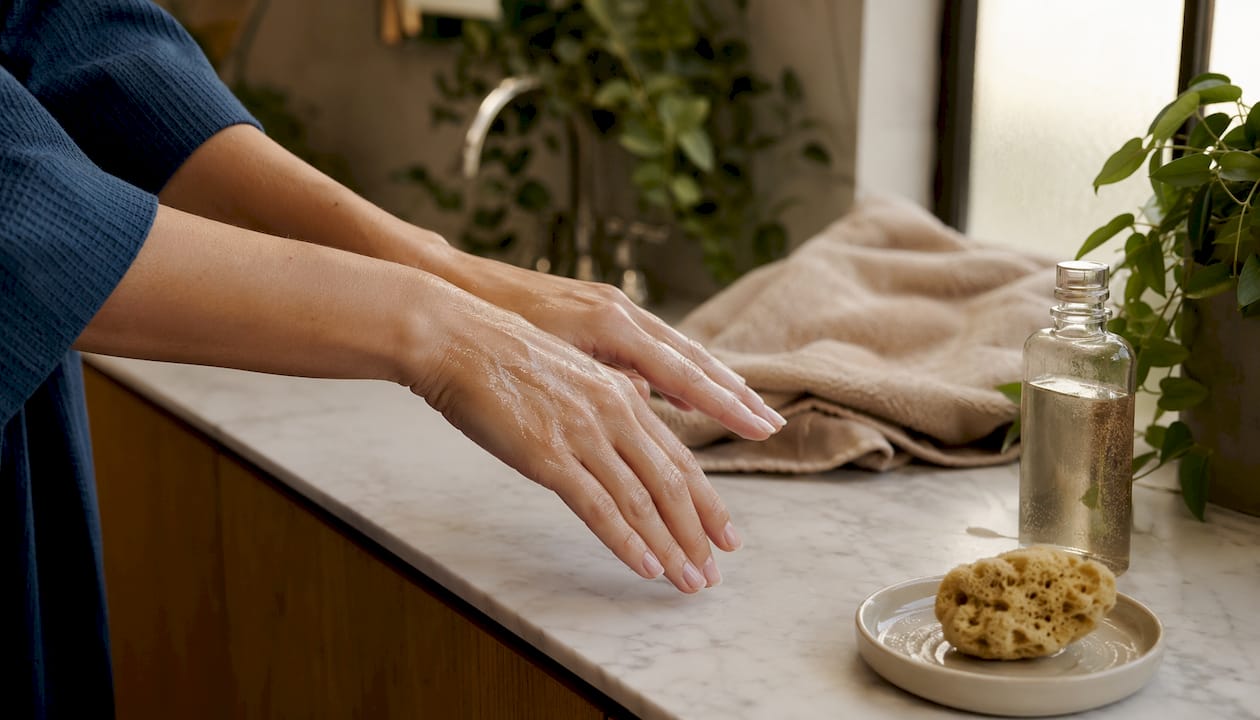
Physical exfoliation: the most important step
Physical exfoliation 24 hours before creates a smoother surface and reduces patchy development. Use an exfoliating mitt or an oil-free sugar scrub, and spend extra time on the knees, elbows, ankles, tops of the feet, and hands. These areas have thicker, drier skin and will grab unevenly if left unprepared.
Pro Tip: Spend at least 60 seconds on each rough zone — knees, elbows, and ankles — using small circular motions. These are the spots most likely to show uneven pigment if you rush.
Moisturise selectively, not everywhere
This is where most people go wrong. Applying a lightweight, fast-absorbing lotion only to dry-prone zones (knees, elbows, ankles, wrists) prevents those areas from absorbing excess pigment while leaving the rest of the skin free. Heavy, full-body moisturiser applied immediately before a patch can form a barrier that blocks absorption. Apply the lotion the night before, not on the morning of application. You can also explore hydration tactics for tan longevity to support your skin between patch cycles.
The patch-test: do not skip it
A simple patch-test 24–48 hours ahead is the fastest way to detect a contact reaction before committing to a full application. Choose a discreet site such as the inner upper arm. If there is no redness, swelling, or itching after 24 hours, you are clear to proceed.
How to apply NuTan® patches safely and effectively
Oils and creams create a physical barrier between the patch membrane and your skin. Even a thin layer of body lotion on the application site is enough to reduce how effectively the active ingredient crosses the skin barrier.
Recommended placement zones include the upper arm, flank, upper thigh, and torso. These areas offer relatively consistent skin thickness and lower sensitivity compared with the inner wrist or neck. For discreet placement, the upper thigh or flank works well under most clothing. Avoid bony prominences and areas that flex repeatedly, as movement can lift the patch edge.
After application, avoid water exposure, heavy sweating, and tight clothing over the patch site for at least a couple of hours. These conditions can compromise adhesion before the patch has fully bonded.
To remove, peel back slowly from one edge rather than pulling sharply. Inspect the skin underneath: mild redness that fades within 30 minutes is normal. Dispose of used patches safely, folding the adhesive side inward before placing in household waste.
How much sun do you actually need with NuTan® patches?
NuTan® patches are designed to require significantly less UV exposure than conventional tanning methods to achieve comparable pigment development. That reduction in UV need is a meaningful safety advantage, particularly for fair-skinned individuals in the UK.
Use short, controlled periods of natural daylight rather than deliberate sunbathing sessions.
Apply SPF 30 or higher to the face and any thin-skinned areas (décolletage, tops of hands) whenever you are outdoors.
Seek shade during peak UV hours (11 AM–3 PM in the UK summer).
Avoid sunburn at all costs. A burn does not accelerate results; it damages the skin barrier and can interrupt the melanogenesis process the patch has initiated.
If you only need to expose a small area, consider protective clothing rather than relying solely on sunscreen.
Safety, contraindications, and when to consult a clinician
Certain individuals should consult a GP or dermatologist before using transdermal tanning patches. This includes people who are pregnant or breastfeeding, those taking medications that affect skin sensitivity or pigmentation, anyone with a known pigmentary disorder, and those with a history of severe skin allergy or contact dermatitis.
Stop all other topical actives (retinoids, acids, medicated creams) in the application area for the duration of patch use. Combining them increases the risk of irritation and unpredictable skin responses.
Red-flag signs to act on immediately:
Blistering, spreading rash, or intense burning at the patch site.
Swelling beyond the patch margin.
Systemic symptoms such as dizziness or difficulty breathing.
If any of these occur, remove the patch, rinse the area with cool water, and seek medical advice promptly.
What to expect and how to fix common problems
First signs of pigment change typically appear within a few days of consistent patch use, as the MC1R activation process gradually increases melanin production. This is not an instant colour change; it is a natural, progressive deepening of your skin tone.
Uneven pigment usually traces back to skipped exfoliation or inadequate moisturising of dry zones. Target the patchy areas with a gentle exfoliation and apply a thin layer of lightweight lotion to those spots specifically. For a deeper look at causes and fixes, the guide to uneven tan covers the most common culprits.
Patch detaches early: if a patch lifts before its wear time is complete, remove it, clean and dry the skin, and apply a fresh patch only once the area has fully settled. Do not re-apply to irritated or damp skin.
Irritation at the site: remove the patch, allow the skin to recover fully, and re-patch-test before resuming. If irritation persists beyond 48 hours, consult a pharmacist or GP.
Maintenance: keep skin well hydrated between patch cycles to support an even, lasting result. Avoid prolonged water submersion and harsh scrubbing over tanned areas.
What not to do when using transdermal tanning patches
Do not apply heavy creams, oils, or fragranced products to the patch site at the time of application.
Do not combine patches with topical staining products of any kind. NuTan® patches work by stimulating your skin’s own melanin production, not by staining the surface. Mixing methods introduces unpredictable results.
Do not shave or wax the application site on the same day. The 24–48-hour buffer is non-negotiable.
Do not deliberately sunbathe to accelerate results. Short, controlled light exposure is all that is needed; prolonged sun exposure increases burn risk without improving outcomes.
Do not use patches on broken, sunburned, or actively irritated skin.
Why do NuTan® patches work? The science in plain English
NuTan® patches contain a proprietary formulation called Nutan MSH-ComplexB, a beta-melanocyte-stimulating hormone (b-MSH) complex derived from a natural source. This compound works in the same way as alpha-melanocyte-stimulating hormone (a-MSH) in the body.
Mechanism step | What happens |
b-MSH delivered transdermally | Active ingredient crosses the skin barrier via the patch |
MC1R activation | b-MSH binds to Melanocortin 1 Receptor on melanocyte surface |
Melanogenesis triggered | Biochemical cascade increases melanin production |
Pigment develops naturally | Skin darkens progressively without surface staining |
Cellular protection | Increased melanin provides a degree of natural photoprotection |
Because the mechanism works at a cellular level, a healthy, well-hydrated skin barrier is important. That is precisely why the preparation steps in this article matter: they create the optimal surface conditions for the patch to do its job. Healthy skin nutrition also plays a role; vitamins that support skin health can complement your routine between patch cycles.
Key takeaways
Preparing your skin correctly is what separates a patchy result from a smooth, natural-looking tan with NuTan® patches.
Point | Details |
Timing is everything | Exfoliate 24 hours before; complete hair removal 24–48 hours before application. |
Physical exfoliation first | Use a mitt or oil-free scrub; focus on knees, elbows, ankles, and hands. |
Moisturise dry zones only | Apply lightweight lotion the night before to dry-prone areas only, not all over. |
Patch-test before full use | Test on a discreet site 24–48 hours ahead to rule out contact reactions. |
NuTan® patches: natural pigment | NuTan® activates MC1R to stimulate your own melanin, requiring significantly less UV exposure than conventional methods. |
Consult your GP if you experience any persistent reaction, and always follow UK sun-safety guidance when combining patch use with outdoor light exposure.
A note on patch-first preparation
The tanning industry has long defaulted to surface-level solutions: products that stain the skin and fade within days. What makes patch-based tanning genuinely different is that the result comes from inside your own cells. That shift in mechanism changes everything about how you prepare, and it is why the steps in this guide are not interchangeable with generic pre-tan advice.
NuTan® patches are available with worldwide delivery, so whether you are following UK safety guidance from home or abroad, the same preparation principles apply. For personalised advice on whether patches are right for your skin type or health situation, a conversation with your GP or dermatologist is always the right first step.
NuTan® patches: options, availability, and how to order
NuTan® offers a straightforward range to suit different needs and experience levels. A single box of 10 patches is the ideal starting point, giving you enough supply to patch-test, complete a full preparation routine, and begin your first cycle. For ongoing use, the 2-box kit of 20 patches offers better value. Experienced users looking for a stronger pigment response can opt for the Triple Strength variant, formulated for those who want a deeper, faster result.
All orders ship worldwide. Follow the preparation routine in this guide before your first application, and remember to patch-test at least 24 hours before committing to a full course.

Useful sources
Physical exfoliation timing and pre-tan salon techniques — TanningBedAuthority: supports the 24-hour exfoliation buffer and patch-test guidance.
How to exfoliate before a spray tan — Talking Tan: source for the 48-hour chemical-active pause and targeted moisturising advice.
Hair removal timing for tanning — BlushPicks: supports the 24–48-hour hair-removal buffer.
Fake tan prep and moisturising strategy — Ameliorate: supports selective moisturising of dry zones only.
Step-by-step skin prep routine — Small Batch Serums: supports problem-area focus during exfoliation.
NuTan® brand and product information — NuTan: primary source for mechanism of action, product claims, and safety guidance.
FAQ
How long before applying a NuTan® patch should you exfoliate?
Exfoliate physically at least 24 hours before application. This allows your skin to settle and reduces the risk of irritation or patchy pigment development.
Can you shave on the same day as patch application?
No. Shave or wax at least 24–48 hours beforehand to avoid open follicles and raw skin, which increase irritation risk and can affect how the patch adheres.
Do NuTan® patches require a lot of sun exposure?
NuTan® patches are designed to work with significantly less UV exposure than conventional tanning methods. Short, controlled periods of natural daylight are sufficient; deliberate sunbathing is not recommended.
What should you do if the patch causes irritation?
Remove the patch immediately, rinse the area with cool water, and allow the skin to recover fully before considering reapplication. If irritation persists beyond 48 hours, consult a GP or pharmacist.
Can you use moisturiser before applying a NuTan® patch?
Apply lightweight lotion only to dry-prone zones (knees, elbows, ankles, wrists) the night before, not on the day of application. Heavy creams or oils on the patch site at the time of application will reduce adhesion and absorption.
Recommended