

What is tan fading? your guide for low-UV tanning
- 9 hours ago
- 9 min read
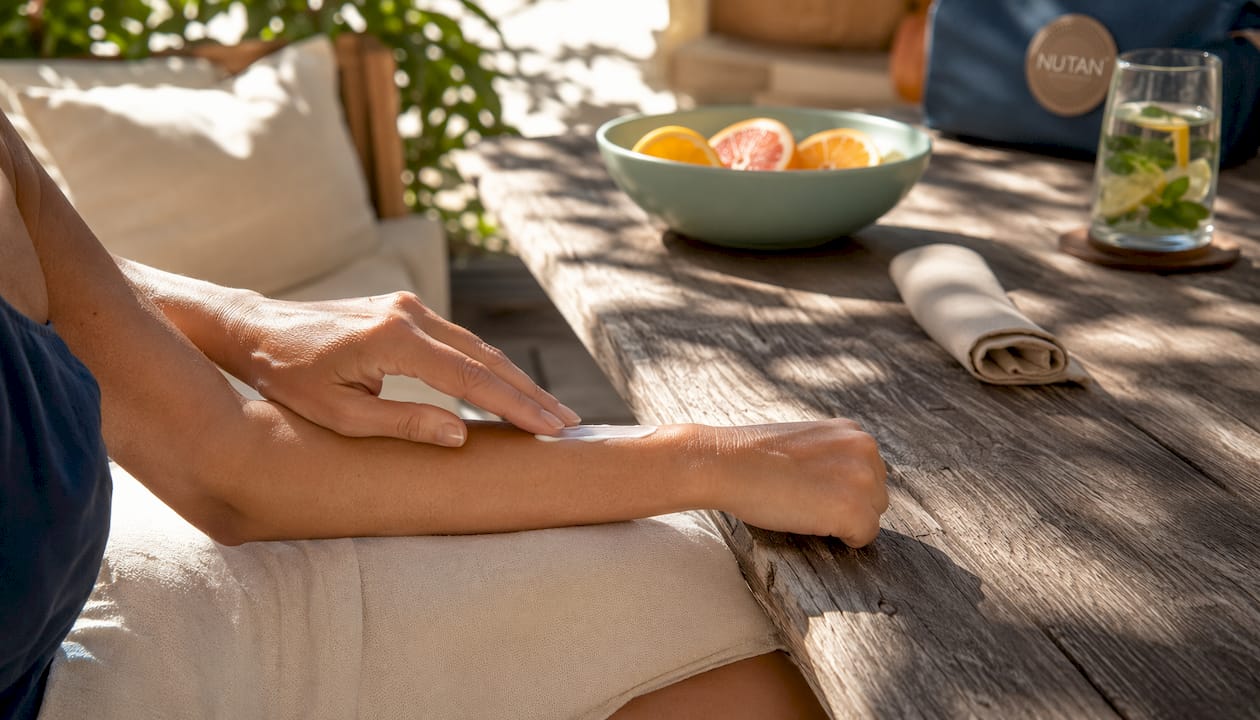
Tan fading is the natural shedding and replacement of melanin-rich skin cells, gradually returning your skin to its baseline colour. Visible fading typically begins within days of reduced UV exposure, and a full return to your natural tone usually takes several weeks. The single most effective thing you can do to slow that process is moisturise consistently and avoid aggressive exfoliation. For those using NuTan® transdermal tanning patches, the same principle applies: because the tan is built within living skin cells rather than sitting on the surface, it responds directly to how well you care for your skin’s barrier.
Table of Contents
What is tan fading, and why does it happen?
Tan fading is the direct result of desquamation: the continuous process by which your skin sheds its outermost layer of cells and replaces them with fresh ones. When your skin tans, melanocytes (the pigment-producing cells in the epidermis) produce melanin through a process called melanogenesis. That melanin transfers into surrounding keratinocytes, giving skin its darker appearance. As those keratinocytes migrate upward through the epidermal layers and are eventually shed, the pigment goes with them.
Your position on the Fitzpatrick scale strongly influences how long pigment persists. Deeper skin types (Fitzpatrick IV–VI) tend to retain colour longer because melanin is denser and more evenly distributed. Fairer types (I–II) shed pigmented cells faster, so fading is quicker and sometimes patchier. Skin that is naturally drier also tends to turn over more slowly, which can actually extend how long a tan holds.
Key biology points at a glance:
Where pigment sits: melanin is produced in melanocytes in the basal layer and transferred into keratinocytes throughout the epidermis.
Which layer sheds: the stratum corneum (outermost layer) is the first to go, taking surface-level pigmented cells with it.
Typical cycle: epidermal renewal takes roughly 2–4 weeks, varying with age and skin health.
Sun protection note: a fading tan offers no meaningful UV defence; daily broad-spectrum sunscreen remains necessary throughout.
How long does a tan take to fade?
A UV-induced tan typically shows visible fading in 7–14 days, with full fade taking up to 30 days. Topical surface-staining methods fade considerably faster, with visible fade starting in 3–5 days and full fade generally within 5–10 days.

Tanning method | Visible fade begins | Full fade | Key variable |
UV-induced (sun) | 7–14 days | Up to 30 days | Skin type, aftercare |
Melanin-stimulating patches | 7–14 days | Up to 30 days or more | Cell turnover, hydration |
Topical surface stain | 3–5 days | 5–10 days | Exfoliation, showering |
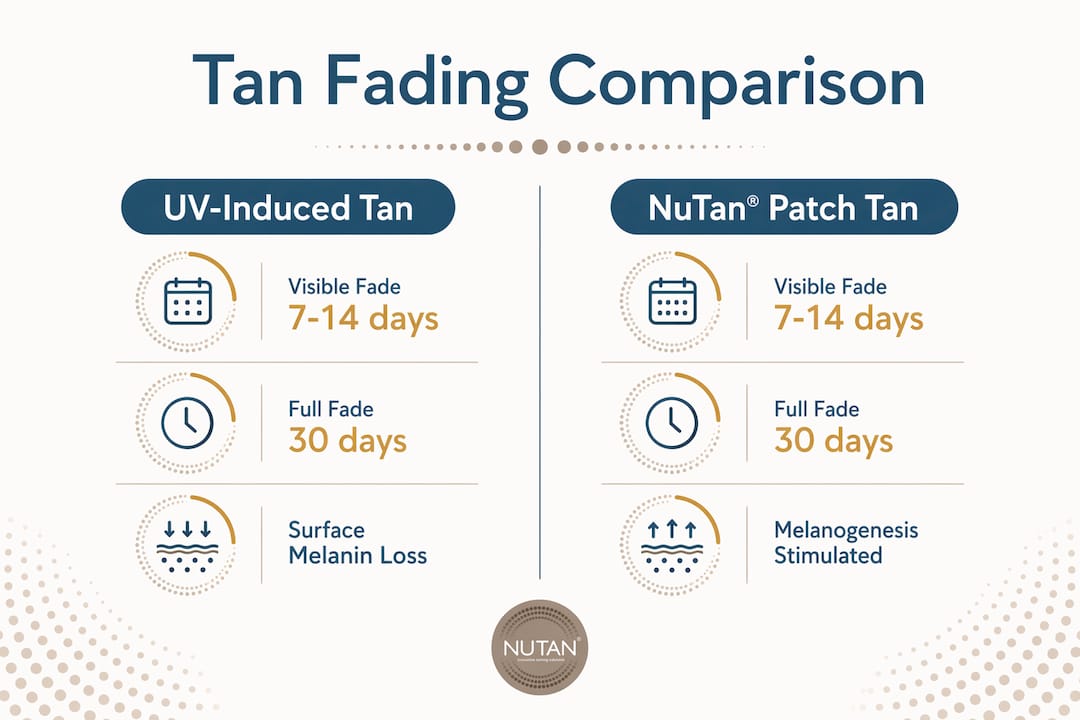
Variables that shift the timeline include age (cell turnover slows with age, so older skin may hold colour longer), Fitzpatrick skin type, daily moisturisation habits, and how frequently you shower in hot water. Consistent tanning skincare routines can meaningfully extend where you sit in that window.
What speeds up tan fading?
The most common accelerants are exfoliation, hot water, harsh cleansers, and dehydration. Each one increases the rate at which pigmented cells are stripped from the skin’s surface, shortening the visible life of your tan.
Exfoliation. Physical scrubs and chemical exfoliants (AHAs, BHAs, retinol) directly remove the stratum corneum, taking pigmented keratinocytes with them. Even a single aggressive scrub session can visibly lighten a tan overnight.
Hot showers and baths. Hot water dehydrates the skin and accelerates shedding. Long, hot showers are one of the most consistent causes of premature, uneven fading.
Harsh cleansers and soaps. Products that strip the skin’s natural oils compromise the barrier, increasing transepidermal water loss and speeding cell turnover.
Dehydration. Poorly hydrated skin sheds faster. Drinking adequate water and applying moisturiser regularly keeps the barrier intact and slows desquamation.
Chlorinated or salt water. Swimming in pools or the sea accelerates surface shedding, particularly when combined with sun exposure and towel-drying.
For NuTan® patch users, the same list applies. Avoiding these habits between patch cycles helps preserve the melanin-stimulated colour and reduces how frequently you need to top up.
How to slow or manage tan fading
The single most effective principle is this: protect your skin’s barrier and keep it evenly hydrated. A well-maintained barrier slows desquamation, keeping pigmented cells in place longer and maintaining a more even colour.
Daily moisturisation is non-negotiable. Apply a fragrance-free, non-acid-based moisturiser morning and evening. Avoid formulas containing AHAs, retinol, or brightening agents near areas where your patches are active, as these will accelerate fading in precisely the zones you want to maintain.
Shower in lukewarm water and keep it brief. Switch to a mild, sulphate-free body wash, and pat your skin dry rather than rubbing. These two changes alone can noticeably extend how long your colour lasts.
Pro Tip: Apply your moisturiser while your skin is still slightly damp after a shower. This seals in water before it evaporates, slowing desquamation and keeping the barrier intact for longer.
For readers with sensitive or eczema-prone skin, gentle cleansing guidance is worth reviewing before choosing products, as barrier disruption is a particular concern.
Your daily maintenance checklist: moisturise on damp skin morning and evening, use lukewarm water for showers, choose a sulphate-free body wash, pat dry gently, avoid exfoliants and acid-based products between patch cycles, and apply broad-spectrum SPF daily.
Do different tanning methods fade differently?
Yes, and the difference comes down to mechanism: where the colour sits in the skin determines how it leaves.
Method | Mechanism | Where colour sits | Fade start | Full fade | Maintenance |
UV-induced | Melanogenesis in living cells | Within epidermis | 7–14 days | Up to 30 days | Moisturise, SPF, avoid exfoliation |
Melanin-stimulating patches | MC1R activation, melanogenesis | Within epidermis | 7–14 days | Up to 30 days or more | Same as UV; patch top-ups |
Topical surface stain | Surface-level colour deposit | Stratum corneum only | 3–5 days | 5–10 days | Frequent reapplication |
For patch users, the practical implication is reassuring: because NuTan® patches stimulate your skin’s own melanogenesis, the colour behaves like a UV tan. It does not rub off, does not wash away with a single shower, and fades gradually as your skin renews naturally. Routine-based maintenance, rather than sporadic intense exposure, is what keeps it looking its best. You can read more about non-invasive tanning methods for further context on how low-UV approaches compare.
How NuTan® patches affect tan fading and what to expect
NuTan® patches stimulate melanogenesis directly, so the tan they produce behaves like a UV-induced tan rather than a surface deposit. The colour sits within the epidermis, in living keratinocytes, and fades gradually as those cells complete their natural cycle.
The active ingredient is Nutan MSH-ComplexB, a beta-melanocyte-stimulating hormone (b-MSH) derived from a natural source. It works by binding to and activating the Melanocortin 1 Receptor (MC1R) on the surface of melanocytes, triggering a series of biochemical events that increase melanin production and provide cellular protection. The result is a natural-looking tan that does not rub off or wash away. NuTan® patches require more than 70% less UV exposure than conventional sunbathing to achieve a comparable result, making them a genuinely lower-risk route to a sun-kissed glow.
After patch use, fading is gradual and responds well to the same barrier-care routine described above. Moisturisation, gentle cleansing, and avoiding exfoliants between cycles all help extend the colour. When the tan does begin to fade, it does so evenly rather than in patches, provided the skin is kept hydrated. Minimal UV exposure is still required during the active patch period, and daily broad-spectrum sunscreen is non-negotiable throughout. If you have an existing skin condition, consult a dermatologist or GP before starting any new tanning method.
When is fading normal, and when should you see a dermatologist?
Most tan fading is entirely normal and simply reflects your skin’s renewal cycle. Gradual, even lightening over days to weeks is nothing to be concerned about.
Seek professional advice if you notice any of the following:
Rapid, patchy peeling that appears suddenly rather than gradually.
Persistent redness, irritation, or a rash in areas where a patch was applied or where you have been sun-exposed.
Unexpected hyperpigmentation (dark spots or uneven darkening) that does not resolve within a few weeks.
Blistering or significant skin texture changes following UV exposure.
If any of these occur, stop using the product, photograph the affected area, and contact your GP or a dermatologist. The Fitzpatrick scale is a useful starting point for understanding your skin’s natural response to UV, and a dermatologist can use it to set realistic expectations for how long your tan will hold and how your skin is likely to respond to melanin-stimulating approaches.
Key takeaways
Tan fading is a normal biological process driven by epidermal cell turnover, and consistent barrier care is the most effective way to slow it.
Point | Details |
Biology of fading | Melanin-rich keratinocytes shed during routine epidermal renewal, typically every 2–4 weeks. |
Expected timeline | UV and patch-stimulated tans show visible fading in 7–14 days; full fade takes up to 30 days. Topical surface stains fade faster, typically starting in 3–5 days and fully fading within 5–10 days. |
Top maintenance actions | Moisturise on damp skin, use lukewarm water, and avoid AHAs and exfoliants between patch cycles. |
Patch tans vs surface stains | NuTan® patch tans fade like UV tans (gradual, even) because the colour sits within living skin cells. |
Sun protection always | Daily broad-spectrum SPF is necessary even while a tan is fading; a tan does not replace sunscreen. |
A note on safe practice and realistic expectations
The conversation around tanning has shifted considerably, and rightly so. Chasing a deep colour through repeated, unprotected sun exposure is a habit the evidence simply does not support. What the evidence does support is a routine-centred, lower-intensity approach: steady melanin stimulation, consistent barrier care, and daily sun protection.
NuTan® was developed with exactly that philosophy in mind. The patches offer a way to support your skin’s natural tanning process with significantly reduced UV exposure, and the fading behaviour reflects that: gradual, manageable, and responsive to good skincare. For anyone uncertain about how their skin type will respond, a conversation with a dermatologist before starting is always worthwhile. NuTan® ships worldwide, so wherever you are, that option is available to you.
If you have questions about the science behind the patches or want to explore further reading, the NuTan® knowledge base is a good place to start.
NuTan® patches: a lower-UV route to a natural tan
For anyone who wants a genuine, natural-looking tan without the UV burden of conventional sunbathing, NuTan® patches offer a clinically grounded alternative. The patches use Nutan MSH-ComplexB to activate MC1R and stimulate your skin’s own melanin production, requiring more than 70% less UV exposure than typical tanning methods to achieve a comparable result. The tan builds within living skin cells, fades gradually, and does not wash or rub off.
A broad-spectrum sunscreen is still required during any UV exposure, however minimal, and you should follow the usage instructions carefully. If you have a skin condition or are taking medication that affects photosensitivity, consult a clinician before use. NuTan® delivers worldwide, and the 20-patch kit is the most popular choice for those building and maintaining a tan across a season. For a stronger result, the Triple Strength option is available for readers who want faster pigment build-up.
This article is for general information only and does not constitute medical or dermatological advice. Consult a qualified healthcare professional for guidance specific to your skin.
Useful sources and further reading
The factual claims in this article are supported by the sources linked inline throughout. For deeper reading and clinical guidance, the following UK-focused resources are recommended:
NHS (nhs.uk): general guidance on sun safety, skin types, and UV protection; search “sun safety” on the NHS website for current recommendations.
British Association of Dermatologists (bad.org.uk): clinical guidance on skin conditions, pigmentation, and sun protection; their patient information leaflets are freely available.
Tanning Trends: accessible explanations of the biology behind tan fading and skin renewal.
Talking Tan: practical timelines and aftercare guidance for UV tans.
The Beauty Foodie: evidence-informed skincare advice on tan longevity and barrier care.
For personalised advice on your skin type, tanning response, or any pigmentation concerns, consult a practising dermatologist or GP in the UK.
FAQ
What is tan fading in simple terms?
Tan fading is the gradual lightening of tanned skin as melanin-rich cells are shed during the skin’s natural renewal cycle. It is a normal process and not a sign of poor skin health.
How long does a tan take to fade completely?
A UV-induced or patch-stimulated tan typically shows visible fading in 7–14 days and returns fully to baseline within up to 30 days, depending on skin type and aftercare. Topical surface stains fade faster, usually starting in 3–5 days and fully fading within 5–10 days.
Is tan fading normal, or should I be concerned?
Gradual, even fading is entirely normal and reflects healthy epidermal turnover. Rapid patchy peeling, persistent irritation, or unexpected dark spots warrant a consultation with a GP or dermatologist.
How can I prevent tan fading too quickly?
Moisturise on damp skin twice daily, shower in lukewarm water, use a sulphate-free body wash, and avoid AHAs, retinols, and physical exfoliants between tanning cycles.
Do NuTan® patches fade differently from a surface tan?
Yes. Because NuTan® patches stimulate melanogenesis within living skin cells via MC1R activation, the tan fades gradually and evenly, like a UV tan, rather than washing off quickly the way a surface stain would.
Recommended