

0.1% Retail Cap: Which Whitening Strips Are Legal in the UK
- 2 days ago
- 9 min read
Buy or use a stronger, unregistered product outside that route and you risk a product that breaches the law, and potentially your own safety. The three things to remember: check the label percentage, use the dentist route for anything stronger than a cosmetic top-up, and be wary of anyone offering whitening who isn’t GDC-registered.
TL;DR:
Only licensed dental professionals can legally supply whitening products with more than 0.1% hydrogen peroxide in the UK, and a supervised first application is mandatory.
Products containing between 0.1% and 6% hydrogen peroxide require a dentist’s assessment and supervision, with most clients continuing treatment at home afterward.
Any whitening strips sold online or imported that lack clear ingredient percentages, UK seller information, or are priced significantly lower than compliant products are likely illegal or mislabelled.
Misuse of high-peroxide products can cause tissue burns, enamel damage, and sensitivity, which is why regulation mandates proper clinical assessment and supervision.
Buying from unverified sources or using products outside the legal limits voids consumer protections, emphasizing the importance of choosing compliant, transparently labelled products.
Table of Contents
What UK law and official guidance actually say
The legal position on whitening strips comes from the Cosmetic Products (Safety) (Amendment) Regulations 2012, which built on earlier EU cosmetics law to set hard limits on hydrogen peroxide in tooth-whitening products. The regulation doesn’t ban whitening. It draws a line based on concentration and who is allowed to supply it.
That line works like this:
Retail products sold directly to the public must contain 0.1% hydrogen peroxide or less.
Products above 0.1% and up to 6% hydrogen peroxide can only be legally supplied when a registered dental professional first assesses the patient and supervises the first application, according to the General Dental Council.
Anything above 6% hydrogen peroxide has no legal route for cosmetic tooth whitening in the UK, full stop.
Products in the 0.1% to 6% band must carry labelling that reflects this and the first-use condition attached to it.
The “first use” clause is easy to miss but matters a great deal. It means the dentist, hygienist, or therapist has to be present for the first application, not just hand over a box and walk away. Once that first supervised application has happened, the patient can typically continue the course at home with the professional whitening kit provided by a registered dental practice.
Who can legally supply or perform teeth whitening in the UK
Only certain registered professionals may lawfully carry out or supply whitening above the 0.1% retail threshold. A landmark High Court ruling confirmed that tooth whitening constitutes the practice of dentistry, which is why supply is restricted rather than open to any beautician or salon.
The people legally permitted to provide whitening treatments above retail strength include:
Registered dentists, who can assess, prescribe, and supervise full-strength treatments.
Dental hygienists and dental therapists, working to a dentist’s prescription.
Clinical dental technicians, again acting within a dentist’s prescription and scope of practice.
Anyone offering whitening outside this list, including beauty salons, mobile “whitening technicians,” or unregistered training-course graduates, is operating illegally. The GDC has been explicit that a short commercial training certificate does not confer legal authority to provide whitening treatments, regardless of how the course markets itself. There’s also an age restriction: whitening treatments involving peroxide are not to be provided to anyone under 18, except in specific clinical circumstances tied to disease or trauma. When Trading Standards or the GDC uncover unregistered provision, the consequences run from product seizure to criminal prosecution and fitness-to-practise referrals for anyone who happens to be a registered professional operating outside the rules.
What the peroxide percentage on the label really means
Here’s where a lot of confusion sets in.
At At 0.1% hydrogen peroxide, the retail limit, most strips will produce only a subtle change, if any is visible at all. This is by design. The regulation caps retail concentration precisely because anything meaningfully whitening tends to need enough peroxide that supervision becomes sensible.
You’ll also see “carbamide peroxide” listed on some products rather than hydrogen peroxide directly. Carbamide peroxide breaks down into hydrogen peroxide once applied, so the two aren’t interchangeable percentages. A product listing carbamide peroxide should state, or make available through the manufacturer’s technical data sheet, the equivalent hydrogen peroxide release, so you can judge it against the legal thresholds properly.
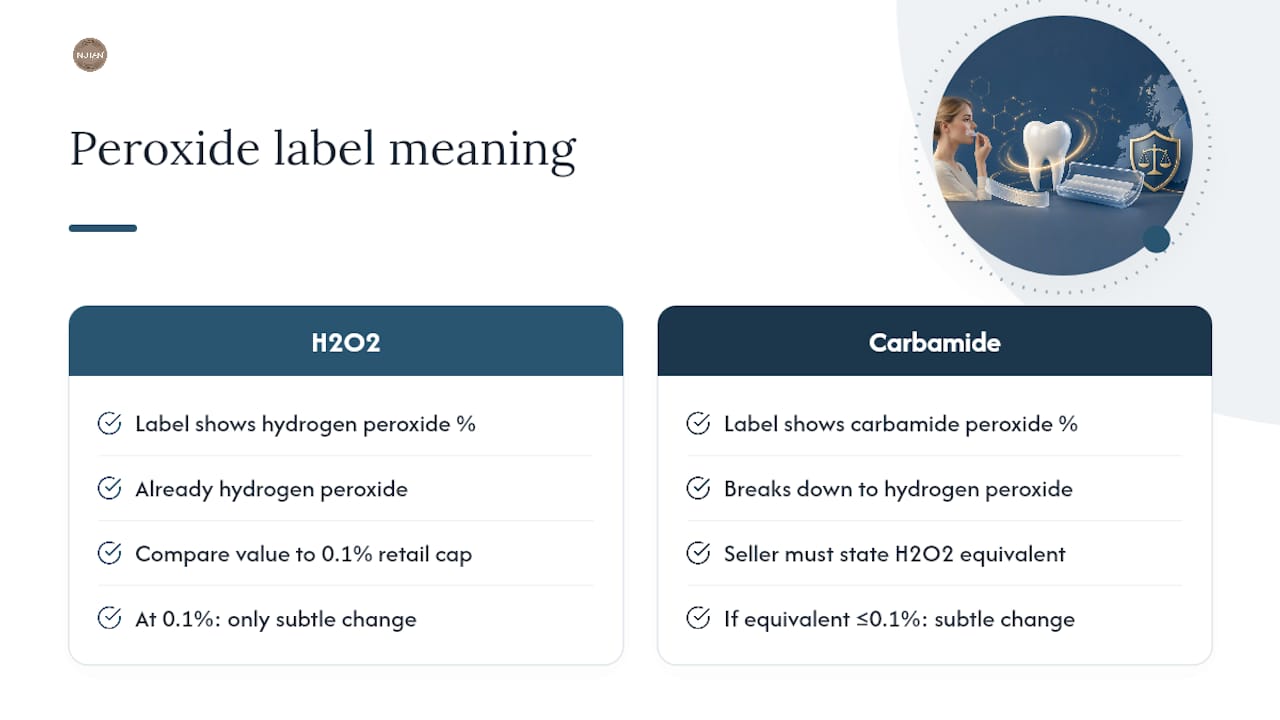
Pro Tip: Never assume a carbamide peroxide percentage is directly comparable to hydrogen peroxide. If the equivalent hydrogen peroxide release isn’t stated anywhere on the packaging or the seller’s product page, ask before you buy, or treat it as a red flag.
Why these restrictions exist in the first place
Hydrogen peroxide isn’t dangerous at low, controlled doses, but misuse causes real harm. Overuse or excessive concentration can cause soft-tissue burns to gums and cheeks, enamel erosion, and sensitivity that can linger for weeks after the offending product has been binned.
A dental examination before whitening isn’t a bureaucratic hoop. It exists to catch decay, exposed dentine, and gum disease before peroxide gets anywhere near them, all of which make whitening painful or actively harmful if missed. There’s also a financial and legal backstop most consumers never think about: dental indemnity insurance is void if the provider isn’t registered, which means anyone harmed by an unregistered “whitening technician” has essentially no route to compensation through that provider. Regulation here functions as both a safety net and a form of consumer protection that only exists because the supply chain is restricted in the first place.
Buying, importing, and travelling with whitening strips
That includes strips ordered from overseas marketplaces and brought back in a suitcase.
A few practical points worth knowing:
Customs and Trading Standards have the power to seize whitening products that exceed the legal concentration, whether they arrive by post or in luggage.
Testing carried out by dental organisations has repeatedly found online whitening products mislabelled or over the legal peroxide threshold, so a product being freely sold on a marketplace is no guarantee it’s compliant.
If you’ve already bought stronger strips abroad, check the manufacturer’s technical data sheet for the actual hydrogen peroxide release, and stop using the product if you can’t confirm it sits within UK limits.
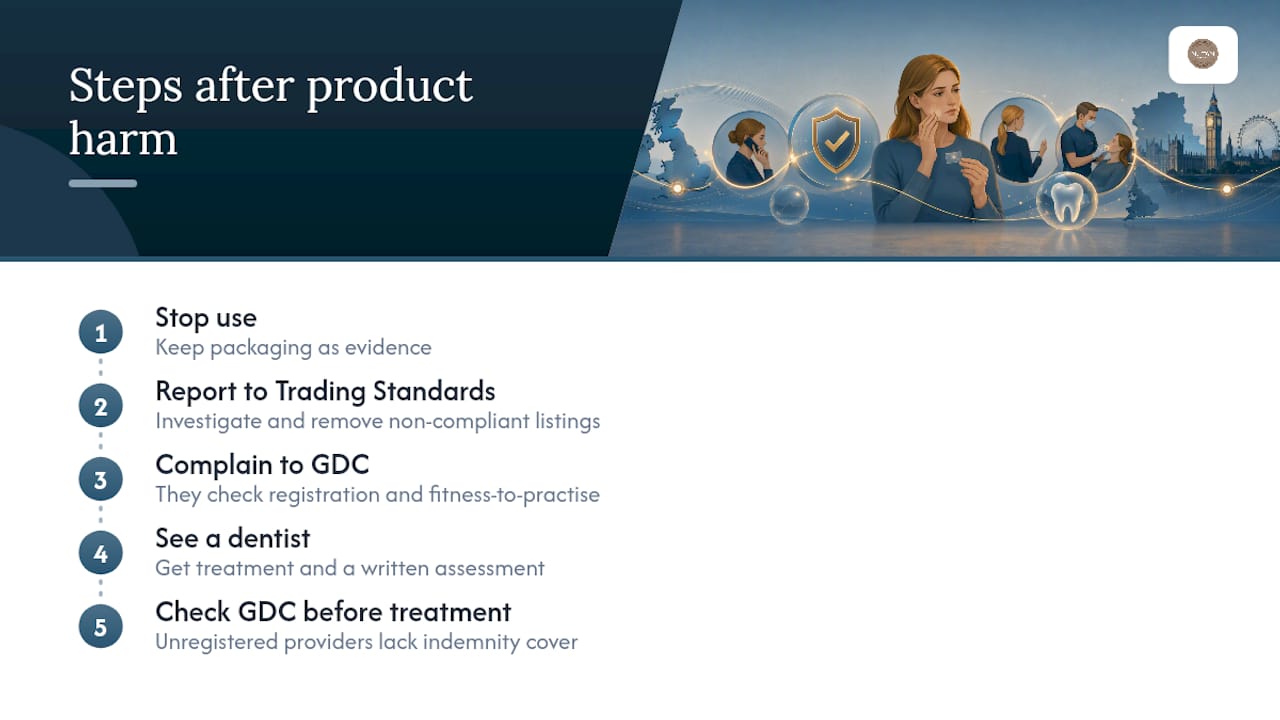
Suspected illegal or mislabelled products can be reported directly to Trading Standards.
This is also the underlying reason certain well-known American whitening strip brands, formulated at concentrations well above the UK’s retail cap, simply aren’t sold here: not a marketing choice, but a labelling and supply-law mismatch.
Lawful routes to a whiter smile in the UK
Book a dental assessment. A dentist checks for decay, sensitivity, and gum health before recommending anything stronger than retail strength.
Get supplied with a dentist-prescribed kit or in-surgery treatment. This is where the 0.1% to 6% concentration band becomes available to you, either as a take-home kit or a chairside treatment.
Attend the first supervised application. The dentist or hygienist needs to be present for the first use, after which most kits are designed for you to continue the course at home.
Keep expectations realistic if sticking to retail-only options. A genuinely low-peroxide product will brighten surface staining gradually rather than deliver a dramatic shift overnight.
For anyone wanting a faster, still-compliant result, safe at-home options exist within the legal framework, it’s just a matter of matching the product to what’s actually achievable at 0.1%.
How to spot an illegal or mislabelled whitening product
A few seconds checking the label saves a lot of hassle later. Look for the hydrogen peroxide percentage stated explicitly, and a UK manufacturer or importer address printed on the packaging or listing.
Red flags worth walking away from:
No ingredient percentages listed anywhere, on the box or the online listing.
A seller contactable only through an overseas address with no UK presence.
Pricing dramatically below what comparable compliant products cost.
Anonymous sellers with no traceable business details.
If something looks off, report it to Trading Standards and speak to your dentist before using it, particularly if you’ve already experienced sensitivity or gum irritation.
NuTan®: compliance, product transparency, and safety information
NuTan® supplies teeth whitening and oral hygiene products in the UK with ingredient percentages and usage instructions clearly listed on every product page, including the NuSmile V34 Whitening Strips. The products are presented with safety guidance and advice to consult a dentist for whitening strength above retail legal limits. This level of transparency about product contents and realistic outcomes is a quality standard desirable for whitening brands selling into the UK.
Recent changes and what to watch for in 2026
What has changed is enforcement intensity. Trading Standards and the GDC have both become more active in pursuing unregistered whitening providers operating out of salons, pop-up clinics, and mobile setups, particularly in response to a rise in social-media-marketed whitening treatments aimed at younger consumers.
Online marketplace policing has also tightened. Platforms selling into the UK face increasing pressure to remove listings for peroxide concentrations that breach the retail limit, though enforcement remains inconsistent and imported non-compliant strips still slip through. If you’re buying online in 2026, treat marketplace vetting as unreliable rather than assume a listing being live means it’s legal.
Anyone providing professional whitening services should keep an eye on GDC standards updates directly, since guidance on training and scope of practice gets refined periodically even when the underlying law stays fixed.
Official guidance and legislation worth checking yourself
For anyone who wants to verify any of this directly rather than take a summary on trust, three sources cover the ground thoroughly:
The GDC’s guidance on illegal tooth whitening, which sets out the legal thresholds and registration requirements in plain terms.
The Cosmetic Products (Safety) (Amendment) Regulations 2012 on legislation.gov.uk, the statutory text itself.
The Oral Health Foundation’s explainer on tooth whitening and the law, and DDU guidance for practitioners, both useful for the practical side of first-use rules.
Our editorial take: the law here protects you more than it inconveniences you
That’s the wrong read. The gap exists because the UK treats meaningful whitening as a clinical act requiring assessment, not a cosmetic purchase like a new toothbrush.
Where conventional advice falls short is in stopping at “check the label.” That’s necessary but not sufficient. The bigger blind spot is assuming any seller offering stronger strips online is simply cutting through red tape, when in practice they’re often selling a product with no verified peroxide release, no UK accountability, and no insurance backing if something goes wrong.
It’s the only route that gets you real strength, real supervision, and a legal product, all at once.
— NuTan
Get compliant whitening without the guesswork
There are retail-compliant whitening products available that state the hydrogen peroxide percentage clearly, offering an alternative to uncertain overseas products.
Our NuSmile V34 Whitening Strips sit within the UK’s retail limits and come with full usage instructions, no ambiguous labelling and no guessing at carbamide-to-hydrogen-peroxide conversions. If you’d rather go the powder route, the Pap+ Teeth Whitening Powder offers a peroxide-free alternative for gradual brightening between dental visits. For anyone whose staining needs more than a retail-strength product can offer, the honest next step is booking a dentist assessment first, and pairing that with a compliant home-care routine afterwards, such as the Enamel Care Bundle to protect enamel through the process. Browse the full range and pick the option that matches what your smile actually needs.
This article is general information, not a substitute for advice from a qualified lawyer. Consult a qualified legal professional about your own circumstances before acting on anything here.
Sources
FAQ
Are Crest Whitening Strips illegal in the UK?
Crest Whitening Strips aren’t sold legally in the UK because their hydrogen peroxide concentration exceeds the 0.1% retail limit set by UK cosmetics regulation, not because whitening strips themselves are banned.
Who can legally whiten teeth in the UK?
Only registered dentists, dental hygienists, dental therapists, and clinical dental technicians acting on a dentist’s prescription can legally supply or perform whitening above the 0.1% retail threshold, following a High Court ruling confirming whitening is dentistry.
Why are Crest Whitening Strips not sold in the UK?
Their peroxide concentration falls outside what UK law permits for direct retail sale, and no UK importer can legally supply them to consumers without routing them through a registered dental professional.
Recommended
Comments