

Why darker skin tans differently: the science explained
- 1 day ago
- 9 min read
Darker skin tans differently because it contains a higher concentration of eumelanin, a stable, UV-absorbing pigment that responds to sun exposure faster and more deeply than the pheomelanin dominant in lighter skin tones. This biological difference sits at the heart of skin tanning differences across the Fitzpatrick scale, which classifies skin types I through VI based on pigmentation and UV response. Understanding the dark skin tanning process is not just fascinating science. It is practical knowledge that shapes how you protect, care for, and work with your skin rather than against it.
Why darker skin tans differently: the role of melanin
The core reason why darker skin tans differently comes down to melanin type and quantity. Human skin produces two forms of melanin: eumelanin, which is brown to black in colour, and pheomelanin, which is yellow to red. Darker skin predominantly contains eumelanin, which absorbs and dissipates UV radiation far more effectively than pheomelanin. Pheomelanin, by contrast, can generate reactive oxygen species under UV exposure, contributing to cellular stress rather than protection.

The difference goes deeper than pigment type alone. Melanogenesis pathways are biochemically identical across all skin types, but the output varies significantly due to genetic factors controlling melanin type and melanosome size. Darker skin has larger, more active melanocytes that produce more eumelanin per cell. This explains both the greater tanning response and the heightened risk of hyperpigmentation when melanocytes are overstimulated.
The table below shows how melanin characteristics differ across skin tones.
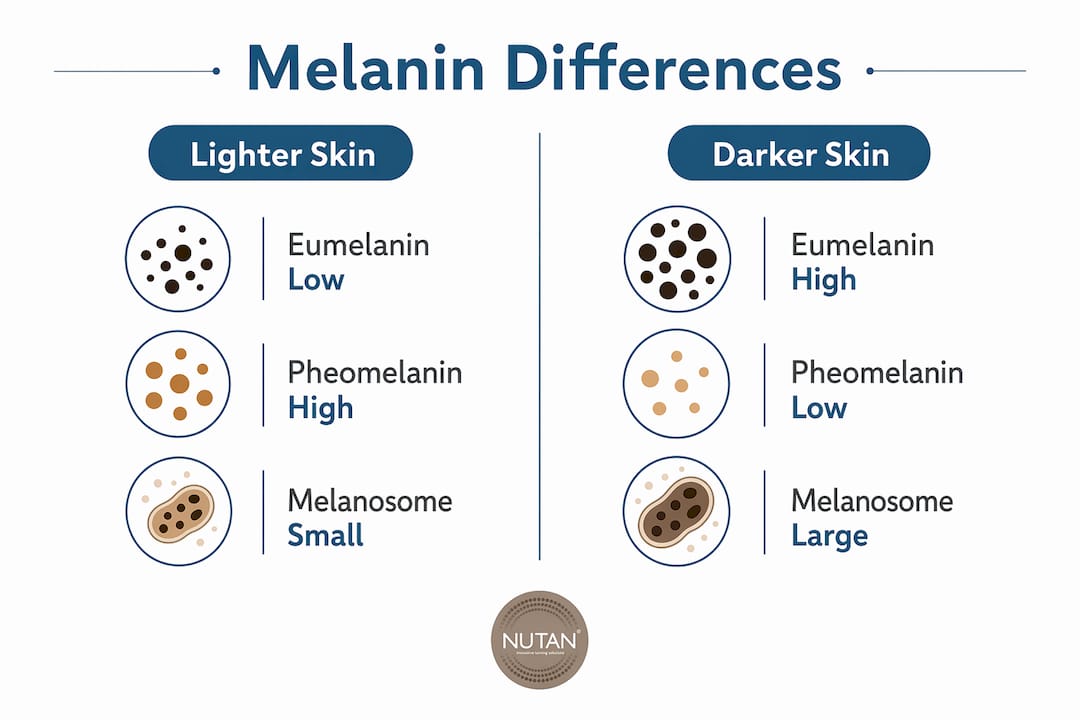
Characteristic | Lighter skin (Fitzpatrick I–III) | Darker skin (Fitzpatrick IV–VI) |
Dominant melanin type | Pheomelanin | Eumelanin |
Melanosome size | Smaller | Larger |
UV absorption efficiency | Lower | Higher |
Natural SPF equivalent | Approximately 3 | Approximately 13 |
Hyperpigmentation risk | Lower | Higher |
Pro Tip: If you have a deeper skin tone, your melanocytes are highly reactive. Even gentle UV exposure can trigger visible tanning within a session or two, so starting with short, controlled sessions protects against uneven results.
Why does darker skin tan faster?
Darker skin types, classified as Fitzpatrick IV–VI, show faster and stronger melanocyte reactivity, enabling quicker, noticeable tanning with shorter UV exposure than lighter types. People with lighter skin may need weeks of consistent exposure to achieve a visible tan. Those with deeper tones can see skin tone deepening within a few sessions. This speed is an advantage, but it also demands more care.
UVA radiation causes immediate pigment darkening through oxidation of existing melanin, while UVB induces delayed melanin production that creates a longer-lasting tan. Both wavelengths contribute to the tanning process, but they differ in timing and biological effect on melanocytes. For darker skin, this dual mechanism means tanning results can appear quickly but also deepen significantly with repeated exposure.
Safe tanning session guidelines for darker skin:
Start short. Begin with 10–15 minutes of midday sun exposure and assess your skin’s response before extending sessions.
Build gradually. Increase exposure by no more than 5 minutes per session to avoid triggering over-reactive melanocytes.
Avoid peak UV hours. Between 11AM and 3PM, UV intensity is highest. Morning or late afternoon sessions reduce unnecessary UV load.
Protect sensitive areas. Apply broad-spectrum SPF to the face and décolletage, which are more prone to uneven pigmentation.
Rest between sessions. Allow 48 hours between tanning sessions so melanocytes can stabilise and produce even colour.
Pro Tip: Consistency beats intensity every time. Short, regular sessions produce a more even, lasting result than one long afternoon in the sun.
Common myths about darker skin and sun damage
The most persistent myth about darker skin is that it does not burn and does not need sun protection. This is false. The natural SPF equivalent of darker skin is approximately 13, compared to around 3 in fair skin. That is a meaningful advantage, but it offers limited protection against cumulative UV damage and skin cancer over time.
Tanning is a protective stress response to UV-induced DNA damage, visible as an increase in melanin. It is not a harmless cosmetic effect. Every tan is evidence that your skin has been under stress. Darker skin experiences photoageing and DNA damage just as lighter skin does, simply at a slower rate.
“Darker skin’s natural melanin advantage is best understood as a time advantage, not immunity. Cumulative UV exposure still causes invisible DNA damage, premature ageing, and in some cases, skin cancer. Broad-spectrum sunscreen is not optional for any skin tone.”
Hyperpigmentation and post-inflammatory hyperpigmentation (PIH) are common risks in darker skin when melanocytes overreact to UV or irritation. Even minor inflammation, such as a small scratch or a reaction to a skincare product, can trigger dark patches and uneven colour in Fitzpatrick IV–VI skin. The key risks to be aware of include:
Hyperpigmentation: Dark patches caused by excess melanin production in response to UV or inflammation.
Post-inflammatory hyperpigmentation (PIH): Discolouration that follows any skin trauma, including sunburn, waxing, or harsh exfoliation.
Photoageing: Cumulative UV damage that accelerates fine lines and loss of elasticity, even without visible burning.
Invisible DNA damage: UV-induced cellular changes that occur below the surface without any immediate visible sign.
Darker skin’s melanocytes can over-react to stressors, causing uneven pigmentation. Managing irritation is the single most effective way to maintain an even complexion. This means choosing gentle skincare, avoiding harsh exfoliants during tanning periods, and always applying broad-spectrum SPF. You can read more about minimising UV-induced damage and keeping your complexion even in our detailed guide.
Vitamin D and the challenge for darker skin tones
Melanin’s UV-absorbing power creates a trade-off. The same pigment that protects darker skin from UV damage also reduces the skin’s ability to synthesise vitamin D. Vitamin D production requires UVB radiation to penetrate the skin and trigger a conversion process in the lower layers. Higher melanin levels filter out more UVB before it reaches those layers.
The result is a measurable gap in vitamin D status. Studies show up to 82% of Black Americans have insufficient vitamin D, compared to 42% of the general population. This is not a minor statistical footnote. Vitamin D deficiency is linked to bone health, immune function, and mood regulation, making it a genuine health concern for people with deeper skin tones.
Factor | Impact on darker skin |
Melanin density | Reduces UVB penetration for vitamin D synthesis |
Geographic location | Northern latitudes reduce UVB availability, especially in winter |
Season | Vitamin D synthesis drops significantly between october and march in the UK |
Dietary intake | Oily fish, eggs, and fortified foods can partially compensate |
Supplementation | Public Health England recommends 10 micrograms daily, especially in winter |
The practical approach is balance. Moderate, regular sun exposure supports vitamin D production without accumulating excessive UV damage. During winter months in the UK, supplementation is the most reliable option for maintaining adequate levels regardless of skin tone.
Best practices for tanning and skincare with darker skin
Consistent, moderate UV exposure yields better, longer-lasting tans with fewer risks than intense, prolonged sunbathing, particularly for darker skin types. Shorter, controlled sessions reduce hyperpigmentation and skin stress while supporting even melanin development. The goal is to work with your skin’s biology, not push against it.
Practical skincare habits that support even tanning results:
Moisturise daily. Well-hydrated skin tans more evenly and is less prone to patchy results. Use a fragrance-free moisturiser morning and evening.
Exfoliate gently, not aggressively. Light exfoliation once or twice a week removes dead skin cells that can cause uneven colour. Avoid harsh scrubs that trigger PIH.
Apply broad-spectrum SPF. Use at least SPF 30 on the face and any areas prone to uneven pigmentation, even on days with moderate sun.
Treat after-sun care seriously. Apply a soothing, alcohol-free after-sun product to calm melanocytes and reduce the risk of post-exposure flare-ups.
Avoid irritants during tanning periods. Retinoids, strong acids, and fragranced products increase sensitivity and raise the risk of uneven pigmentation.
Melanosome size and distribution in darker skin influence the longevity of a tan and pigment persistence, which means deeper skin tones often maintain their tan longer with fewer maintenance sessions. This is a genuine advantage, and it is worth building a routine that supports it. For a full guide to pairing sun exposure with a skincare routine, the tanning skincare routine guide covers every step in detail.
NuTan® patches offer an alternative approach for those who want to support their skin’s natural tanning process with significantly less UV exposure. The patches contain the NuTan MSH-ComplexB formulation, which activates the Melanocortin 1 Receptor (MC1R) on melanocytes to trigger natural melanin production. This means you can achieve a natural-looking tan with far less time in the sun, reducing the cumulative UV load that drives hyperpigmentation and DNA damage. For darker skin types particularly sensitive to uneven pigmentation, this is a meaningful benefit. You can learn more about how alpha-MSH drives tanning and why MC1R activation matters.
Pro Tip: If uneven pigmentation is a concern, address it before tanning season begins. Use a gentle brightening serum containing niacinamide or vitamin C for four to six weeks, then introduce UV exposure gradually.
Key takeaways
Darker skin tans faster and more deeply than lighter skin because eumelanin absorbs UV radiation more efficiently, but this natural advantage does not eliminate the need for sun protection or careful skincare.
Point | Details |
Eumelanin drives faster tanning | Darker skin produces more eumelanin, enabling visible tanning within a few sessions. |
Natural SPF is not full protection | An SPF equivalent of approximately 13 protects against acute burns but not cumulative UV damage. |
Hyperpigmentation is the key risk | Over-reactive melanocytes in Fitzpatrick IV–VI skin can cause dark patches from UV or irritation. |
Vitamin D deficiency is a real concern | Higher melanin reduces UVB penetration, increasing the risk of insufficient vitamin D synthesis. |
Consistent, short sessions work best | Moderate, regular UV exposure produces an even tan with fewer risks than prolonged sunbathing. |
What working with darker skin tones has taught me
The most common mistake I see is treating darker skin as though it is invincible. The natural melanin advantage is real, and it is worth appreciating. But it creates a false sense of security that leads people to skip sunscreen, overdo sun sessions, and then wonder why they are dealing with stubborn dark patches months later.
Hyperpigmentation in deeper skin tones is not just a cosmetic inconvenience. It can take months to fade, and the wrong treatment can make it worse. Post-inflammatory hyperpigmentation requires careful management to avoid further melanocyte stimulation. Gentle brightening agents and avoiding irritants are the foundation of recovery, not aggressive peels or strong actives.
What I find genuinely encouraging is how well darker skin responds when you work with its biology. Short, consistent sun sessions, good hydration, and a calm skincare routine produce results that are even, lasting, and genuinely healthy-looking. The skin’s natural eumelanin advantage means the tan holds longer and looks richer. That is something to work with, not override.
The shift I advocate for is moving away from the idea that more UV exposure equals a better tan. For darker skin especially, less is more. Measured exposure, proper protection, and support for your skin’s natural processes produce the best results with the least risk. If you are curious about what causes uneven tanning and how to prevent it, that is the right place to start.
— NuTan®
NuTan® patches: a smarter approach to tanning for deeper skin tones
For those with darker skin who want a natural-looking tan without the risks that come with extended UV exposure, NuTan® offers a considered alternative.
NuTan® tanning patches use the NuTan MSH-ComplexB formulation to activate your skin’s own melanin production through the MC1R receptor, the same biological pathway triggered by sun exposure. The result is a genuine, natural tan that does not wash or rub off. Crucially, the patches require over 70% less UV exposure than conventional tanning methods to achieve a comparable result. For darker skin types where hyperpigmentation and uneven pigmentation are real concerns, reducing UV load is not just a convenience. It is a meaningful step towards healthier skin. NuTan® ships worldwide, so wherever you are, a safer approach to tanning is within reach.
FAQ
Why does darker skin tan faster than lighter skin?
Darker skin contains more eumelanin and larger, more active melanocytes that respond to UV exposure quickly. Fitzpatrick IV–VI skin types can see visible tanning within a few sessions, compared to weeks for lighter skin tones.
Does darker skin still need sunscreen?
Yes. The natural SPF equivalent of darker skin is approximately 13, which reduces acute burn risk but does not prevent cumulative UV damage, photoageing, or skin cancer. Broad-spectrum SPF remains necessary for all skin tones.
What causes hyperpigmentation in darker skin after tanning?
Hyperpigmentation occurs when melanocytes overreact to UV exposure or skin irritation, producing excess melanin in localised areas. Darker skin types are more prone to this response due to larger, more reactive melanocytes.
Why are people with darker skin more likely to be vitamin D deficient?
Higher melanin levels filter out more UVB radiation before it reaches the skin layers responsible for vitamin D synthesis. Studies show up to 82% of Black Americans have insufficient vitamin D, highlighting the need for dietary sources or supplementation.
Can NuTan® patches work for darker skin tones?
NuTan® patches activate the MC1R receptor to trigger natural melanin production, working with the skin’s own biology regardless of skin tone. They require over 70% less UV exposure than conventional tanning, making them a practical option for those wanting to reduce hyperpigmentation risk.
Recommended