

£150–£500? At Home Whitening Costs in the UK, Where NuTan® Fits
- 23 hours ago
- 10 min read
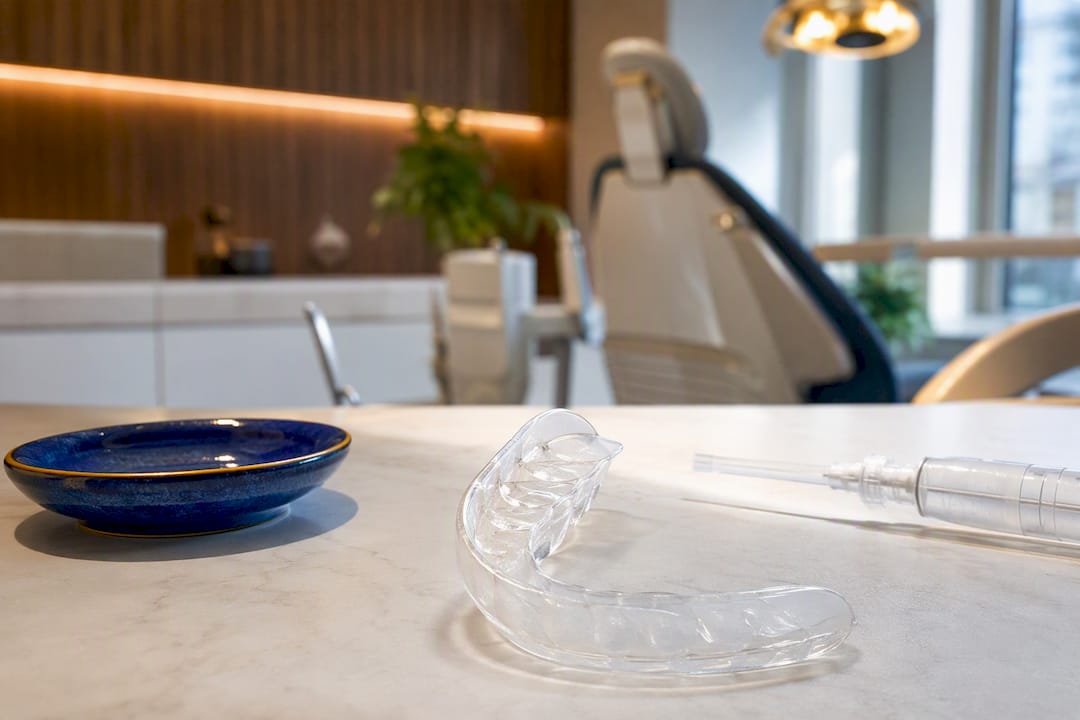
Dentist-supervised at-home whitening kits typically cost between £150 and £500 in the UK, in-clinic single-visit treatments run £300 to £800, and over-the-counter kits sit at £10 to £120. For most people, the dentist-supervised home route offers the strongest long-term value: custom trays last for years and refills cost far less than starting again. One thing to flag early: whitening is cosmetic, so none of this is covered by the NHS.
TL;DR:
Dentist-supervised kits cost between £150 and £500, providing custom trays for long-term use, which reduces ongoing maintenance costs compared to single treatments.
In-clinic treatments deliver faster results with one visit for £300 to £800 but lack reusable equipment for future touch-ups, making them less cost-effective long term.
Over-the-counter kits are the cheapest but only lighten teeth modestly, with legal limits capping peroxide at 0.1%, limiting their shade-changing ability.
Treatment prices vary significantly by location, with London clinics often charging 30-40% more than comparable clinics elsewhere due to higher overheads.
Always verify peroxide concentration and GDC registration, and avoid illegal online kits that exceed legal peroxide limits to ensure safety and compliance.
Table of Contents
Is your whitening kit actually legal? UK safety rules explained
Long-term maintenance: what whitening actually costs you over time
Choosing a dentist or home kit: questions to ask before you pay
NuTan®'s UK teeth whitening range and where it fits the cost bands
Ready to start? Where to buy NuTan® whitening products in the UK
At home whitening cost UK: the full price breakdown
Three routes dominate the UK market, and the price gap between them tells you almost everything about what you’re actually paying for.
Dentist-supervised at-home kits, the middle ground, typically cost £150 to £500 nationally. That price covers a proper clinical process rather than just a tub of gel: a consultation, impressions for custom-fitted trays, and a course of professional-strength whitening gel to use at home over several weeks. London clinics tend to sit at the upper end of this band, sometimes nudging past £500 for premium branded systems, while prices outside the capital often land closer to £200 to £350.
In-clinic treatments, usually LED or laser-accelerated systems, cost more: £300 to £800 for a single visit. You’re paying for speed here. A dentist applies a higher-strength gel under professional supervision and the whole thing is done in an hour or two, often producing a 6 to 8 shade change in one sitting. It’s the quickest route to a dramatic result, but it comes without the reusable trays you get from the take-home option, so there’s less built-in value for future top-ups.
Over-the-counter kits are the budget entry point at roughly £10 to £120. They’re capped by law at 0.1% hydrogen peroxide, which limits what they can actually achieve. Think gentle brightening and stain removal rather than a genuine shade transformation. Some premium branded home systems, sold through dental practices rather than supermarket shelves, do climb into the £500 to £700 range, usually because they bundle in extra gel syringes or a longer aftercare package.
Method | Typical UK price | Speed | Typical shade change |
Dentist-supervised at-home kit | £150–£500 | 2–6 weeks | 4–8 shades |
In-clinic (LED/laser) treatment | £300–£800 | 1 visit | 6–8 shades |
Over-the-counter kit | £10–£120 | Days to weeks | Minimal to modest |
Premium branded home system | £500–£700 | 2–6 weeks | 4–8 shades |
A few practical points worth knowing before you compare quotes:
Dentist-supervised kits give you custom trays you keep and reuse for years, which changes the long-term maths considerably.
In-clinic treatments deliver faster results but typically don’t include reusable equipment for future maintenance.
OTC kits are the cheapest entry point but rarely deliver the shade change most people are actually hoping for.
Regional pricing varies enough that a London quote and a quote from a smaller town can differ by £100 or more for the same service.
What affects the price you’re quoted
Two clinics offering “the same” dentist-supervised whitening kit can quote wildly different figures, and it’s rarely random.
Location matters more than most people expect. London and the South East consistently sit at the top of the national price range, sometimes 30 to 40% above equivalent treatment elsewhere in the UK. That’s less about the whitening itself and more about clinic overheads, which get baked into every treatment price on the books.
What’s actually included in the quote varies enormously. A £150 quote and a £450 quote might both say “at-home whitening kit,” but one includes a full clinical consultation, impressions, custom trays, multiple gel syringes and a follow-up review, while the other is a stripped-down version with one syringe and no aftercare check. Always ask for an itemised breakdown before comparing two prices side by side.
Peroxide concentration and branded systems push prices up. Professional-grade gels used under dental supervision can contain concentrations up to 6% hydrogen peroxide, far higher than anything sold over the counter. Branded premium systems tend to charge more, partly for the formulation and partly for the additional gel volume and support that comes with the box.
Existing dental work changes the cost picture. Fillings, crowns, veneers or untreated decay all need addressing before whitening starts, and any preparatory treatment adds to your total bill. It’s also worth knowing that crowns and composite restorations won’t lighten along with your natural teeth, which can affect both your treatment plan and your final cost if a visible mismatch needs correcting.
Finance plans change what you pay upfront, not what you pay overall. Many clinics offer interest-free instalments on treatments above roughly £250, and where credit is involved, the Financial Conduct Authority regulates the terms. Read the small print regardless.
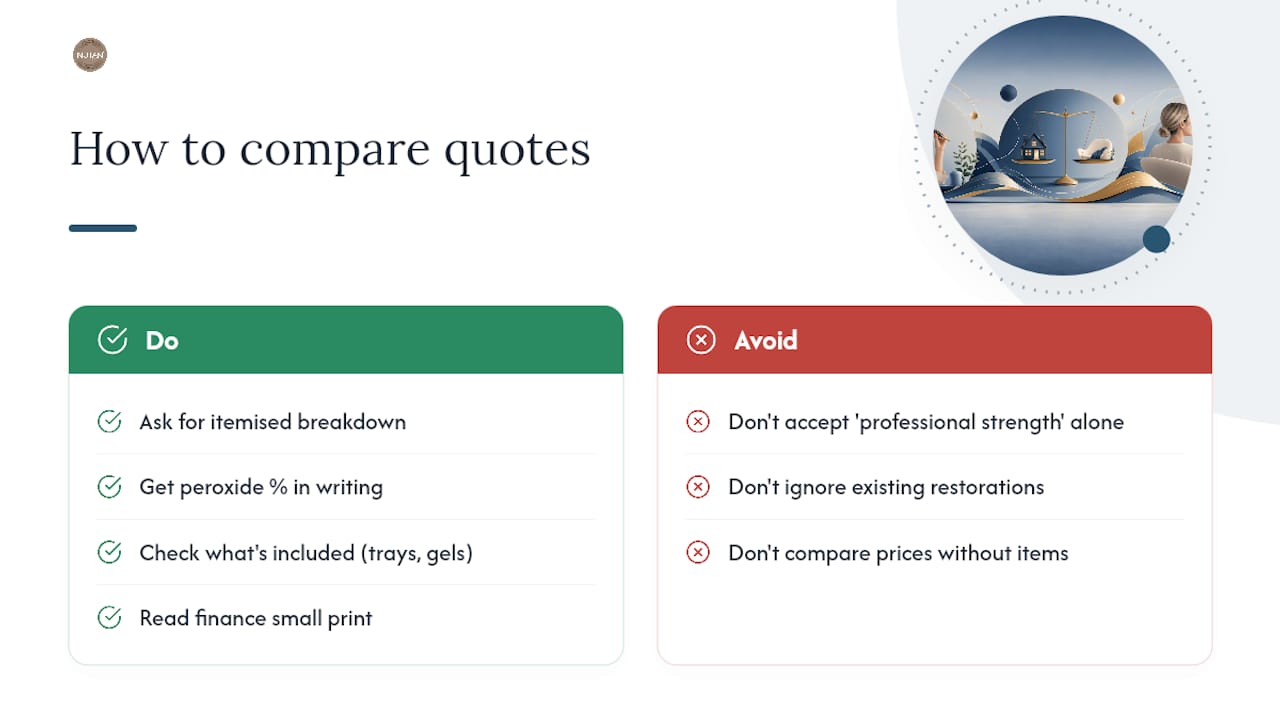
Pro Tip: Ask every clinic for the exact peroxide percentage in writing before you commit. “Professional strength” means nothing on its own. If a provider doesn’t give you a number, that’s a red flag worth walking away from.
How dentist-supervised at-home whitening actually works
The process behind that £150 to £500 price tag follows a fairly consistent pattern across UK dental practices, and understanding each stage helps explain exactly what you’re paying for.
Clinical consultation and suitability check. A dentist examines your teeth and gums, checks for decay or existing restorations, and confirms you’re a suitable candidate. This is also the moment to verify the provider is GDC registered, which you can check independently through the General Dental Council’s online register.
Impressions and custom tray production. The dentist takes moulds of your teeth, sent to a lab to produce trays that fit your mouth precisely. This lab step is one of the main reasons dentist-supervised kits cost more than OTC alternatives, but it’s also the step that gives you a reusable asset for years to come.
Daily home application. You wear the trays with professional-strength gel for 1 to 2 hours a day, or overnight, across 2 to 6 weeks, depending on the concentration and your dentist’s schedule.
Gradual shade improvement. Most patients see a 4 to 8 shade improvement by the end of the course, a more gradual change than in-clinic treatment, but one that generally comes with less sensitivity because your teeth adjust slowly.
Combined packages for faster results. Some clinics offer an in-clinic session followed by a shorter home top-up course. These combined packages sit at a higher price point but suit anyone wanting a quick initial boost with a gentler maintenance phase.
Mild sensitivity during the first week or two is common and usually settles once the course finishes. If sensitivity is severe or persistent, stop and speak to your dentist rather than pushing through.
Is your whitening kit actually legal? UK safety rules explained
The rules here aren’t complicated, but they catch a surprising number of people out. That’s a genuinely low concentration, which is exactly why OTC kits struggle to deliver a dramatic shade change no matter how the packaging is worded.
Anything stronger than that, up to concentrations of 6%, can only be used or supplied under dental professional supervision. That restriction exists because higher-strength peroxide needs a clinical check first: a dentist confirms there’s no decay, gum disease, or exposed dentine that the gel could aggravate before it ever touches your teeth.
A significant share of the whitening kits sold illegally online in the UK exceed the legal peroxide limit, and dental bodies specifically warn against buying from unverified sellers rather than a GDC-registered provider.
A few safety points worth keeping in mind:
Whitening is classed as a cosmetic procedure in the UK and is not available on the NHS; every route discussed here is a private cost.
Overuse of high-strength or illegal kits can cause enamel damage, sensitivity and gum irritation.
If you experience persistent pain, gum burns, or unusual white patches, stop treatment and contact your dentist.
Always verify a provider’s GDC registration number before starting any higher-strength treatment.
Long-term maintenance: what whitening actually costs you over time
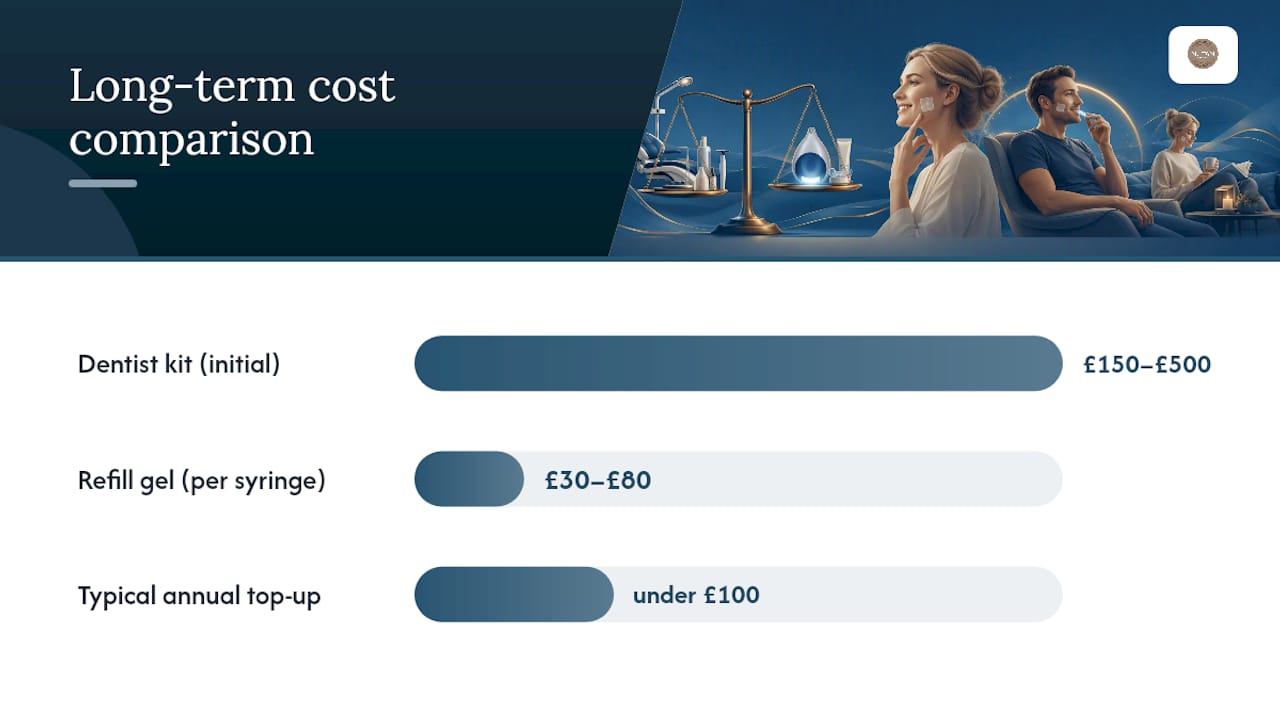
The upfront £150 to £500 isn’t the whole financial story. Custom trays, once made, are a reusable asset. Most last for years with reasonable care, which is the real financial advantage of the dentist-supervised route over a one-off in-clinic session.
Maintenance mostly means buying refill gel syringes, typically £30 to £80 each from your dentist. Most patients need occasional top-ups a year to keep their shade steady, and dental professionals often suggest this reusable-tray model precisely because it keeps ongoing costs low compared with repeating the entire initial process.
A typical annual top-up often lands under £100, a fraction of the £150 to £500 you’d pay to start from scratch with new trays and a full course. That gap is exactly why the initial spend on a proper dentist-supervised kit tends to pay for itself within two or three years of maintenance.
Choosing a dentist or home kit: questions to ask before you pay
A good clinic will answer every one of these without hesitation. A vague answer to any of them is worth noting.
Is there a clinical consultation before treatment starts? If a provider skips this, walk away. It’s the step that catches decay, gum problems, or restorations that need addressing first.
Can you confirm your GDC registration number? Every legitimate dental professional in the UK has one, and you can verify it independently through the General Dental Council.
What’s the exact peroxide concentration in the gel? A precise number, not a marketing phrase like “professional strength,” is what you’re after.
How much gel is included, and what happens if I need more? This affects both your results and your first-year running cost.
What does aftercare and tray replacement look like? Ask whether a follow-up check is included and what a replacement tray costs if yours wears out.
Are finance terms transparent? Where credit is offered, the FCA regulates it, so ask for full terms in writing rather than a verbal summary.
Red flags to watch for: no clinical check offered at all, vague or unstated peroxide percentages, prices that seem too low for the concentration claimed, or no GDC number when asked directly. Good aftercare looks like a scheduled follow-up, a clear replacement policy for trays, and a straight answer every time you ask a pricing question.
Pro Tip: If a quote seems unusually cheap for a “professional” kit, ask why. Genuine dentist-supervised treatment has fixed cost drivers, consultation time, lab fees, gel, so an unusually low price often means one of those steps has been cut.
NuTan®'s UK teeth whitening range and where it fits the cost bands
NuTan® stocks a UK-available range built around the same value logic covered above: proper formulation, transparent contents, and products designed to fit sensibly into a long-term whitening routine rather than a one-off gimmick.
The NuSmile home whitening kit sits within the affordable end of the home whitening category, offering a straightforward at-home routine for people who want brighter teeth without booking a clinic slot.
NuSmile V34 whitening strips work as an OTC-style maintenance option, useful for keeping a shade steady between more intensive treatments.
Enamel care and oral hygiene bundles round out the range for anyone building a full maintenance routine rather than a single purchase.
These products slot naturally into the maintenance model already discussed: an initial investment followed by low-cost, occasional top-ups. For deeper guidance on using them safely, NuTan®'s NuSmile home whitening guide and its fast, safe whitening options guide cover application and suitability in more detail. Anyone with braces or other orthodontic work should check NuTan®'s whitening with braces guidance before starting.
Our take on cost versus safety in UK whitening
The mistake we see most often isn’t overspending, it’s chasing the lowest price without asking what’s actually in the gel. A £20 kit and a £300 dentist-supervised kit aren’t competing products; they’re solving different problems at different concentrations, and comparing them on price alone misses the point entirely.
We’d rather see someone spend £200 on a properly supervised home kit with a genuine clinical check than £500 on a premium system bought purely on branding. Verification matters more than budget here: confirm GDC registration, get the peroxide percentage in writing, and treat any higher-strength product as something that needs professional oversight, not a shortcut. Read NuTan®'s safe whitening guide before starting anything above OTC strength, and speak to a registered dentist first if you’re in any doubt.
— NuTan
Ready to start? Where to buy NuTan® whitening products in the UK
If you’ve weighed up the cost bands above and you’re ready to move, NuTan®'s NuSmile home whitening kit gives you a straightforward, transparently priced way to start at home, without the guesswork of unverified online sellers selling kits that may breach UK peroxide limits.
A typical purchase includes the whitening formulation and clear instructions for a daily home routine, giving you a lower-cost alternative to a full in-clinic course while still following a proper, safe application schedule. If you’ve had recent dental work, existing sensitivity, or you’re considering anything above OTC strength, check with a GDC-registered dentist first, that consultation step is the one thing worth never skipping, whatever route you choose. For ongoing maintenance once your initial results settle in, NuTan®'s V34 whitening strips offer a simple way to keep your shade topped up between deeper treatments. Browse the full range on the NuSmile product pages and pick the option that matches your budget and your teeth.
This article is general information, not a substitute for advice from a qualified doctor. Consult a qualified healthcare professional about your own circumstances before acting on anything here.
Sources
FAQ
Can yellow teeth go white again?
Yes. Yellowing from staining or ageing generally responds well to peroxide-based whitening, with most dentist-supervised courses delivering a 4 to 8 shade improvement. Whitening only works on natural tooth tissue, so existing crowns or fillings won’t change shade.
Is it worth paying for teeth whitening?
For most people, yes, particularly with a dentist-supervised at-home kit, since the custom trays are reusable and long-term maintenance costs relatively little compared with the initial £150 to £500 outlay. Cheaper OTC kits are worth trying only if your expectations are modest, as they’re capped at 0.1% peroxide by law.
Does the NHS pay for teeth whitening?
No. Whitening is classed as a cosmetic procedure in the UK, so it’s never available on the NHS and every option, from OTC kits to in-clinic treatment, is paid for privately.
What’s the best at-home teeth whitening kit in the UK?
Dentist-supervised kits using custom-fitted trays consistently outperform OTC alternatives on results and long-term value, since the trays are reusable for years. NuTan®'s NuSmile home whitening kit is built around that same principle for UK buyers wanting a straightforward, transparently formulated home option.
How long do at-home whitening results last?
Results typically last 1 to 3 years depending on diet, smoking and oral hygiene, after which a top-up using refill gel, usually £30 to £80 per syringe, restores the original shade without repeating the full treatment.
Recommended
Comments