

14 Day Lab Tests: Is Charcoal Teeth Whitening Safe for Your Enamel?
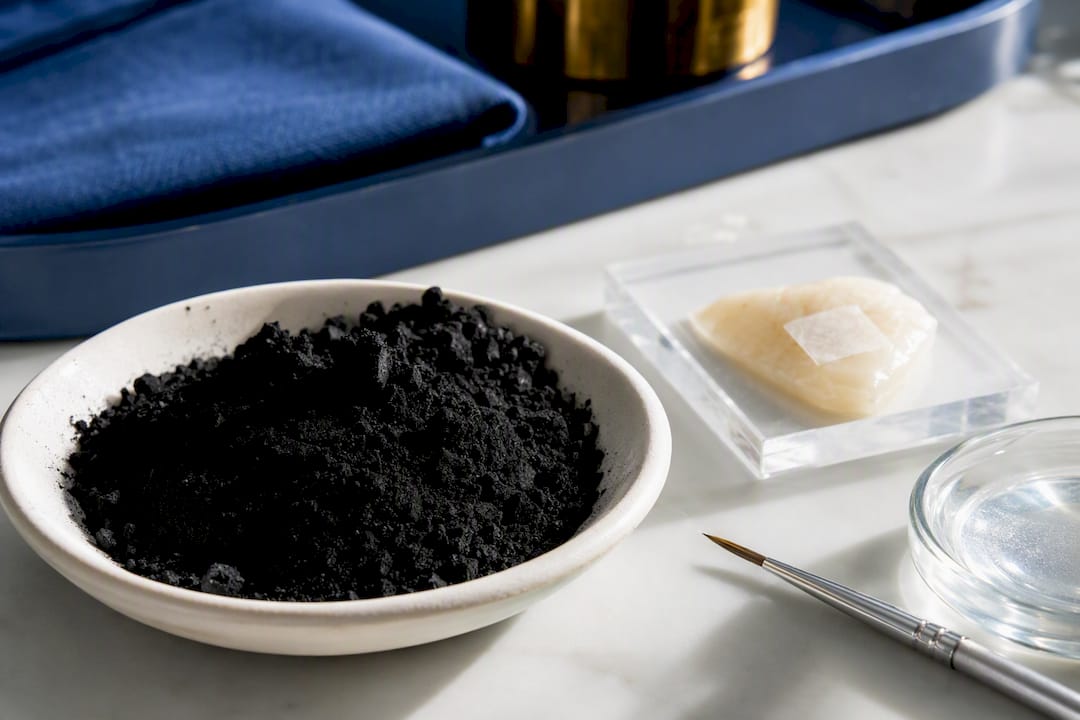
Charcoal can lift some surface stains from your teeth, but it is not broadly safe for routine whitening. The abrasive particles that scrub away discolouration also wear down enamel, and most charcoal products skip fluoride entirely, leaving teeth more exposed to decay. An occasional trial is a different risk profile to daily brushing with it. Before you try either, get your enamel and any fillings checked by a dentist.
TL;DR:
Regular use of charcoal toothpaste can significantly increase enamel wear and surface roughness, leading to faster staining and sensitivity over time.
Charcoal is ineffective at changing the color of dentin, so it cannot produce lasting whitening results comparable to peroxide-based treatments.
The evidence supporting charcoal’s whitening benefits is inconsistent and biased, with laboratory studies showing more roughness and less color change than peroxide gels.
People with sensitive teeth, enamel erosion, restorations, or young children should avoid charcoal altogether due to heightened risks.
Safer whitening options include fluoride toothpaste for gentle stain removal or peroxide-based products for actual color lightening, ideally used under professional supervision.
Table of Contents
Charcoal teeth whitening safe or not? How it’s supposed to work
Activated charcoal is not the stuff from your barbecue. It is charcoal that has been treated with oxygen to open up a mass of tiny pores, which increases its surface area and gives it a genuine capacity to bind to certain substances, a property called adsorption. That is the basis of the claim behind most teeth whitening charcoal products: the powder or paste is meant to grab onto surface debris and lift it away as you brush.
In practice, two things happen at once:
The gritty texture physically scrubs off extrinsic stains, the surface discolouration from coffee, tea, wine, or smoking.
The adsorption effect may pull some loose surface particles into the porous structure of the charcoal itself.
What it cannot do is change the colour of dentin, the yellowish layer beneath your enamel that shows through as teeth age or as enamel thins. Genuine bleaching, the kind that lightens tooth colour from within, requires a peroxide-based agent that breaks down staining molecules chemically. Charcoal has no equivalent mechanism.
What the science shows: effectiveness and measurable harm
The clinical picture on charcoal for teeth whitening is more sobering than the branding suggests. A systematic review of charcoal-containing whitening toothpastes found higher abrasive potential and inconsistent whitening results across the products tested, and rated much of the underlying evidence as medium to high risk of bias. That is a polite way of saying the marketing has outpaced the proof.
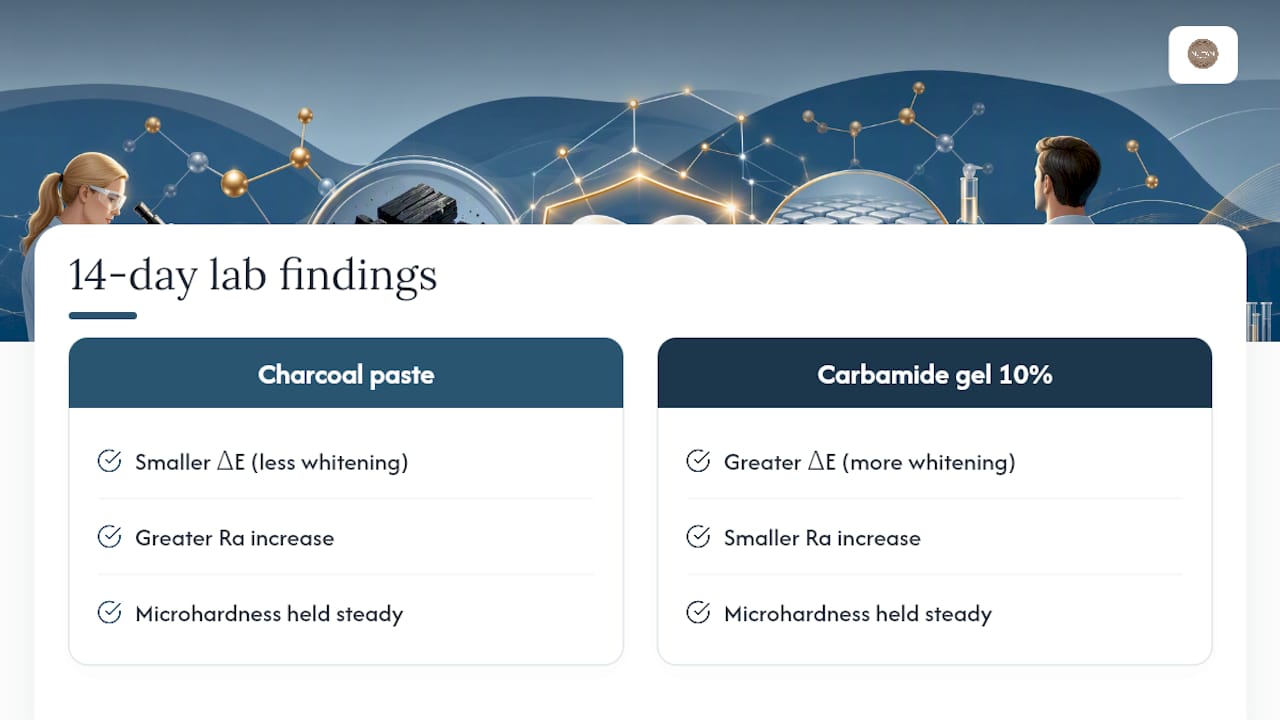
Laboratory data backs this up with harder numbers. A 2024 study measuring enamel roughness and colour change put charcoal dentifrice through 14 days of simulated brushing. The charcoal group showed a meaningful increase in surface roughness (Ra), while its colour change (ΔE, the standard metric for whitening) came in lower than the group brushing with 10% carbamide peroxide gel. Microhardness held steady in that particular trial, but the roughness increase matters because a rougher enamel surface picks up new stains faster and feels different under the tongue.
Peroxide gels tend to produce the larger colour shift; charcoal pastes more commonly produce the larger roughness increase. Those are two different outcomes, and only one of them is what most people are trying to achieve.
Two caveats are worth holding onto. Most of this research is conducted in vitro, on extracted teeth or enamel samples in a lab, over short windows of days rather than months. That does not make the findings irrelevant. It does mean nobody has robust long-term human data showing what years of charcoal brushing does to a full set of teeth. The absence of that data is itself a reason for caution, not reassurance.
Main risks: who should think twice about charcoal for teeth whitening
The risks with charcoal cluster around four issues, and they compound each other over time.
Enamel abrasion and surface roughness. Repeated brushing with a gritty compound wears the outer enamel layer, and once that surface roughens, it stays rougher.
Dentin exposure and sensitivity. As enamel thins, the more sensitive dentin underneath can become exposed, which is often when people first notice twinges with hot or cold food.
Dark staining in cracks and around dental work. Charcoal particles can lodge in microscopic cracks or around fillings and crowns, sometimes leaving dark marks that only a professional clean can shift.
Loss of fluoride protection. Charcoal can bind fluoride if the two are formulated together, which is one reason most charcoal products leave fluoride out altogether, and that trade-off sacrifices proven cavity protection for an unproven cosmetic effect.
Some people should avoid charcoal products outright: children still developing adult teeth, anyone with visible enamel erosion or existing restorations, and those with a history of sensitivity. Dry tooth powders raise the stakes further, since they lack the lubricating and humectant ingredients that pastes use to soften the mechanical wear of brushing.
Pro Tip: If your teeth already feel sensitive to cold drinks, that is your enamel telling you something. Skip charcoal entirely until a dentist has checked what is causing it.
If you still want to try it: safer use, frequency and dentist questions
If you decide to experiment with charcoal despite the risks, treat it as an occasional cosmetic trial, not a daily habit.
Limit frequency. Use charcoal at most a few times a week, never as a substitute for your regular fluoride toothpaste, and never twice in one session.
Choose paste over powder. Dry powders are more abrasive than pastes because they have no lubricant to cushion the brushing motion, so if you try charcoal at all, a paste formulation is the lower-risk option.
Brush gently. Skip hard scrubbing. Small, light circular motions do less damage than the vigorous scrub most people instinctively apply when chasing a whiter smile.
Alternate with fluoride toothpaste. Follow any charcoal brushing with a standard fluoride paste to restore some of the protective coverage charcoal doesn’t provide.
Ask your dentist first. Raise enamel thickness, any existing restorations, and whether your gum and tooth history makes charcoal a reasonable short-term trial or a clear no. Ask what they’d want to monitor if you go ahead.
Safer, evidence-backed alternatives that actually whiten
Fluoride whitening toothpastes work through mild chemical action and gentle polishing agents, not grit, so they whiten surface stains without the same roughness trade-off charcoal carries. Peroxide-based options go further: professional in-chair bleaching and dentist-supervised at-home kits use hydrogen or carbamide peroxide to lighten colour from within the tooth, which is the only route to real, lasting whitening rather than surface stain removal.
For a lower-sensitivity route at home, NuTan®'s home whitening kit and enamel-focused NuSmile range are built around that same evidence-minded thinking, favouring formulations that avoid unnecessary abrasion. Worth comparing before you commit:
Fluoride whitening toothpaste for everyday, low-risk maintenance
Peroxide-based at-home kits for a genuine colour shift under guidance
Professional in-chair bleaching for the fastest, most controlled result
Enamel-care bundles alongside any whitening routine, to offset sensitivity
Why NuTan® puts safety ahead of trends
Charcoal whitening has the kind of appeal that is hard to argue against on paper: natural-sounding, cheap, and dramatic in before-and-after photos. That is precisely why it deserves more scrutiny, not less. The gap between “removes surface stains” and “safely whitens teeth” is where most of the marketing lives, and it is a gap the laboratory data keeps confirming rather than closing.
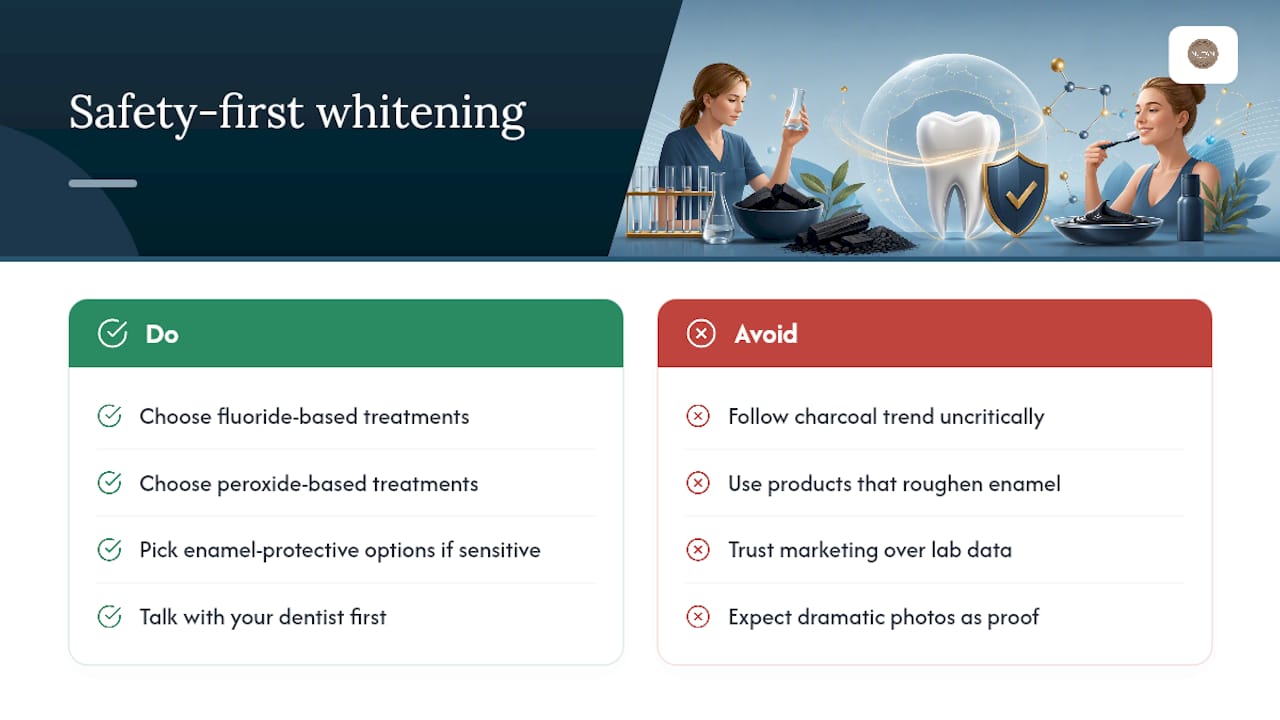
Our view is straightforward: a product that measurably roughens enamel while delivering a smaller colour change than peroxide gel is not a whitening solution, it is a trade-off dressed up as one. We would rather point people toward fluoride-based and peroxide-based routes with a track record, and toward enamel-protective options where sensitivity is a concern, than lean into a trend the evidence does not fully support. Whatever you choose, a conversation with your dentist before you start still beats reading any single article.
A gentler route to whiter teeth, if charcoal isn’t for you
If the abrasion risk has put you off charcoal, NuTan®'s NuSmile Home Whitening Kit gives you a peroxide-based path to real colour change without the surface roughening charcoal studies keep flagging.
The formulations are built to work alongside enamel, not against it, which matters if you have ever felt that twinge of sensitivity after a whitening session. For anyone starting a whitening routine from a position of existing sensitivity or thinning enamel, pairing it with the NuSmile Pro Enamel Care bundle adds a layer of protection most charcoal products never offer in the first place. Both are designed for people who want visible results without gambling on unproven claims.
If you are ready to move past DIY charcoal experiments, visit the NuSmile Home Whitening Kit product page to see what a peroxide-based, enamel-conscious kit actually involves, and decide whether it is the better fit for your teeth.
Key studies and expert guidance
This article is general information, not a substitute for advice from a qualified doctor. Consult a qualified healthcare professional about your own circumstances before acting on anything here.
Sources
FAQ
Is it safe to use charcoal to whiten teeth?
Occasional, short-term use carries limited risk for most healthy adults, but daily use is not advised because it wears enamel and increases surface roughness over time, according to Harvard Health.
What are the potential side effects of using charcoal teeth whitening powder?
Charcoal powders can increase enamel abrasion, raise sensitivity, and lodge in cracks or around restorations, and dry powders are typically more abrasive than pastes because they lack lubricating ingredients, per WebMD.
Can charcoal remove yellow teeth?
Charcoal can lift some extrinsic surface stains, but it does not change the underlying dentin colour that causes a yellowish appearance. Lab data shows its colour change is smaller than that achieved with peroxide gel.
Do dentists recommend charcoal toothpaste?
Most dental guidance leans cautious rather than supportive, citing higher abrasivity, inconsistent whitening evidence, and the absence of fluoride in most charcoal formulations. Anyone considering it should check with their own dentist first, given the systematic review findings on risk of bias in existing studies.
Recommended
Comments