

Non-Invasive Tanning Methods: Safe Examples That Work

Non-invasive tanning refers to methods that create a sun-kissed glow with minimal or no UV exposure or injections, primarily through topical products like Tanning Patches, DHA-based self-tanners and professional spray tans. These are the safest examples of non invasive tanning available today, and they work by interacting with the outermost layer of dead skin cells rather than penetrating deeper tissue. DHA-based topical products darken only the skin’s surface safely, with colour developing in 4–8 hours and lasting 5–7 days. NuTan® also offers transdermal tanning patches as a newer, needle-free alternative to Melanotan injections, these, like the injections stimulate your bodies naural ability to tan. Understanding your options makes choosing the right method straightforward.
1. What are the most popular topical sunless tanning products?
Topical self-tanners are the gold standard for non-invasive tanning, recommended by dermatologists worldwide. They come in several formats, each suited to different skin types and application preferences.
Lotions are the most forgiving format. They blend easily, dry slowly enough to allow even coverage, and work well for beginners. The slower absorption time reduces the risk of streaking.
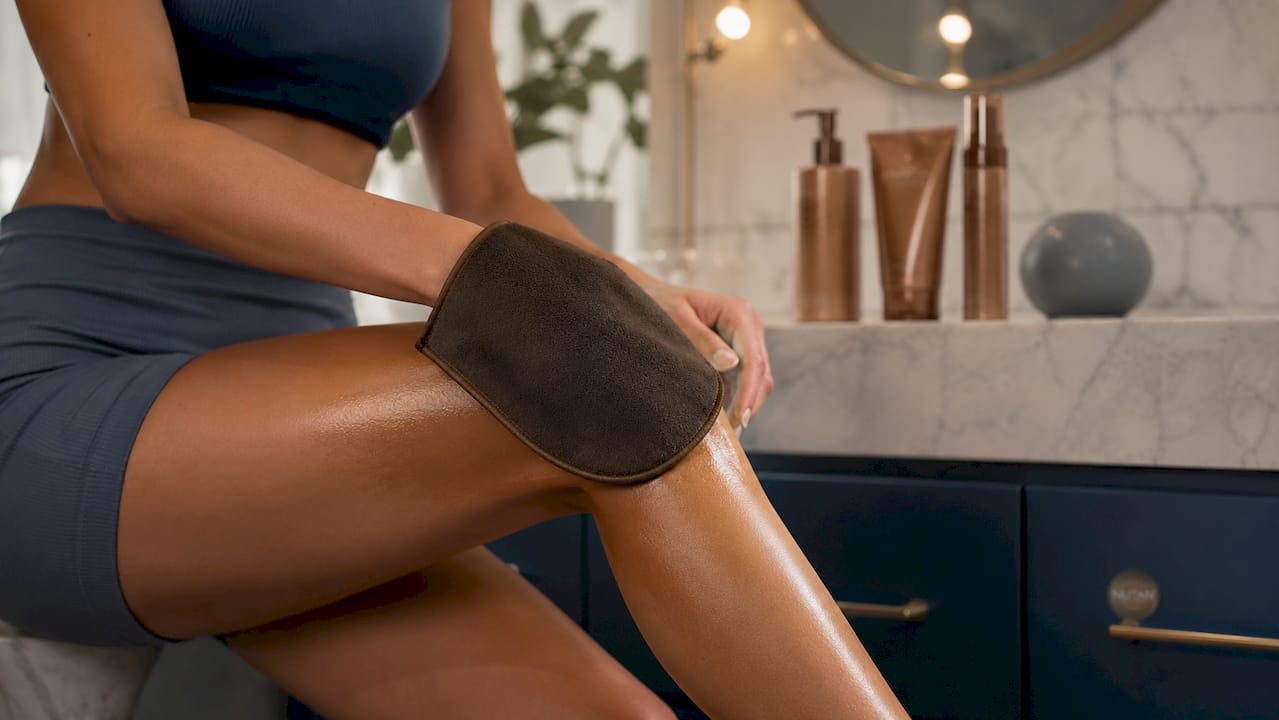
Mousses are lightweight and fast-drying. They deliver a deeper color faster than lotions, making them popular for people who want visible results within a few hours. Clear mousses let you see exactly where you have applied the product, which helps prevent missed spots.
Sprays and drops offer the most control over color intensity. Tanning drops mix into your daily moisturizer, allowing you to build color gradually over several days. This format suits people with sensitive skin or those new to sunless tanning.
All of these formats rely on DHA (dihydroxyacetone), a sugar-derived compound that reacts with amino acids in dead skin cells to produce a brown pigment. The reaction is entirely surface-level, which is why it poses no UV-related health risk.
Erythrulose blended with DHA creates a more natural, longer-lasting tan with less streaking. This combination is especially beneficial for mature or sensitive skin, where DHA alone can sometimes produce an uneven or orange-toned result.
Lotions: Best for beginners; slow-drying and easy to blend
Mousses: Fast-drying; ideal for deeper, quicker color
Drops: Mix into moisturizer; gradual color buildup
Sprays: Good for hard-to-reach areas; requires even application technique
DHA + Erythrulose blends: More natural tone, longer wear, less streaking
Pro Tip: Apply self-tanner in circular motions under good lighting. Systematic, circular application motions prevent missed spots, especially when using a clear tanning mousse that blends invisibly.
2. How does professional airbrush or spray tanning work?
Professional airbrush tanning is the fastest and most customizable non-invasive tanning method for event preparation. A trained technician applies a DHA solution to your skin using a fine-mist airbrush gun, covering the entire body in a single session.
Professional airbrush sessions last 15–20 minutes, with color development times ranging from 2–4 hours for express formulas to 18–24 hours for standard solutions. That flexibility means you can book a session the morning before an event or the evening before for a deeper result.
The process offers genuine customization. Technicians adjust the DHA concentration and tone to match your natural skin color, your desired depth, and even the undertone (warm golden versus cool bronze). This level of precision is difficult to replicate at home.
Here is what to expect from a professional airbrush session:
Consultation: The technician assesses your skin tone and discusses your color goal.
Preparation check: You arrive with clean, exfoliated skin and no moisturizer or deodorant.
Application: The technician applies the DHA solution in even, overlapping passes.
Drying: You stand still for 2–3 minutes while the solution sets. Airbrush tanning requires a proper drying and setting step to lock in the tan and maximize longevity.
Post-care instructions: Avoid water, sweat, and tight clothing for the development period.
Color reveal: Full color appears within the development window.
Safety is straightforward. Avoid inhaling the mist by breathing through a cloth or holding your breath during facial application. Reputable salons use ventilated booths or open-air application areas.
Pro Tip: Wear loose, dark clothing to your appointment. Tight fabric can rub the solution before it sets, causing uneven patches.
3. What innovative non-invasive tanning methods are emerging in 2026?
Patch-based tanning and gradual tanning moisturizers represent the most significant shift in sunless tanning in recent years. Both formats prioritize convenience and skin health over speed, which aligns with how modern beauty routines are evolving.
NuTan® tanning patches contain a natural MSH which stimulates the skins natural ability to tan over a short time, with minimal UV exposure offering a gradual, customisable tan needles. The patch technology is discreet, requires no mixing or blending, and fits easily into a daily routine. You simply apply the patch, wait, and let the patchwork gradually through the skin’s surface layer.
The benefits of patch-based tanning are distinct from other formats:
Gradual colour buildup: Results develop slowly, which reduces the risk of an unnatural or overly dark result
Discreet application: Patches sit flat against the skin and are easy to use at home or while traveling
No mess: No lotions, sprays, or drying time to manage
Customisable intensity: Use more or fewer patches to control depth of coloor
Needle-free and UV-free: A genuinely safe alternative to overuse of sunbeds and injection tanning risks
Gradual tanning moisturizers are another format gaining traction. These products combined with daily hydration build a color over 5–7 days of consistent use. The result looks natural because the color develops slowly, with minimal UV exposure you skin get a nautural tan. The combination with skincare agents aligns with growing consumer preference for multifunctional products that simplify routines.
4. How to prepare your skin and maintain results for the best non-invasive tan
Skin preparation determines whether a sunless tan looks natural or patchy. Skipping prep is the single most common reason for uneven results.
Thorough exfoliation before application removes dead skin cells and creates a smooth, even surface for the DHA reaction. Use a physical scrub or exfoliating mitt 24 hours before tanning. Avoid exfoliating immediately before application, as freshly scrubbed skin can be too sensitive.
Moisturizing dry areas like knees, elbows, ankles, and wrists before applying self-tanner prevents those spots from absorbing too much DHA. A light layer of moisturizer acts as a barrier, regulating pigment absorption on naturally drier patches.
Key preparation and maintenance steps:
Exfoliate 24 hours before: Remove dead skin for an even base
Shave or wax 24 hours before: Hair removal after tanning strips color
Moisturize dry patches: Apply a thin layer to knees, elbows, and ankles before tanning
Apply in sections: Work from ankles upward to avoid smudging
Wash hands immediately after: Palms absorb DHA quickly and can turn orange
Avoid water for 6–8 hours: Let the DHA reaction complete before showering
Moisturize daily after: Hydrated skin holds color longer; read more about hydration and tan longevity
Apply sunscreen outdoors: A tan appearance does not equal UV protection
Pro Tip: Use a tanning mitt for lotion and mousse application. Mitts distribute product evenly and keep your palms clean, which is the most practical upgrade for at-home tanning.
5. How do non-invasive tanning methods compare in safety and effectiveness?
Safety is the clearest dividing line between topical sunless tanning and other methods. DHA-based products carry no UV-related cancer risk and no infection risk. They are the only tanning methods with a consistent safety record backed by health authorities.
Injectable tanning products like Melanotan II are unauthorized and carry severe risks including infection, nerve damage, and unknown ingredients. Health authorities actively discourage their use. This is the clearest reason why non-invasive, topical methods are the responsible choice.
Red light therapy is a separate category that causes frequent confusion. Red light therapy devices do not stimulate melanin production or cause tanning. They emit visible red and near-infrared light for tissue repair only. No pigmentation change occurs. Expecting a tan from red light therapy leads to unsafe behavior, such as combining it with UV exposure to compensate.
Method | Safety | Color result | Longevity | Convenience |
DHA lotion/mousse | High | Natural, buildable | 5–7 days | At-home, easy |
Professional airbrush | High | Customizable, even | 5–10 days | Salon visit required |
Tanning patches (NuTan®) | High | Gradual, natural, real | Builds over days | At-home, no mess |
Gradual tanning moisturizer | High | Subtle, slow build | Ongoing with use | At-home, daily |
UV tanning (sunbed) | Low | Deep, fast | 1–2 weeks | Salon visit required |
Melanotan injections | Very low | Variable | Variable | Requires injection |
The safest non-invasive tanning methods are transdermal patches, DHA-based topical products and professional airbrush tanning. DHA-based topical products and professional airbrush tanning deliver a natural-looking color without UV exposure, infection risk, or needle use, whereas NuTan offer an actual tan with minimal UV exposure and without infection risk, or needle use. Sunless and less sun tanning products do not provide effective sun protection, so sunscreen remains essential after every application.
Key Takeaways
DHA-based topical products, professional airbrush tanning, and NuTan® transdermal patches are the safest and most effective non-invasive tanning methods available, each delivering a natural color without UV exposure or injection risk.
Point | Details |
DHA or a natural MSH is the active ingredient | DHA reacts with dead skin cells to produce colour safely, with no UV or health risk. MSH allows you to obtain an acutal tan naturally with minimal UV exposure. |
Preparation determines results | Exfoliate 24 hours before and moisturize dry areas to prevent patchiness. |
Patches offer a needle-free option | NuTan® tanning patches allow your body to absorb a inhouse formulated MSH gradually for a natural, customizable tan at home. |
Sunscreen is still required | Sunless tanners provide no UV protection; apply SPF every time you go outdoors. |
Red light therapy does not tan | Red light devices repair tissue only and cause no pigmentation or colour change. |
What I have learned from years of watching people tan the wrong way
The most common mistake people make is treating sunless tanning as a shortcut. They skip exfoliation, apply too much product at once, and then blame the method when the result looks patchy or orange. The method is not the problem. Preparation is.
DHA-based products have a genuinely strong safety record. The science is clear, the results are predictable, and the risk profile is as low as any cosmetic product gets. The people who get the best results treat application like a skincare routine, not a one-step fix. However, for a natural tan that can't rub off NuTan® tanning patches are the way forward.
Patch technology is the development I find most interesting right now. NuTan® tanning patches remove the mess and guesswork from at-home tanning entirely. For people who have tried lotions and mousses and found them frustrating, patches are worth trying. The gradual buildup also means the colour is natural than a single heavy application.
The one habit I see people skip most often is sunscreen. A tan appearance creates a false sense of protection. Sunless tanning products provide no UV defence, and SPF additives in some tanners are insufficient for meaningful protection. Apply a broad-spectrum SPF 30 or higher every time you go outside, regardless of how bronzed you look.
Stay radiant, stay safe.
— NuTan®
NuTan® patches: a cleaner way to achieve a gradual glow
Achieving a natural tan with minimal UV exposure or needles is exactly what NuTan® was designed for. NuTan® transdermal tanning patches deliver an in-house formulated MSH (Nutan MSH Complex B) gradually absorbs through the skin’s surface, building a customisable, sun-kissed colour at your own pace with minimal UV exposure.

The patches are pain-free, mess-free, and simple to use at home. NuTan® Triple Strength patches are among the brand’s most popular options, offering a deeper colour for those who want a more visible result. Shop the full range of NuTan® tanning patches and find the right strength for your skin tone. For a stronger glow, the triple strength formula delivers three times the tanning intensity in the same easy-to-use patch format.
FAQ
What is non-invasive tanning?
Non-invasive tanning is any method that creates a tan without UV radiation or with minimal UV exposure or injections, primarily using topical DHA-based products.
How long does a non-invasive tan last?
DHA-based self-tanners last 5–7 days, while professional airbrush tans can last up to 10 days with proper aftercare. Regular moisturizing and gentle cleansing extend results. NuTan™ patches last as long as you want once the tan you desire is acheived you pop a patch on once or twice per week to maintain the colour (you will still need UV exposure).
Are tanning patches safe to use?
NuTan® tanning patches apply an MSH transdermally and carry the same strong safety profile as other DHA-based topical products. They are needle-free, minimal UV exposure, and we designed for for at-home use.
Does red light therapy give you a tan?
Red light therapy does not cause tanning. These devices emit light for tissue repair only and produce no melanin stimulation or pigmentation change.
Do sunless tanners protect against sunburn?
Sunless tanners provide no meaningful UV protection. SPF additives in tanners are insufficient for sun defense, so applying a separate broad-spectrum sunscreen is necessary every time you go outdoors.
Recommended
Comments