

Role of alpha MSH in tanning: the science explained
Alpha-melanocyte-stimulating hormone (alpha-MSH) is the primary hormonal signal that triggers skin tanning by activating melanocortin-1 receptors (MC1R) on pigment-producing cells called melanocytes. Understanding the role of alpha MSH tanning reveals far more than simple skin darkening. This 13-amino acid peptide drives a biochemical cascade that shifts pigment production towards eumelanin, the brown-black pigment that offers superior UV protection, while simultaneously activating DNA repair pathways that work entirely independently of pigmentation. Research shows alpha-MSH reduces UV-induced DNA damage by 59% and cuts sunburn cells by over 50% through these pigmentation-independent mechanisms. That dual role makes alpha-MSH one of the most significant peptides in skin biology.
How does alpha MSH drive the tanning process?
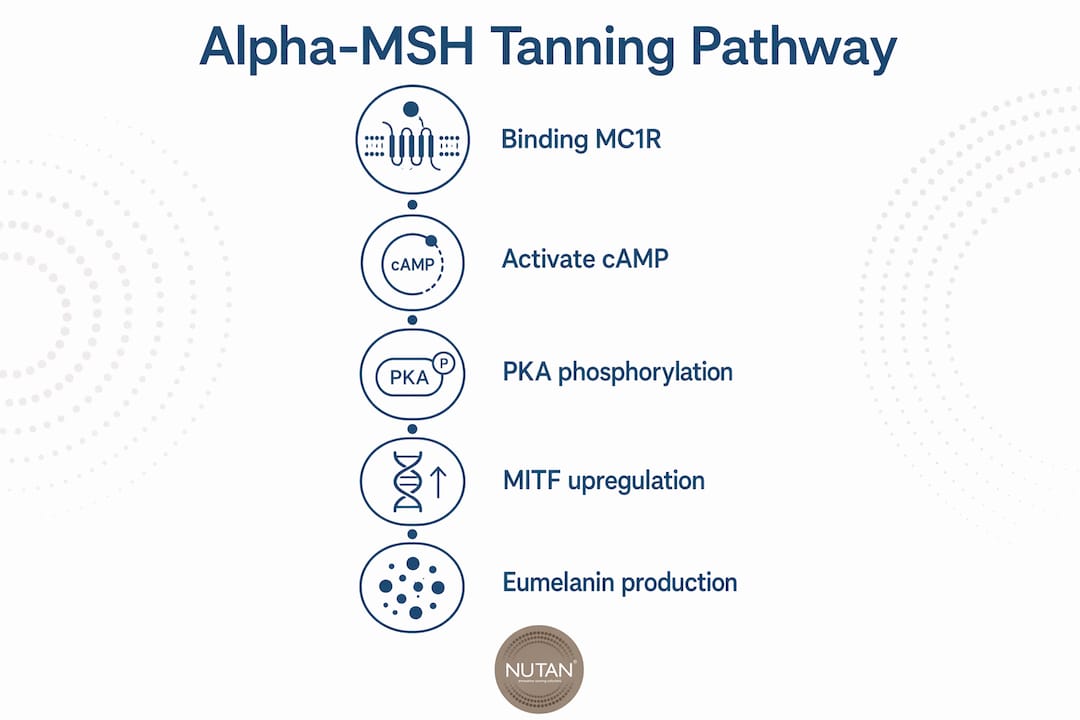
Alpha-MSH binds to the MC1R receptor on melanocytes with exceptionally high receptor affinity, measured at a Ki of approximately 0.23 nM. That binding strength means even small concentrations of the peptide produce a strong cellular response. Once MC1R is activated, it triggers the cyclic adenosine monophosphate and protein kinase A (cAMP/PKA) signalling pathway inside the melanocyte.
The cAMP/PKA pathway phosphorylates a transcription factor called CREB (cAMP response element-binding protein). Phosphorylated CREB then upregulates MITF, the master regulator of melanocyte identity and function. MITF in turn switches on the genes encoding melanogenic enzymes, most notably tyrosinase, the rate-limiting enzyme in melanin synthesis.
The result is a decisive biochemical switch. Melanocytes that were producing pheomelanin, the red-yellow pigment common in fair-skinned people, shift production towards eumelanin. This matters enormously for skin health. Eumelanin provides superior UV shielding and radical scavenging compared to pheomelanin, and it is strongly associated with lower melanoma risk. Pheomelanin, by contrast, can generate reactive oxygen species under UV exposure, actually increasing oxidative stress in skin cells.
Pigment type | Colour | UV protection | Melanoma association |
Eumelanin | Brown to black | High | Lower risk |
Pheomelanin | Red to yellow | Low | Higher risk |
Pro Tip: If you have fair skin that tends to burn rather than tan, your melanocytes are likely producing predominantly pheomelanin. Supporting MC1R activation through peptide-based approaches can help shift that balance towards the more protective eumelanin.
Understanding how body chemistry affects tanning helps clarify why two people can spend the same time in the sun and achieve very different results. The difference often comes down to MC1R function and the ratio of eumelanin to pheomelanin being produced.
What photoprotective effects does alpha MSH provide beyond pigmentation?
The photoprotective role of alpha-MSH extends well beyond skin darkening. Alpha-MSH enhances nucleotide excision repair (NER), the cellular mechanism that identifies and removes UV-induced DNA lesions called cyclobutane pyrimidine dimers (CPDs). This process relies on the XPA protein pathway and operates regardless of how much melanin is present in the skin.
This is a critical distinction. Most people assume a tan is protective purely because it blocks UV light. Alpha-MSH proves that assumption is incomplete. Even before visible pigmentation develops, the peptide is already priming skin cells to repair UV damage more efficiently.
Alpha-MSH also acts as an immunomodulator. It suppresses pro-inflammatory cytokines including TNF-α, IL-1β, and IL-6, which are released in skin tissue following UV exposure. Reducing these cytokines limits the inflammatory cascade that contributes to sunburn, chronic skin ageing, and immune suppression in the skin.
The key photoprotective effects of alpha-MSH include:
DNA repair activation: Upregulates NER to remove CPDs from both melanocytes and keratinocytes via the XPA-dependent pathway.
Sunburn cell reduction: Decreases sunburn cells by over 50%, reducing the visible and cellular signs of UV damage.
Anti-inflammatory action: Suppresses TNF-α, IL-1β, and IL-6, limiting post-UV inflammatory damage.
Oxidative stress reduction: The shift to eumelanin reduces reactive oxygen species generated by pheomelanin under UV light.
Immunomodulation: Modulates local immune responses in skin, supporting long-term skin health beyond acute sun protection.
Pro Tip: Do not assume that a visible tan means your skin is fully protected. Alpha-MSH’s DNA repair and anti-inflammatory benefits are active before pigmentation is visible. Supporting MC1R signalling early in the tanning process provides a layer of cellular protection that pigment alone cannot replicate.
What factors influence how effectively alpha MSH stimulates tanning?
Several biological and environmental factors determine how strongly alpha-MSH drives the tanning response. Genetics plays the most significant role. MC1R loss-of-function mutations are common in fair-skinned populations and directly explain why some people cannot tan effectively. These mutations reduce or eliminate the receptor’s ability to respond to alpha-MSH, leaving melanocytes defaulting to pheomelanin production and significantly increasing melanoma risk.
A natural antagonist called Agouti Signalling Protein (ASIP) competes directly with alpha-MSH at the MC1R binding site. ASIP blocks MC1R signalling, preventing the tanning cascade and pushing pigment synthesis back towards pheomelanin. Researchers are now investigating ASIP inhibition as a pharmacological strategy to restore alpha-MSH signalling in people with high ASIP activity or MC1R variants.
Environmental co-stimulation also matters. Alpha-MSH does not act alone. UV or inflammatory co-stimulation is required to trigger the full melanogenesis response. UV exposure causes keratinocytes to release pro-opiomelanocortin (POMC)-derived peptides including alpha-MSH itself, creating a feedback loop that amplifies the tanning signal. Without some level of UV or inflammatory trigger, the cascade remains incomplete.
Factor | Effect on alpha-MSH tanning response |
Functional MC1R | Strong eumelanin production and effective tanning |
MC1R loss-of-function mutation | Reduced or absent tanning; increased pheomelanin |
High ASIP activity | Blocks MC1R; suppresses tanning signal |
UV or inflammatory co-stimulation | Required to trigger full melanogenesis cascade |
Short alpha-MSH half-life | Limits duration of natural signalling without delivery support |
The pharmacokinetic reality of alpha-MSH also limits its natural effectiveness. Endogenous alpha-MSH has a half-life of only 10–20 minutes in circulation. That brief window means the natural peptide clears the system before sustained melanogenesis can be fully established. This pharmacokinetic limitation is precisely why synthetic analogs and advanced delivery systems have become the focus of serious research.
What are the applications of alpha MSH analogs for safer tanning?
The short half-life of natural alpha-MSH created the need for synthetic analogs capable of sustained MC1R activation. Afamelanotide is the most clinically advanced of these analogs. It is FDA-approved for photoprotection in patients with erythropoietic protoporphyria (EPP), a rare condition causing extreme UV sensitivity. Afamelanotide demonstrates that targeted MC1R activation can produce meaningful photoprotection in a regulated, clinical setting.
Unregulated alternatives present a very different picture. Melanotan II is a broad melanocortin receptor agonist that activates MC1R, MC3R, and MC4R simultaneously. Health authorities have issued warnings about its unregulated use, citing adverse effects and potential links to increased melanoma risk. The lack of receptor selectivity means it produces systemic effects well beyond skin pigmentation.
The practical solution lies in targeted delivery. Transdermal systems can deliver peptides directly through the skin, bypassing the rapid clearance that limits natural alpha-MSH. This approach maintains sustained receptor activation without the risks associated with injection-based methods. Non-invasive tanning methods that harness peptide science represent the most promising direction for people seeking a natural-looking tan with reduced UV exposure.
Key considerations when evaluating alpha-MSH analog applications:
Receptor selectivity: Selective MC1R agonists carry fewer systemic side effects than broad melanocortin agonists.
Delivery method: Transdermal delivery avoids injection risks and provides more controlled, sustained peptide release.
UV requirement: Even with analog support, minimal UV exposure remains part of the tanning process. The goal is to reduce that requirement significantly, not eliminate UV entirely.
Regulatory status: Only clinically approved analogs or well-formulated cosmetic peptide products offer a responsible path to MC1R activation.
NuTan® addresses these considerations directly. The NuTan® MSH-ComplexB formulation uses beta-melanocyte-stimulating hormone (b-MSH) derived from a natural source, delivered transdermally via patch. It activates MC1R to initiate the same biochemical cascade described throughout this article, producing a natural tan that does not wash or rub off. Pairing the patches with a broad spectrum SPF 70 sunscreen during any minimal UV exposure required is a sensible addition to the routine.
Key takeaways
Alpha-MSH is the master regulator of skin tanning, driving eumelanin production via MC1R activation while simultaneously enhancing DNA repair and suppressing inflammation, making it far more than a simple pigmentation signal.
Point | Details |
Alpha-MSH activates MC1R | Binding triggers the cAMP/PKA pathway, upregulating MITF and tyrosinase for melanin production. |
Eumelanin is the protective pigment | The shift from pheomelanin to eumelanin reduces oxidative stress and lowers melanoma risk. |
DNA repair is pigmentation-independent | Alpha-MSH enhances NER via XPA pathways, reducing UV-induced DNA lesions before visible tanning occurs. |
MC1R mutations and ASIP limit tanning | Genetic variants and the natural antagonist ASIP can block the tanning cascade entirely. |
Delivery systems overcome half-life limits | Transdermal peptide patches provide sustained MC1R activation that natural alpha-MSH cannot maintain alone. |
NuTan®'s perspective on alpha-MSH and tanning science
What strikes me most about alpha-MSH research is how thoroughly it reframes what tanning actually is. Most people still think of a tan as purely cosmetic. The science tells a different story. The same peptide that darkens your skin is also repairing DNA damage and suppressing inflammation. That dual function is not incidental. It is the body’s own photoprotection system working as designed.
What I find equally telling is the variability. Two people can have identical UV exposure and produce completely different tanning responses, purely because of MC1R genetics and ASIP activity. That variability is not a flaw in the system. It is a reminder that tanning is a biological process, not a cosmetic one, and it responds to biological inputs.
The practical implication is clear. Chasing a tan through prolonged UV exposure, when your MC1R function is compromised or ASIP is blocking the signal, is not just ineffective. It is counterproductive. The UV damage accumulates while the protective eumelanin response fails to materialise. Supporting MC1R activation directly, through well-formulated peptide delivery, is a far more rational approach. It works with your biology rather than against it.
The emergence of transdermal peptide delivery gives people a genuinely safer path to the sun-kissed glow they are looking for. That is not a marketing claim. It is the logical outcome of understanding the science.
— NuTan®
NuTan® patches: peptide-based tanning grounded in the science
The biochemistry of alpha-MSH points clearly towards one conclusion: effective, safer tanning requires MC1R activation, not simply more UV exposure.

NuTan® tanning patches deliver b-MSH transdermally, activating MC1R to initiate the same melanogenesis cascade described throughout this article. The result is a natural tan that builds gradually, does not wash off, and requires significantly less UV exposure than conventional tanning methods. The formulation uses a natural source for its active peptide, and the patch format eliminates the risks associated with injectable alternatives. For those who want the science working in their favour, NuTan® offers a straightforward, needle-free way to achieve it.
FAQ
What is the role of alpha MSH in tanning?
Alpha-MSH binds to MC1R receptors on melanocytes, triggering the cAMP/PKA pathway that upregulates melanin-producing enzymes and shifts pigment synthesis towards protective eumelanin. It also activates DNA repair mechanisms independently of pigmentation.
How does alpha MSH affect skin beyond darkening it?
Alpha-MSH enhances nucleotide excision repair to remove UV-induced DNA lesions and suppresses pro-inflammatory cytokines including TNF-α and IL-1β, providing cellular protection that operates before any visible tan develops.
Why do some people tan poorly despite sun exposure?
MC1R loss-of-function mutations prevent effective alpha-MSH signalling, causing melanocytes to default to pheomelanin production. High levels of the natural antagonist ASIP can also block MC1R, suppressing the tanning response entirely.
What is the difference between eumelanin and pheomelanin?
Eumelanin is the brown-black pigment associated with effective UV shielding and lower melanoma risk. Pheomelanin is the red-yellow pigment that offers poor UV protection and can generate oxidative stress under UV light.
How do transdermal patches relate to alpha MSH biology?
Natural alpha-MSH clears the body in 10–20 minutes, limiting its tanning effect. Transdermal peptide patches like those from NuTan® deliver b-MSH steadily through the skin, maintaining sustained MC1R activation for a more consistent and controlled tanning response.
Recommended
Comments