

What causes uneven tan: your complete 2026 guide
- Jul 4
- 8 min read

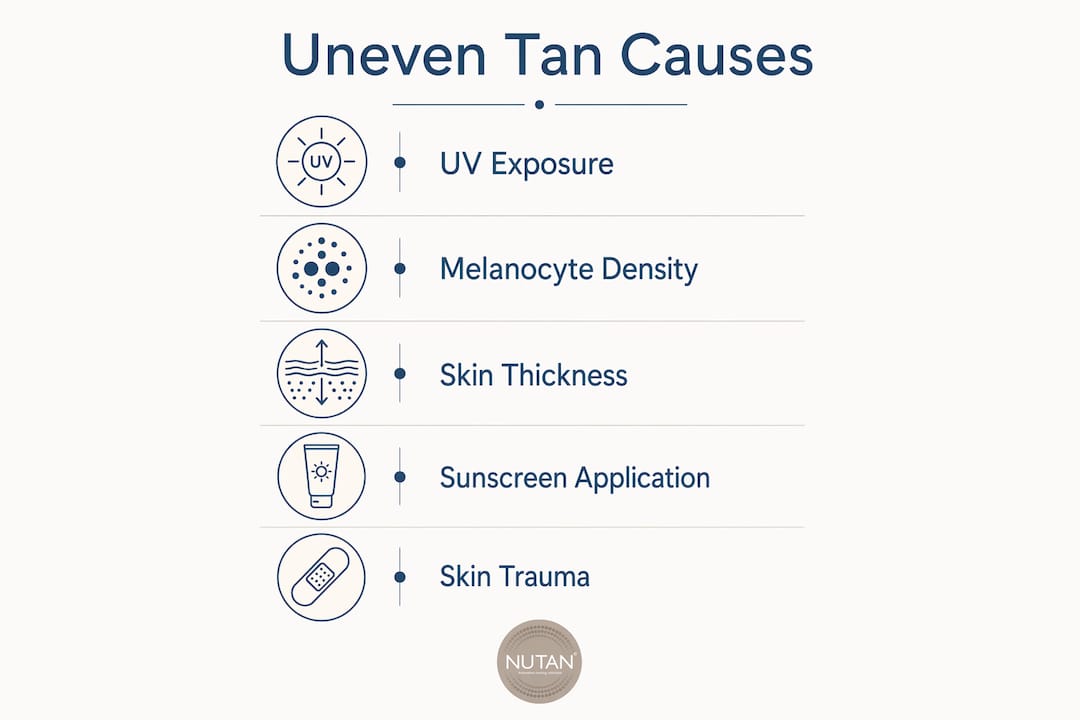
Uneven tanning is defined as inconsistent pigmentation across the body, caused by differences in UV exposure, melanocyte density, and skin condition from one area to another. Your face and shoulders tan faster than your inner thighs or stomach because melanin concentrations vary significantly by body region. Clothing coverage, posture, prior skin trauma, and skipped preparation steps all compound this natural variation. Understanding what causes uneven tan is the first step toward achieving a smooth, sun-kissed glow rather than a patchy, frustrating result. This guide covers the biology, the behavioural triggers, and the practical fixes.
What causes uneven tan: the biological truth
Uneven tanning is primarily driven by unequal UV exposure and varying melanocyte density across body regions. Melanocytes are the pigment-producing cells in your skin. Their density differs considerably depending on where you look on the body, which means some areas produce more melanin and darken more readily than others.
Body area | Melanocyte density | Skin thickness | Tanning tendency |
Face and shoulders | High | Thin to medium | Tans quickly |
Arms and legs | Medium | Medium | Tans moderately |
Elbows and knees | Medium | Thick and dry | Absorbs more pigment, patches easily |
Inner thighs and stomach | Low | Thin | Tans slowly |
Underarms | Low | Thin | Rarely exposed, tans least |
Skin thickness also plays a direct role. Thicker skin, such as on the elbows and knees, has a higher rate of cell turnover and tends to be drier. This causes those zones to absorb pigment differently and often appear darker or patchier after sun exposure. The result is a colour gradient across the body that no amount of extra sun time will fully correct without targeted preparation.
Skin texture adds another layer of complexity. Rough or textured skin holds pigment unevenly because the surface is not uniform. Smooth skin reflects and absorbs UV light more consistently, producing a more even result. This is why body chemistry and melanin density matter so much when planning any tanning routine.
How does UV exposure behaviour cause patchy skin?
Behavioural factors are responsible for a large share of tanning unevenness, and they are entirely preventable. Uneven sun exposure from posture, clothing, and shade creates the classic patchy tan pattern most people recognise: dark shoulders, pale sides, and untouched underarms.
The most common behavioural causes include:
Posture and body position. Lying on your back exposes your front evenly, but your sides and the backs of your knees receive far less direct UV light. Staying in one position too long creates clear lines of demarcation.
Clothing and accessories. Watch straps, bra straps, and waistbands create sharp tan lines. Even loose clothing casts shadows that block UV light from reaching the skin beneath.
Shade and movement. Sitting under a parasol for part of the day and then moving into full sun creates inconsistent exposure across a single session.
Sunscreen application gaps. Missed patches of skin, particularly on the back, sides, and behind the knees, receive unfiltered UV while protected areas tan more slowly. The contrast builds over multiple sessions.
Rapid tanning and sunburn. Tanning too quickly or burning causes the skin to peel. Peeling removes the top layer of pigmented cells unevenly, leaving splotchy areas that take weeks to settle.
Sunscreen is frequently blamed for blocking a tan, but uneven application is actually a leading cause of patchy results. Applying SPF carefully and consistently across all exposed skin produces a more uniform tan over time, not a lighter one.
Pro Tip: Rotate your position every 20–30 minutes during sun exposure. Front, back, and each side. This simple habit alone reduces positional patchiness significantly.
Does skin trauma make an uneven tan worse?
Skin trauma is one of the most overlooked causes of patchy pigmentation, and it is frequently mistaken for a tanning error. Post-inflammatory hyperpigmentation (PIH) occurs when healed skin injuries, such as acne scars, insect bites, or minor cuts, trigger excess melanin production after UV exposure. The result is darker patches that sit against lighter surrounding skin, worsening the appearance of an uneven tan.
The following skin conditions and habits contribute directly to PIH and patchy pigmentation:
Healed acne and blemishes. Even fully healed spots leave behind areas of elevated melanin activity. Sun exposure darkens these patches disproportionately.
Insect bites and minor abrasions. Any small wound that has healed can become a dark spot after UV exposure, particularly in people with medium to deeper skin tones.
Harsh scrubbing. Micro-trauma from aggressive scrubbing stimulates melanin production as a protective response. This paradoxically creates darker patches in areas you were trying to smooth.
Bleaching and harsh chemical products. Products that disrupt the skin barrier cause localised inflammation. Inflamed skin responds to UV by producing excess pigment, deepening unevenness.
Dehydration and skin stress. Dehydrated skin forms an uneven surface and compromises the melanin formation process. Dry skin also fades faster, making patchy areas more visible as the tan wears off.
Pro Tip: Switch to a gentle, sulphate-free body wash and apply a fragrance-free moisturiser twice daily. Keeping the skin barrier intact is the single most effective way to prevent PIH from worsening an existing uneven tan.
Hydration is not a cosmetic luxury in this context. Skin hydration directly affects how evenly melanin forms and how long a tan lasts. Dry skin sheds faster, and with it goes the pigment you worked to build.
What preparation mistakes lead to an uneven tan?
Most patchy tans are preventable with the right preparation. Exfoliating 24 hours before tanning and moisturising dry areas prevents the vast majority of streaks and uneven patches. Skipping either step is the most common preparation mistake sunbathers and self-tanners make.
Follow this preparation routine before any tanning session:
Exfoliate your entire body 24 hours before. Use a gentle body scrub or exfoliating mitt. Focus on the back, upper arms, and legs. Removing dead skin cells creates a uniform surface for pigment to develop on.
Moisturise dry and rough zones. Apply a thick, fragrance-free moisturiser to elbows, knees, ankles, and wrists the night before. Joints like elbows and knees have thicker, drier skin that absorbs pigment faster, so pre-moisturising slows that absorption and balances the result.
Shower and pat dry gently. Avoid rubbing the skin aggressively before tanning. Pat dry with a soft towel to avoid micro-trauma.
Apply SPF evenly to all exposed areas. Do not rush this step. Use a broad-spectrum SPF 30 or higher and cover every exposed surface, including the sides of the torso and behind the ears.
Avoid tight clothing immediately after. Friction from waistbands and bra straps removes surface pigment before it has time to set, creating sharp, unnatural lines.
Pro Tip: Apply a slightly thicker layer of SPF or a barrier cream to your elbows, knees, and ankles before sun exposure. This slows pigment absorption in these naturally darker zones and brings them closer in line with the rest of your body.
Preparation is not optional if you want an even result. Skipping exfoliation and moisturising is the equivalent of painting over a rough, uneven wall and expecting a smooth finish.
How to fix an uneven tan safely
Correcting a patchy tan requires patience and a gentle approach. Aggressive treatments worsen the problem by triggering additional melanin production through micro-trauma. The goal is to fade overexposed areas and gradually build pigment in lighter patches until the overall tone evens out.
Correction method | Benefit | Caution |
Gentle exfoliation bath | Fades darker patches by removing pigmented surface cells | Use lukewarm water and a soft cloth only; avoid scrubbing |
Mixed self-tanner and moisturiser | Builds pigment gradually on pale spots without overloading | Apply in thin layers; allow each layer to develop fully before adding more |
Deliberate sun positioning | Balances exposure by targeting underexposed areas | Use SPF on already-dark zones to prevent further deepening |
SPF layering on dark patches | Slows further darkening of overexposed areas | Reapply every two hours for consistent protection |
Gradual self-tan product | Allows controlled colour build-up across the whole body | Avoid applying directly to joints without prior moisturising |
The most important rule when correcting a patchy tan is to avoid “panic-applying” extra product to light patches. Layering too much product quickly creates an unnatural build-up that is harder to correct than the original patchiness. Blend gradually, allow the skin to respond, and repeat over several days rather than one session.
Deliberate sun positioning combined with SPF layers is the most effective natural correction method. Expose underexposed areas to direct sunlight while keeping already-dark zones protected. This gradual rebalancing approach takes time but produces the most natural result.
Key takeaways
Uneven tanning results from a combination of biological variation in melanocyte density, behavioural exposure habits, and skin condition, all of which are manageable with the right preparation and correction approach.
Point | Details |
Melanocyte density varies by area | Face and shoulders tan faster; inner thighs and stomach tan more slowly due to lower melanin concentration. |
Preparation prevents most patchiness | Exfoliating 24 hours before and moisturising dry zones prevents the majority of uneven results. |
Skin trauma worsens unevenness | PIH from healed acne, bites, or harsh scrubbing causes dark patches that deepen with UV exposure. |
Gradual correction is safest | Mixing self-tanner with moisturiser and deliberate sun positioning corrects patchiness without triggering further melanin response. |
Hydration is non-negotiable | Dehydrated skin fades unevenly and sheds pigment faster, making patchy areas more pronounced over time. |
Why patience is the most underrated tanning advice
After years of working closely with tanning science and skin health, one truth stands out above all the preparation tips and correction methods: most people want to fix an uneven tan in a single session, and that urgency is exactly what makes it worse.
The skin’s melanin system is not designed to respond instantly or uniformly. It responds to signals, and when you overload it with aggressive scrubbing, excess product, or prolonged UV exposure in one sitting, it produces pigment erratically. The result is the very patchiness you were trying to avoid.
What actually works is consistency over time. A gentle exfoliation routine, daily moisturising, and measured UV exposure or controlled pigment-building sessions produce far more even results than any quick fix. The skin barrier is the foundation of everything. When it is intact and well-hydrated, melanin forms more uniformly and the tan holds longer.
The uncomfortable truth is that many people with chronically uneven tans have underlying skin barrier damage from years of harsh products or over-exfoliation. Rebuilding that barrier takes weeks of gentle care before tanning results improve meaningfully. That is not a failure. That is simply how skin biology works, and respecting it produces better outcomes than fighting it.
— NuTan
A smarter way to tan with NuTan®
Uneven tanning often comes down to the unpredictability of UV exposure and how differently each patch of skin responds to it. NuTan® was developed to address exactly that.

NuTan® transdermal tanning patches use the NuTan MSH-ComplexB formulation, which contains a naturally sourced Beta-melanocyte-stimulating hormone (b-MSH). This active ingredient binds to the Melanocortin 1 Receptor (MC1R) on your skin’s melanocytes, triggering natural pigment production from within. Because the process is driven biochemically rather than by direct UV exposure, you achieve a natural-looking tan with over 70% less UV exposure than traditional tanning methods require. The tan does not wash off or rub away. For anyone tired of patchy results and unpredictable sun sessions, NuTan® tanning patches offer a calmer, more consistent path to a golden glow.
FAQ
What causes uneven tan on the body?
Uneven tanning is caused by differences in melanocyte density, skin thickness, and UV exposure across body areas. Face and shoulders tan faster than inner thighs and stomach because they have higher melanin concentrations and receive more direct sunlight.
Why is my tan patchy after sun exposure?
Patchy tans typically result from uneven sunscreen application, posture during sun exposure, or prior skin trauma such as healed acne or insect bites triggering post-inflammatory hyperpigmentation.
How do I fix an uneven tan at home?
Gentle exfoliation baths fade darker patches, while mixing a gradual self-tanner with moisturiser builds pigment slowly on lighter areas. Avoid applying extra product in one go, as this worsens unevenness.
Does dehydrated skin cause a patchy tan?
Yes. Dehydrated skin sheds surface cells faster and forms an uneven texture, causing pigment to develop and fade inconsistently. Daily moisturising is one of the most effective ways to maintain an even tan.
How long before tanning should I exfoliate?
Exfoliate 24 hours before any tanning session. This removes dead skin cells without leaving the skin sensitised, creating a smooth, uniform surface for pigment to develop evenly.
Recommended
Comments