

Why skin darkens after sun: the science explained
- Jul 3
- 8 min read

Skin darkens after sun exposure because ultraviolet (UV) radiation triggers the skin to produce more melanin, its primary pigment, as a direct protective response to cellular damage. This process, known as melanogenesis, is the body’s attempt to shield deeper tissue from further harm. Understanding why skin darkens after sun exposure reveals a biological paradox: the very tan that signals protection also confirms that DNA damage has already occurred. Two distinct UV wavelengths drive this response. UVA causes immediate darkening by oxidising existing melanin, while UVB stimulates the production of entirely new melanin over several days.
Why skin darkens after sun: the cellular mechanism
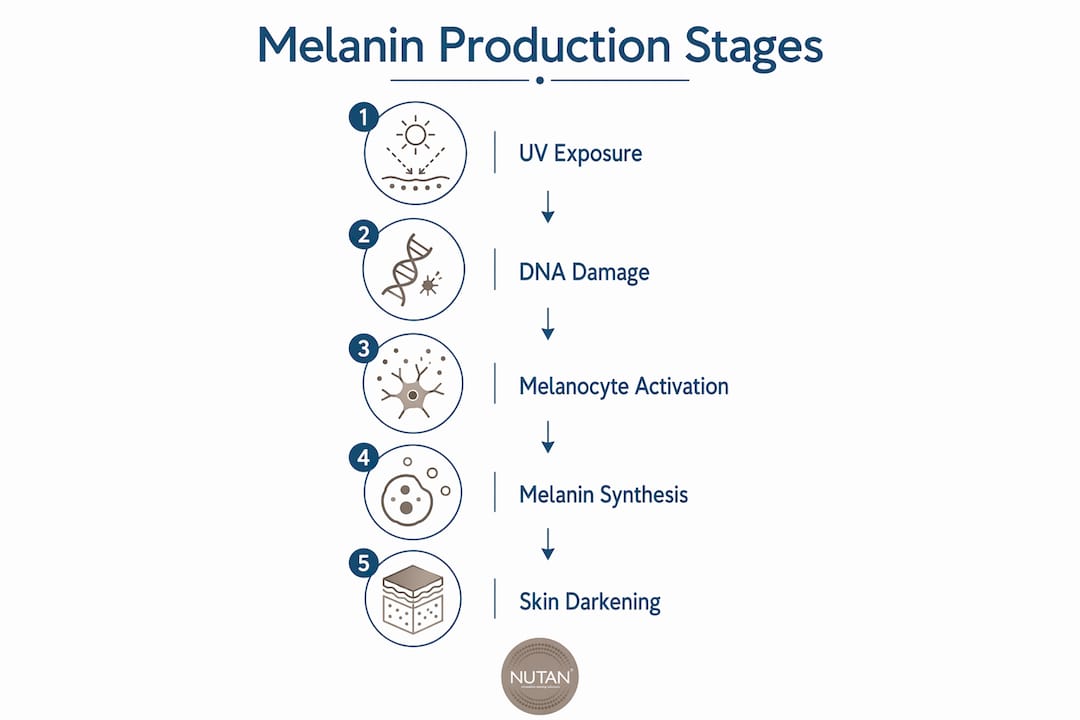
Melanogenesis is the formal term for the process that causes skin darkening after sun exposure. It begins in specialised cells called melanocytes, which sit at the base of the epidermis and produce melanin in small structures called melanosomes. When UV radiation strikes the skin, it causes direct DNA damage in the form of cyclobutane pyrimidine dimers (CPDs). This photodamage signals the melanocytes to increase melanin production, which then transfers upward into surrounding skin cells, creating the visible darkening we associate with a tan.
Two types of melanin exist in human skin. Eumelanin is brown to black in colour and provides stronger UV protection. Pheomelanin is yellow to red and offers far less shielding. People with naturally darker skin produce predominantly eumelanin, while those with fairer skin produce more pheomelanin. This distinction matters because eumelanin absorbs UV energy more effectively, which is why skin tone influences both the speed and depth of tanning.
The tanning response actually has two phases. UVA radiation causes an immediate darkening within hours by oxidising and redistributing existing melanin already present in the skin. This effect is quick but temporary. UVB radiation, by contrast, triggers the synthesis of entirely new melanin, producing a delayed tan that appears two to three days after exposure and lasts considerably longer.
The skin also responds to UV exposure by thickening the outer layer, the stratum corneum. This physical adaptation adds a modest additional barrier against further radiation. However, neither melanin production nor skin thickening eliminates the underlying DNA damage that triggered them.
Melanocytes produce melanin in response to UV-induced DNA damage.
Eumelanin (brown/black) offers stronger UV protection than pheomelanin (yellow/red).
UVA causes immediate, temporary darkening through melanin oxidation.
UVB triggers delayed, longer-lasting tanning through new melanin synthesis.
Skin thickening provides additional but limited physical protection.
Pro Tip: Applying a broad-spectrum sunscreen before sun exposure does not prevent tanning entirely, but it significantly reduces the DNA damage that drives melanogenesis.
How does melanin protect the skin, and what are its limits?
Melanin absorbs UV energy and converts it to heat, preventing radiation from penetrating deeper into the skin where it could damage blood vessels, nerves, and immune cells. This absorption is genuinely protective, but the degree of protection a natural tan provides is modest. A natural tan provides only around SPF 3. That means tanned skin can tolerate roughly three times more UV exposure than untanned skin before equivalent damage occurs. For context, most dermatologists recommend SPF 50 or higher for daily sun protection.
The deeper problem is that the tan itself is evidence of prior harm. Natural tanning requires DNA damage to trigger melanin synthesis, making the protective response inseparable from the injury that caused it. Relying on a tan as a “base” before a holiday is a common misconception. The tan signals that harmful UV exposure has already occurred, not that the skin is now safe.
Key limitations of melanin as sun protection:
SPF 3 is the approximate protection level of a deep tan, far below the SPF 30–50 recommended by dermatologists.
Melanin does not repair existing DNA damage; it only limits further penetration.
Cumulative UV exposure causes photoaging, actinic keratoses, and increased skin cancer risk regardless of pigmentation level.
Physical sunscreens and clothing provide protection without requiring prior DNA damage.
What causes hyperpigmentation and sunspots after sun exposure?
Skin darkening after sun exposure is not always uniform. Localised overproduction of melanin produces distinct pigmentation conditions that differ from general tanning. UV exposure stimulates melanocytes to produce excess melanin in concentrated areas, causing darker patches that persist long after a tan fades.
Tanning versus hyperpigmentation
General tanning is a diffuse, relatively even darkening across exposed skin. Hyperpigmentation is localised and often irregular. The distinction matters because hyperpigmentation can indicate underlying cellular dysfunction, hormonal influence, or post-inflammatory changes rather than a straightforward UV response.
Type | Cause | Appearance |
Suntan | Diffuse UV-induced melanogenesis | Even darkening across exposed areas |
Melasma | Hormonal triggers combined with UV exposure | Symmetrical patches on face |
Solar lentigines (sunspots) | Chronic UV exposure causing localised melanocyte clusters | Flat, well-defined brown spots |
Post-inflammatory hyperpigmentation | Melanin overproduction following skin injury or inflammation | Dark marks at sites of previous spots or wounds |
Melasma is particularly common in women during pregnancy or when taking hormonal contraceptives, because oestrogen amplifies the melanocyte response to UV. Solar lentigines, commonly called sunspots or age spots, result from years of cumulative UV exposure causing permanent clusters of overactive melanocytes. Post-inflammatory hyperpigmentation follows any skin trauma, from acne to cuts, where the healing process triggers excess melanin production.
Melanocytes have memory, which means hyperpigmentation tends to return if sun protection is inadequate after treatment. This persistence is why managing these conditions requires consistent, long-term sun protection rather than a single course of treatment.
Avoid direct sun exposure on hyperpigmented areas whenever possible.
Apply SPF 50 sunscreen daily, even in overcast conditions.
Seek shade between 11AM and 3PM when UV intensity peaks.
Wear wide-brimmed hats and UV-protective clothing over affected areas.
How does skin type affect darkening and UV damage?
Baseline melanin levels vary significantly across skin tones, and this variation shapes how the skin responds to UV radiation. People with naturally darker skin have more melanin and produce it more efficiently, which provides a degree of inherent UV protection. However, darker skin accumulates DNA damage similarly to lighter skin, even when the visible signs appear later or less obviously.
This delayed presentation creates a real clinical risk. Signs of sun damage in darker skin are often less obvious, leading to underrecognition and later diagnosis of photoaging or skin cancer. The assumption that dark skin is immune to UV harm is one of the most persistent and dangerous myths in skincare. Skin cancer, including melanoma, occurs across all skin tones.
Understanding how body chemistry affects tanning helps explain why two people with similar skin tones can respond very differently to the same amount of sun exposure. Genetics, hormonal status, medication use, and even diet influence melanocyte activity and the speed of melanin production.
Fair skin (Fitzpatrick types I–II): Burns quickly, tans minimally, the highest risk of UV-induced DNA damage.
Medium skin (Fitzpatrick types III–IV): Tans more readily, moderate burn risk, still accumulates significant UV damage.
Darker skin (Fitzpatrick types V–VI): Tans deeply, lower burn risk, but not immune to photoaging or skin cancer.
All skin types benefit from broad-spectrum SPF 50 sunscreen applied daily.
What practical steps protect skin and manage darkening after sun?
Sun protection is the single most effective way to prevent both UV-induced skin darkening and the DNA damage that drives it. Broad-spectrum sunscreen with at least SPF 50 blocks both UVA and UVB radiation. Apply it 20 minutes before going outdoors and reapply every two hours, or immediately after swimming or sweating.
Physical barriers add meaningful protection that sunscreen alone cannot provide. Tightly woven clothing, UV-protective swimwear, and wide-brimmed hats reduce UV exposure to covered skin by a significant margin. Seeking shade between 11AM and 3PM, when UV index peaks in the UK from may through august, cuts cumulative exposure substantially.
Apply SPF 50 broad-spectrum sunscreen 20 minutes before outdoor activity and reapply every two hours.
Wear UV-protective clothing and hats to physically block radiation from reaching the skin.
Seek shade during peak UV hours (11AM to 3PM) to reduce cumulative exposure.
Use after-sun products containing aloe vera or niacinamide to calm inflammation and support skin recovery.
Avoid tanning beds entirely. They emit concentrated UVA radiation and increase the risk of photoaging and skin cancer.
Explore non-UV tanning options such as non-invasive tanning methods that stimulate melanin production without requiring UV-induced DNA damage.
Pro Tip: Vitamin C serums applied in the morning help neutralise free radicals generated by UV exposure and can reduce the appearance of existing pigmentation over time.
Hydration also plays a supporting role. Well-hydrated skin maintains a healthier barrier function, which helps regulate the inflammatory response that can trigger post-inflammatory hyperpigmentation. Drinking adequate water and using a moisturiser with ceramides or hyaluronic acid after sun exposure supports faster skin recovery.
Key takeaways
Skin darkens after sun exposure because UV radiation triggers melanin production as a protective response, but this protection is limited and always follows DNA damage.
Point | Details |
Melanin is a protective response | UV radiation causes DNA damage first; melanin production follows as the skin’s defence mechanism. |
A tan provides only SPF 3 | Natural tanning offers minimal UV protection and should never replace sunscreen or physical barriers. |
Hyperpigmentation has distinct causes | Melasma, sunspots, and post-inflammatory pigmentation each have specific triggers that UV exposure worsens. |
All skin tones accumulate UV damage | Darker skin delays visible signs but does not prevent DNA damage, photoaging, or skin cancer risk. |
Prevention outperforms treatment | Daily SPF 50 sunscreen and physical protection are more effective than managing pigmentation after it forms. |
The tan myth: what the science actually tells us
People often ask whether a base tan before a holiday makes sun exposure safer. The honest answer is no, and the science is unambiguous on this point. A tan is not a sign that your skin is ready for more sun. It is a sign that your skin has already been harmed.
What strikes me most, having worked closely with skincare science and the biology of melanin, is how effectively the beauty industry has reframed a damage response as a desirable outcome. The golden glow that people associate with health and vitality is, at the cellular level, the skin’s emergency signal. Melanocytes produce more pigment because they are trying to protect you from something that is already hurting you.
The second misconception I encounter constantly is the belief that darker skin is simply immune to sun damage. Clinically, this is false. The damage accumulates just as it does in lighter skin. The difference is that it often presents later and less visibly, which means it gets diagnosed later. That delay is not protection. It is a diagnostic blind spot.
The most grounded approach to tanning is to separate the aesthetic goal from the UV exposure. A sun-kissed glow does not require DNA damage to achieve. Safer alternatives that work with the skin’s own melanin pathways, rather than forcing the skin to defend itself, represent a genuinely better option for anyone who wants colour without the long-term cost.
— NuTan
A safer way to build a natural tan
For those who want a genuine tan without the DNA damage that UV exposure causes, NuTan® offers a clinically considered alternative.
NuTan® transdermal tanning patches use the brand’s in-house formulated NuTan MSH-ComplexB, a natural source Beta-melanocyte-stimulating hormone (b-MSH) that binds directly to the Melanocortin 1 Receptor (MC1R) on melanocytes. This activates the same biochemical pathway that sunlight triggers, producing a gradual, natural-looking tan with minimal UV exposure. The result is a sun-kissed colour that develops safely, without burning, photoaging, or the cumulative risks of over UV tanning beds. Explore the full range of NuTan® tanning patches and find the option that suits your skin tone and lifestyle.
FAQ
Why does skin darken after sun exposure?
Skin darkens after sun exposure because UV radiation damages DNA in skin cells, triggering melanocytes to produce more melanin as a protective response. This process, called melanogenesis, creates the visible darkening known as a tan.
How long does it take for skin to darken after sun exposure?
UVA radiation causes immediate darkening within hours by oxidising existing melanin. UVB-induced tanning, which involves new melanin synthesis, typically becomes visible two to three days after exposure.
Does a tan protect skin from further UV damage?
A natural tan provides only around SPF 3 protection, which is far below the SPF 30–50 recommended by dermatologists. Relying on a tan as sun protection significantly underestimates the ongoing risk of UV-induced DNA damage.
Can darker skin tones still get sun damage?
Yes. Darker skin accumulates UV-induced DNA damage similarly to lighter skin, though visible signs such as wrinkles and sunspots may appear later. All skin tones require daily broad-spectrum sun protection.
What is the difference between a tan and hyperpigmentation?
A tan is a diffuse, even darkening caused by UV-stimulated melanin production across exposed skin. Hyperpigmentation is localised overproduction of melanin, often triggered by hormones, inflammation, or chronic UV exposure, producing irregular darker patches such as melasma or sunspots.
Recommended
Comments