

What is controlled tanning: your safe bronzing guide

Controlled tanning is defined as the practice of achieving a gradual, bronzed skin tone through regulated exposure to ultraviolet light, managed by timing, lamp type, and session frequency. Unlike stepping outside and hoping for the best, this approach treats UV exposure as something to be measured and managed. The goal is to build melanin steadily, support vitamin D synthesis, and reduce the risk of burning. It is not a risk-free method. It is a managed one. Understanding what controlled tanning involves, and how it differs from simply lying in the sun, is the first step towards making genuinely informed choices about your skin.
How does the controlled tanning process work?
The controlled tanning process relies on delivering a calibrated dose of UV radiation to the skin within a structured session. The two primary technologies used in salons are low-pressure and high-pressure tanning beds, and they behave very differently. Low-pressure lamps emit a broad spectrum of UVA and UVB light, similar in composition to natural sunlight. High-pressure beds concentrate predominantly UVA output, producing visible results in fewer sessions than natural sunlight. That speed comes with a trade-off: higher UVA intensity demands more precise timing.

Salons are legally required to post a Recommended Exposure Schedule for each tanning device. This schedule accounts for the specific irradiance of each lamp type, meaning the timing for one bed is not interchangeable with another. Non-compliance with these schedules is a leading cause of unexpected burns and skin injury. The schedule is not a suggestion. It is the framework that makes the process “controlled” in any meaningful sense.
Session lengths typically run between 5–20 minutes, depending on the device and your skin type. The science of melanin production explains why gradual exposure matters: melanocytes in the skin produce melanin in response to UV stimulation, and that process takes time to build cumulatively. Rushing it by extending sessions does not accelerate results. It accelerates damage.
Identify your skin type using the Fitzpatrick scale before your first session.
Follow the salon’s posted exposure schedule for the specific bed you are using.
Wear certified UV-protective eyewear during every session without exception.
Begin with shorter sessions and increase duration only as your skin adapts.
Allow at least 48 hours between sessions to let melanin development progress.
Pro Tip: Ask your salon to show you the lamp certification and the exposure schedule for the exact bed you are using. If they cannot produce it, choose a different facility.
What are the benefits of controlled tanning?
Controlled tanning offers several genuine advantages over unmanaged sun exposure, provided sessions are conducted responsibly. The most significant practical benefit is consistency. Regulated sessions allow a deliberate build-up of a base tan, reducing the likelihood of severe burning when you spend time outdoors. That base tan is not sunscreen, but it does provide a modest degree of natural protection by increasing melanin density in the skin.
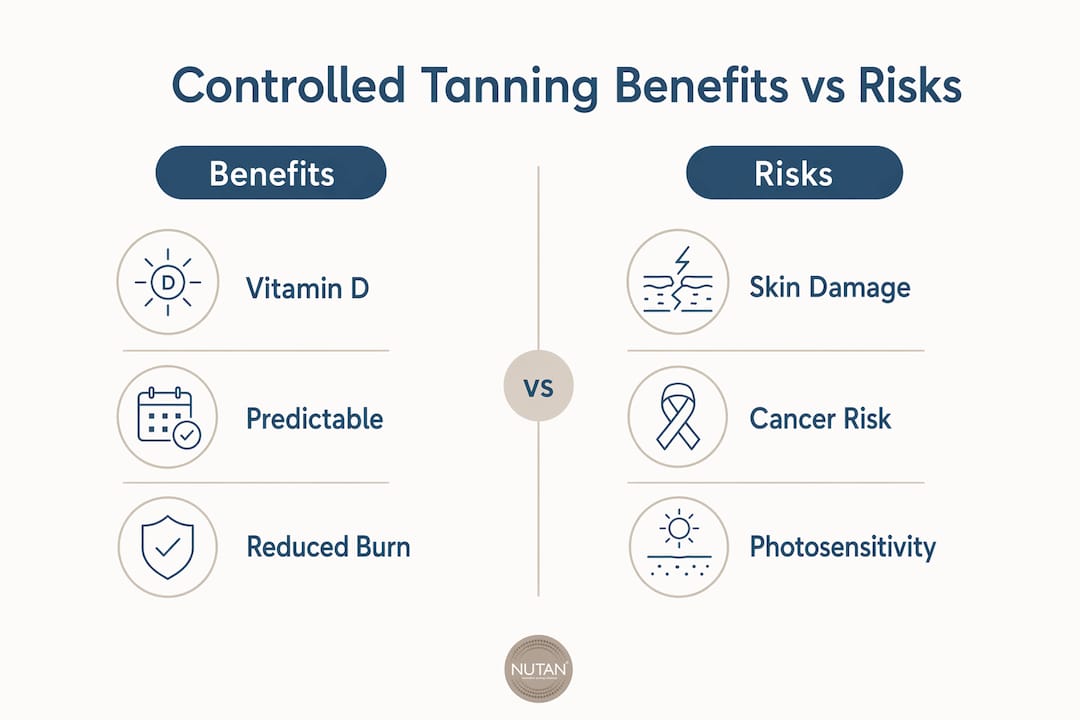
Vitamin D synthesis is another frequently cited benefit. Moderate UVB exposure triggers the skin to produce vitamin D3, which supports bone density and immune function. This is particularly relevant in the United Kingdom, where low sunlight levels for much of the year leave many people deficient. However, many tanning beds use predominantly UVA lamps with limited UVB output, which means vitamin D production from indoor tanning varies considerably by bed type. If vitamin D is your primary concern, supplementation is a more reliable route.
The cosmetic and psychological benefits are also worth acknowledging honestly. A sun-kissed glow tends to improve how people feel about their appearance, and there is evidence that regulated UV exposure can lift mood, particularly during winter months. Year-round availability and sessions as short as 5 minutes make controlled tanning accessible regardless of weather or season. That convenience is a real advantage for anyone who burns quickly outdoors or lives in a climate with limited sunshine.
Key benefits at a glance:
Builds a base tan gradually, reducing outdoor burn risk
Supports vitamin D3 production with moderate UVB exposure (bed type dependent)
Delivers consistent UV doses, unlike variable natural sunlight
Available year-round, independent of weather conditions
Can improve mood through regulated UV exposure during low-sunlight months
Useful for certain therapeutic applications such as psoriasis, under dermatologist supervision
What are the risks and safety considerations?
Controlled tanning is safer than reckless sun exposure. It is not safe in absolute terms. The World Health Organisation classifies tanning bed use as a Group 1 carcinogen. That classification means the evidence for a causal link to cancer is sufficient and established, not theoretical. UV radiation causes cumulative DNA damage to skin cells with every session, regardless of how carefully timed that session is.
The risks associated with UV exposure include:
Premature skin ageing, including wrinkles and loss of elasticity
Increased risk of melanoma and non-melanoma skin cancers
Eye injury, including cataracts and photokeratitis, if protective eyewear is not worn
Immune suppression with repeated high-dose UV exposure
Unpredictable burns when exposure schedules are not followed
Regulatory frameworks exist precisely because these risks are real. The FDA in the United States and equivalent bodies in the UK require salons to display exposure guidelines and restrict use for minors. These rules exist to manage harm, not to eliminate it. Moderation and strict adherence to guidelines reduce risk. They do not remove it.
Pro Tip: If you have a history of skin cancer, are on photosensitising medications, or have a skin condition such as lupus, consult a dermatologist before any UV tanning session. Your individual risk profile matters far more than general guidelines.
Moisturising your skin before and after sessions also supports skin integrity. Hydrated skin is more resilient to UV stress. The role of hydration in tanning is often underestimated, but well-moisturised skin tans more evenly and recovers more effectively between sessions.
How does controlled tanning compare with natural tanning?
The core difference between controlled tanning and natural sun exposure is predictability. Natural tanning is subject to a wide range of variables: cloud cover, time of day, season, latitude, altitude, and skin reflectance from surfaces like water or sand. These factors make it genuinely difficult to know how much UV your skin is receiving at any given moment. Controlled tanning removes most of those variables.
Factor | Controlled tanning | Natural sun tanning |
UV dose consistency | High. Calibrated by lamp type and timer | Low. Varies with weather, season, and geography |
Session duration | 5–20 minutes, precisely timed | Unpredictable. Dependent on conditions |
Vitamin D production | Variable. Depends on UVB lamp content | Generally effective in strong sunlight |
Risk of burning | Reduced when schedules are followed | Higher due to variable UV intensity |
Year-round access | Yes, regardless of weather | No. Seasonal and climate dependent |
UV damage risk | Present with every session | Present with every session |
Consistency and control are the primary advantages of indoor tanning over natural sunlight. That predictability helps people who burn easily manage their exposure more deliberately. However, both methods expose skin to harmful UV radiation with cumulative effects. The controlled environment reduces unpredictable overdosing. It does not change the fundamental biology of UV damage. Understanding how body chemistry affects tanning helps explain why two people following identical schedules can achieve very different results.
Practical tips for safe and effective controlled tanning
Safe controlled tanning requires discipline, not just good intentions. The most common mistake people make is extending sessions because they feel fine during them. UV damage is not felt in real time. Redness and soreness appear hours later, by which point the damage is already done.
Follow the exposure schedule strictly. The posted schedule for your specific bed is calibrated to its lamp output. Overriding it is the primary cause of burns.
Limit session frequency. Allow a minimum of 48 hours between sessions. Melanin development continues after you leave the salon.
Wear certified UV-protective eyewear. Standard sunglasses do not provide adequate protection inside a tanning bed. Use eyewear rated for tanning bed use.
Moisturise before and after every session. Hydrated skin tans more evenly and is less prone to peeling, which can disrupt the base tan you are building.
Consult a healthcare provider if you have any skin conditions, take regular medication, or have concerns about vitamin D levels.
Consider UV-reducing alternatives. NuTan® tanning patches work by activating the Melanocortin 1 Receptor (MC1R) on melanocytes, stimulating natural pigment production with vastly less UV exposure than conventional tanning methods. For those who want a natural-looking tan with reduced UV risk, non-invasive tanning methods are worth understanding before committing to a UV-based routine.
Pro Tip: Track your sessions in a simple log: date, bed type, duration, and how your skin responded. After four to six sessions, you will have a clear picture of how your skin reacts and can adjust accordingly.
Key takeaways
Controlled tanning is a safety-managed UV exposure technique that reduces unpredictable burning but does not eliminate the cumulative skin damage caused by ultraviolet radiation.
Point | Details |
Definition | Controlled tanning uses regulated UV exposure to build melanin gradually and support vitamin D synthesis. |
Process | Session timing, lamp type, and posted exposure schedules are the three pillars of safe controlled tanning. |
Benefits | Consistency, year-round access, and base tan development are the main practical advantages over natural sunlight. |
Risks | WHO classifies tanning bed use as a Group 1 carcinogen; cumulative UV damage occurs regardless of session length. |
Alternatives | NuTan® patches stimulate natural melanin production with minimal UV exposure, offering a lower-risk route to a bronzed look. |
NuTan®'s perspective on controlled tanning
Having worked closely with people seeking a reliable, healthy-looking tan, I have seen the same pattern repeat itself. Someone starts with the best intentions, follows the schedule for the first few sessions, then gradually extends their time because the results feel slow. That is where things go wrong. The controlled part of controlled tanning is not a technicality. It is the entire point.
The misconception I encounter most often is that a tan equals healthy skin. A tan is your skin’s response to DNA stress. Melanin production is a protective mechanism, not a sign of wellness. That does not mean tanning is inherently reckless, but it does mean the framing matters. Approaching it as a managed risk, rather than a harmless cosmetic routine, changes the decisions people make.
What I have found genuinely works is combining a disciplined UV approach with methods that reduce the total UV load on the skin. NuTan® patches, for instance, work by activating the MC1R receptor on melanocytes, which kickstarts pigment production biochemically. The result is a natural tan that does not wash off, achieved with significantly less UV exposure than conventional methods require. For people who burn easily or want to reduce their cumulative UV exposure over time, that combination is worth taking seriously.
The honest advice is this: if you choose controlled tanning, treat the exposure schedule as non-negotiable, protect your eyes without exception, and give your skin time between sessions. And if you want to reduce your UV dependency further, the science behind alternatives like NuTan® patches is sound and the results are real.
— NuTan®
A lower-UV route to a natural-looking tan
Controlled tanning delivers results, but it still relies on UV exposure to do so. For those who want to reduce that UV load without giving up the golden glow, NuTan® tanning patches offer a genuinely different approach.
NuTan® patches contain the MSH-ComplexB formulation, derived from a natural source of Beta-melanocyte-stimulating hormone (b-MSH). The patches work transdermally, activating the MC1R receptor on your skin’s melanocytes to trigger natural pigment production from within. The resulting tan is real, not a stain, and does not rub or wash off. When the patches are active, you need minimal UV exposure to achieve a result comparable to conventional tanning. You can buy NuTan® tanning patches directly online, or explore the NuTan® patch range to find the strength that suits your skin.
FAQ
What is controlled tanning in simple terms?
Controlled tanning is the practice of exposing skin to UV light in a regulated, timed environment to build a gradual tan. It uses calibrated equipment and posted exposure schedules to reduce the risk of burning compared to unmanaged sun exposure.
Is controlled tanning safe?
Controlled tanning is safer than unregulated UV exposure, but it is not without risk. The WHO classifies tanning bed use as a Group 1 carcinogen, meaning cumulative UV damage occurs with every session regardless of how carefully it is managed.
How does controlled tanning differ from natural tanning?
Controlled tanning delivers a consistent, measurable UV dose in a fixed session time, whereas natural sun tanning varies with weather, season, and geography. Both methods cause UV-related skin damage, but controlled tanning reduces the unpredictability of that exposure.
How often should you tan in a controlled setting?
A minimum of 48 hours between sessions is the standard guideline, allowing melanin development to progress and reducing cumulative UV stress on the skin.
Can NuTan® patches replace controlled tanning sessions?
NuTan® patches activate the MC1R receptor on melanocytes to stimulate natural pigment production, requiring significantly less UV exposure than conventional tanning. They do not eliminate UV exposure entirely but reduce the amount needed to achieve a comparable result.
Recommended
Comments