

What is hyperpigmentation? Your guide to a natural tan
- 3 days ago
- 8 min read
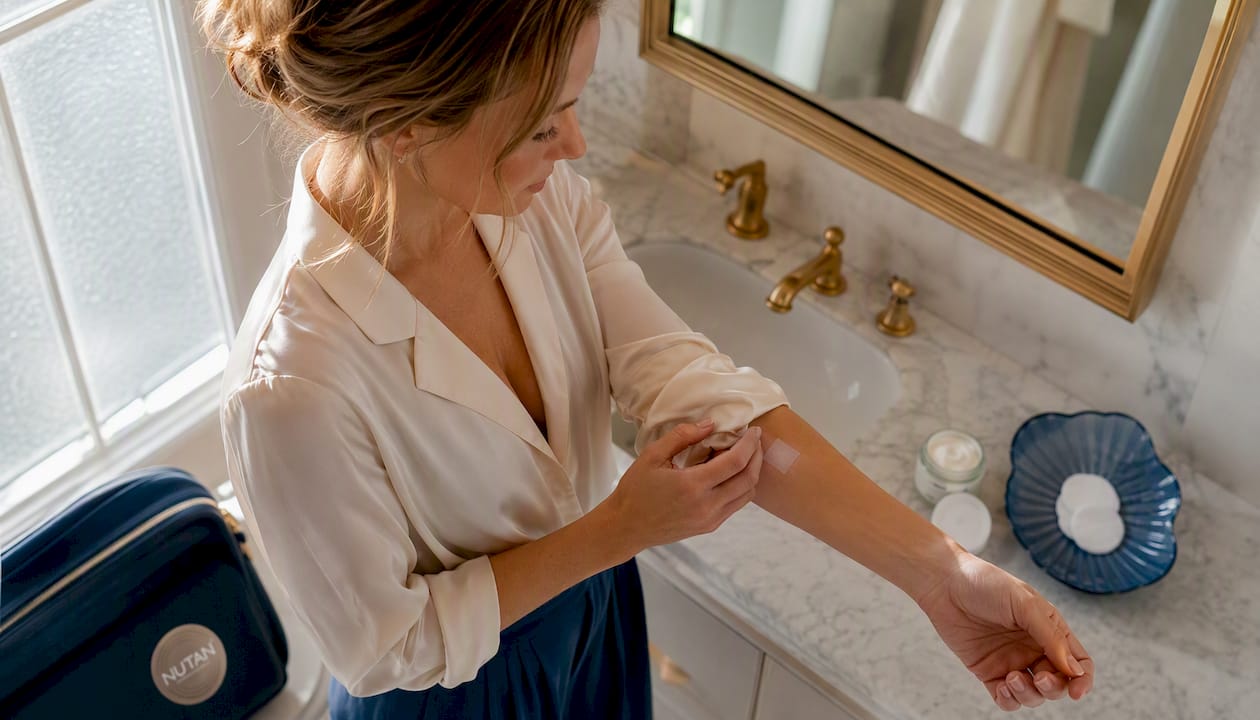
In this guide, “hyperpigmentation” means something quite different from what most skincare articles describe. Here, it refers to a deliberate, whole-skin increase in pigmentation — a controlled deepening of your natural colour produced by NuTan® transdermal tanning patches. The result is an even, sun-kissed glow that develops from within your skin, not a surface stain that washes away in the shower.
Three things make this approach stand out:
Nutan MSH-ComplexB (b-MSH proprietary complex) — NuTan®'s in-house formula mimics melanocyte-stimulating hormone to signal your skin to produce more melanin naturally.
Melanocortin 1 Receptor (MC1R) activation — the patch formula binds to MC1R on your melanocytes, triggering the same biochemical pathway that sunlight activates, but far more efficiently.
Reduced UV exposure — because the pathway is already primed, you need only brief, incidental natural sunlight to activate the tanning process, over 70% less UV than conventional tanning methods.
Most people notice a visible change within days to a couple of weeks, depending on their baseline skin tone and the patch strength chosen.
Table of Contents
How do NuTan® patches trigger whole-skin tanning?
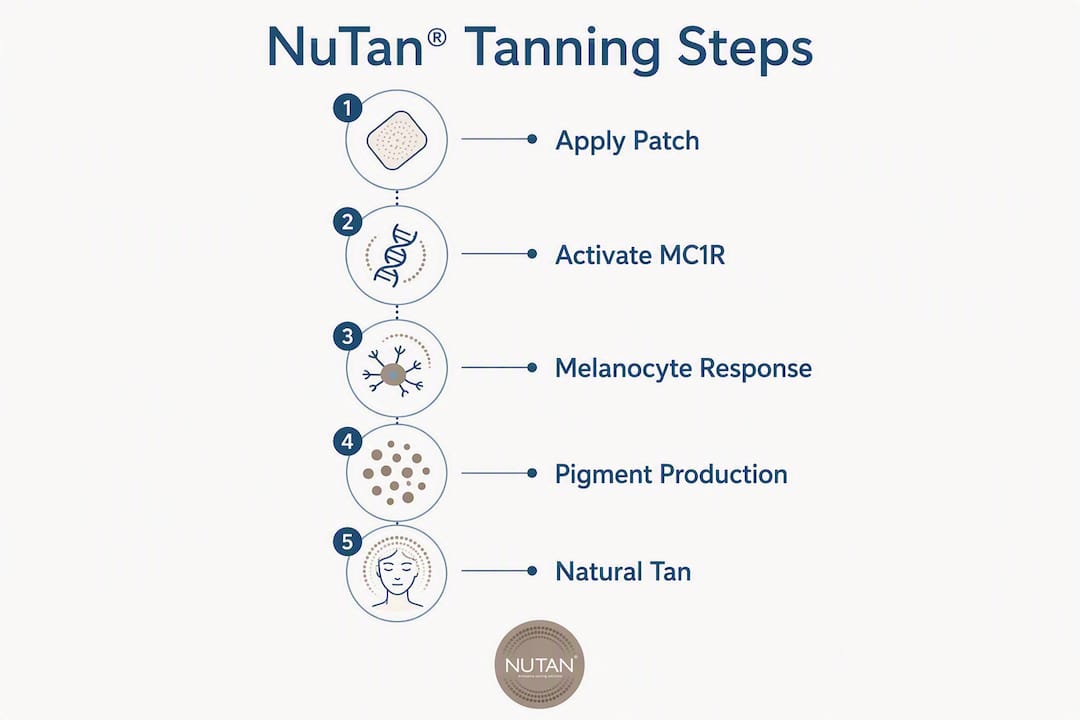
The science behind NuTan® patches follows a well-established biological pathway. Nutan MSH-ComplexB delivers a b-MSH signal transdermally, and that signal behaves like alpha-melanocyte-stimulating hormone (α-MSH) once it reaches your skin’s melanocytes.
When b-MSH binds to MC1R on the melanocyte surface, it triggers a rise in intracellular cyclic AMP (cAMP). That cAMP signal activates MITF, the master transcription factor for pigment production, which in turn switches on tyrosinase and related enzymes. The end result is a measurable increase in eumelanin — the brown-black pigment responsible for a deep, natural-looking tan.
The MC1R pathway is a major determinant of melanin type and amount. Activation by melanocortin peptides increases eumelanin synthesis and the tanning response, producing the characteristic deepening of skin colour associated with sun exposure. — Frontiers in Genetics, MC1R structure, function, and regulation
Because the pigment is produced inside the melanocytes and then distributed to surrounding keratinocytes, the colour is genuine and integrated into your skin. It does not sit on the surface, so it does not rub off or wash away between showers. Scientific literature confirms that melanocortin peptides stimulate melanogenesis and melanosome transfer — the very mechanism NuTan® harnesses.
Who benefits most from NuTan® patches?
NuTan® patches suit a wide range of people, though the depth and speed of response does vary. MC1R variants influence tanning ability, which is why two people using the same patch schedule can see slightly different timelines.
Primary beneficiaries:
People with pale to medium skin tones who want a gradual, natural-looking tan without prolonged sun sessions.
Anyone preparing for a specific occasion — a wedding, holiday, or event — who wants reliable colour without the unpredictability of sunbathing.
Those who want to minimise cumulative UV exposure for skin health reasons.
Groups who should take extra care:
Very fair skin (Fitzpatrick I) may need a conservative starting schedule and careful UV management.
Very dark skin tones (Fitzpatrick V–VI) will see a subtler incremental change; darker skin tans differently due to baseline eumelanin levels.
Anyone on photosensitising medication should consult their GP before starting.
Those who have had recent skin procedures (laser, chemical peels) should wait until the skin has fully healed.
Quick suitability checklist:
Skin tone: pale to medium responds most visibly; darker tones see subtler deepening.
Sun sensitivity: patches reduce UV need, but brief exposure is still required.
Medication: check for photosensitisers with your GP.
Recent procedures: allow full healing before use.
Pro Tip: Always do a patch test on a small area of skin 24 hours before your first full application. Start with Original strength and lower frequency before moving to Triple Strength.
How do you use NuTan® patches and when will you see results?
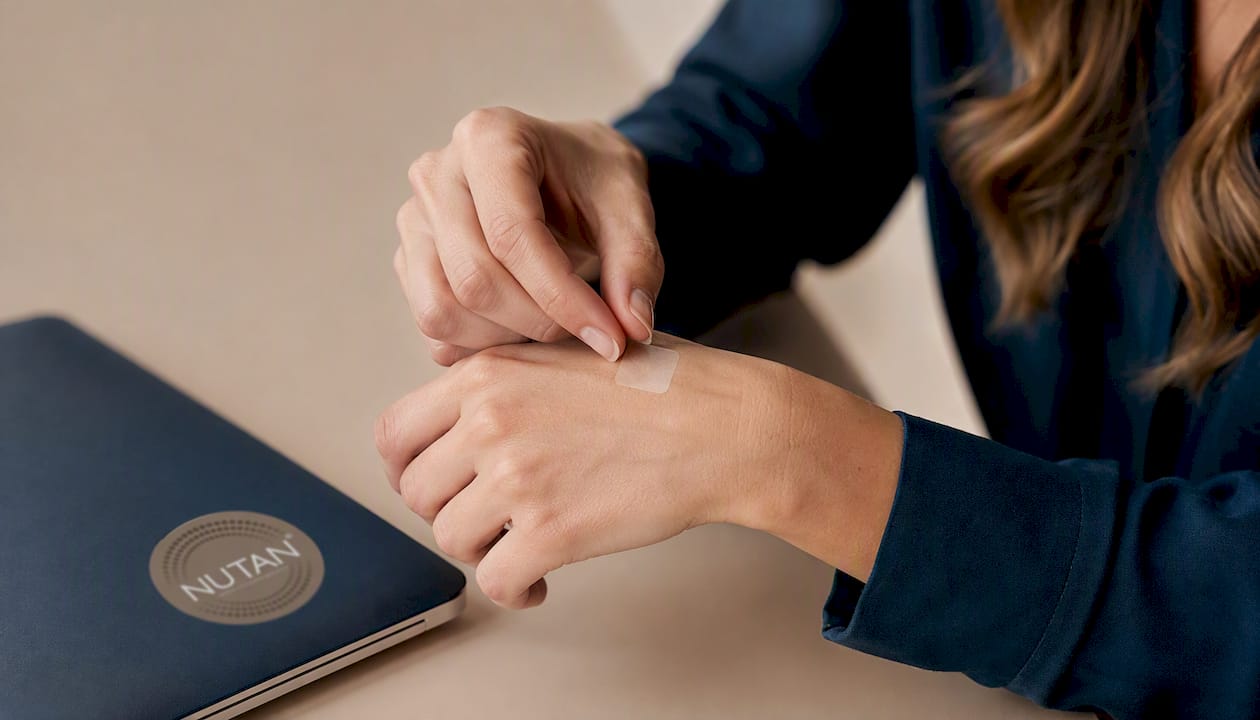
NuTan® patches are applied to clean, dry skin and worn consistently while taking short, incidental natural sunlight sessions to activate the tanning process. The routine is straightforward.
Cleanse and dry the application area thoroughly — no moisturiser or oil on the skin beforehand.
Choose your strength — Original for a gradual build, or Triple Strength for a faster, deeper result.
Apply the patch to a flat, hairless area (inner arm, lower abdomen, or upper thigh work well).
Wear as directed — follow the schedule for your chosen strength.
Get brief natural sunlight — short, incidental exposure is all that is needed to activate pigment production. You do not need to sunbathe.
Repeat on your chosen schedule — daily for faster build, alternate days for a steadier approach, then reduce to maintenance frequency once you reach your desired colour.
Phase | Original strength | Triple Strength |
First visible change | Within about one to two weeks | Within about one week |
Build phase | Several weeks | Several weeks |
Maintenance | Occasional top-up patches | Occasional top-up patches |
Individual results vary based on skin tone, UV exposure, and consistency of use.
Pro Tip: For your first course, apply every other day for the first week rather than daily. This lets you gauge your skin’s response before committing to a faster schedule.
What results can you expect, and how do you keep the tan even?
The tan that develops with NuTan® patches is a gradual, whole-skin deepening of your natural colour. Because the pigment forms within your melanocytes, it blends seamlessly with your skin tone rather than sitting on top of it. There is no streaking, no orange undertone, and no residue on clothing or bedding.
Several factors influence how long the colour lasts: your baseline skin tone, how consistently you use the patches, your UV activation sessions, and how you care for your skin day to day. Regular moisturising slows the natural shedding of surface skin cells, which helps the colour stay even. Exfoliating too aggressively can fade the tan faster.
Maintenance checklist for an even, lasting colour:
Moisturise daily to slow cell turnover and preserve depth of colour.
Use SPF on exposed skin during UV activation sessions — you need only brief exposure, not prolonged burning.
Exfoliate gently and no more than once a week to avoid patchy fading. For guidance on avoiding an uneven tan, NuTan®'s 2026 guide covers the common causes in detail.
Use occasional top-up patches to maintain colour between courses.
Method | UV exposure needed | Mess or residue | Natural appearance | Maintenance |
Transdermal patches | Minimal (brief, incidental) | None | Genuine pigment change | Occasional top-up patches |
Sunbathing | Prolonged, high | None | Natural | Repeated long sun sessions |
Spray/mousse application | None | Can streak or transfer | Surface stain only | Reapplication every few days |
A note on realistic expectations: patches deepen your natural skin tone — they do not produce a colour that is several shades darker overnight. Avoid excessive UV exposure during your patch course; the goal is brief activation, not prolonged sunbathing.
Safety, side effects, and buying responsibly in the UK
NuTan® patches are designed to be used safely at home, and most people tolerate them well. A sensible approach covers a few straightforward steps.
Core safety checklist:
Patch test 24 hours before first full use.
Apply only to intact, healthy skin — avoid broken skin, sunburn, or recently treated areas.
Monitor for redness, itching, or swelling at the application site.
Discontinue use and consult a GP or dermatologist if any reaction persists.
Common minor responses include mild skin sensitivity at the patch site, which usually settles quickly. Rare but serious signs — significant swelling, blistering, or a spreading rash — warrant prompt medical attention.
For UK consumers, buying from NuTan®'s official product pages gives you access to clear ingredient descriptions, usage instructions, and customer support. Always read the product labelling in full before use.
Seek professional advice before using patches if you are pregnant, breastfeeding, or taking photosensitising medication. This article provides general consumer information, not medical advice; confirm suitability with your GP if you have any concerns.
NuTan® patches: what you get and how to buy
NuTan® patches deliver Nutan MSH-ComplexB transdermally, priming your melanocytes so that only brief natural sunlight is needed to build a genuine, lasting tan. Two strengths give you control over pace and depth.
The Original patches suit first-time users and those who prefer a gradual build. Triple Strength patches are formulated for a faster, deeper result and are available in a 20-patch (10 sachet) pack, making them practical for a full tanning course or a pre-holiday build. Compared with repeat spray appointments or lengthy sun sessions, a single pack covers weeks of use at a straightforward cost per application.
NuTan® ships worldwide, so wherever you are based, you can order directly from the official store. For the best value on a longer course, the 20-patch kit is the most cost-effective starting point.
Key takeaways
NuTan® transdermal patches work by activating MC1R with a b-MSH mimic, producing a genuine whole-skin tan with over 70% less UV exposure than conventional tanning methods.
Point | Details |
What “hyperpigmentation” means here | A deliberate, whole-skin increase in pigmentation to produce a natural tan using NuTan® patches. |
The mechanism | Nutan MSH-ComplexB activates MC1R, raising cAMP and increasing eumelanin production within melanocytes. |
UV exposure needed | Brief, incidental natural sunlight only — over 70% less than conventional tanning methods. |
Timeline | First visible change typically within days to a couple of weeks; varies by skin tone and patch strength. |
NuTan® patches | Available in Original and Triple Strength; the tan does not rub or wash off and is maintained with occasional top-up patches. |
A practical note from NuTan®
Most people who use NuTan® patches settle into a rhythm quickly. The typical pattern is to start every other day for the first week, assess the response, then move to daily use if a faster build is wanted. Once the desired colour is reached, a single maintenance patch every week or two keeps things looking natural without overdoing it.
The patches are particularly popular ahead of holidays and weddings, where the goal is reliable, even colour without the unpredictability of last-minute sunbathing. The convenience of needing only a few minutes of natural daylight, rather than hours on a sun lounger, fits easily into a normal week. For a discreet, injection-free approach to building a tan, the patch routine is as low-effort as it gets.
Useful sources for further reading
For readers who want to go deeper on the science or check product details directly:
NuTan® Triple Strength product page — strength options, pack sizes, and buying information.
How natural tanning pathways work — NuTan®'s mechanism-level explainer on the MC1R and MSH pathway.
MC1R: Front and Center in Eumelanin and DNA Repair (PMC) — peer-reviewed overview of MC1R activation and eumelanin synthesis.
MC1R, the cAMP pathway, and the response to solar UV (Frontiers/Wiley) — explains how MC1R variants affect tanning response and UV signalling.
β-MSH and melanotropins (Wiley) — scientific basis for MSH-mimic approaches to melanogenesis.
Key scientific principle: MC1R activation by melanocortin peptides increases eumelanin synthesis in a cAMP-dependent manner — the same pathway NuTan®'s Nutan MSH-ComplexB is formulated to engage.
For skin health support during a tanning regimen, antioxidants for skin can complement your routine by supporting cellular resilience alongside UV activation sessions.
FAQ
What does “hyperpigmentation” mean in the context of NuTan® patches?
Here, it means a deliberate, whole-skin increase in natural pigmentation produced by NuTan® transdermal patches, not localised dark spots or a skin condition.
How much UV exposure do you actually need with NuTan® patches?
Only brief, incidental natural sunlight is required — over 70% less UV than conventional tanning methods, because the MC1R pathway is already primed by Nutan MSH-ComplexB.
How long does the tan from NuTan® patches last?
The tan is a genuine pigment change within your skin, so it fades gradually as skin cells naturally turn over. Regular moisturising and occasional top-up patches maintain the colour.
Are NuTan® patches suitable for all skin tones?
They work across a range of skin tones, though pale to medium tones typically see the most visible change. Very dark skin tones will experience a subtler deepening due to higher baseline eumelanin levels.
Where can you buy NuTan® patches in the UK?
NuTan® patches are available directly from the official NuTan® store online, with worldwide delivery. The Triple Strength 20-patch kit is the most popular option for a full tanning course.
Recommended