

What is photoaging: causes, signs and prevention
- 2 days ago
- 11 min read
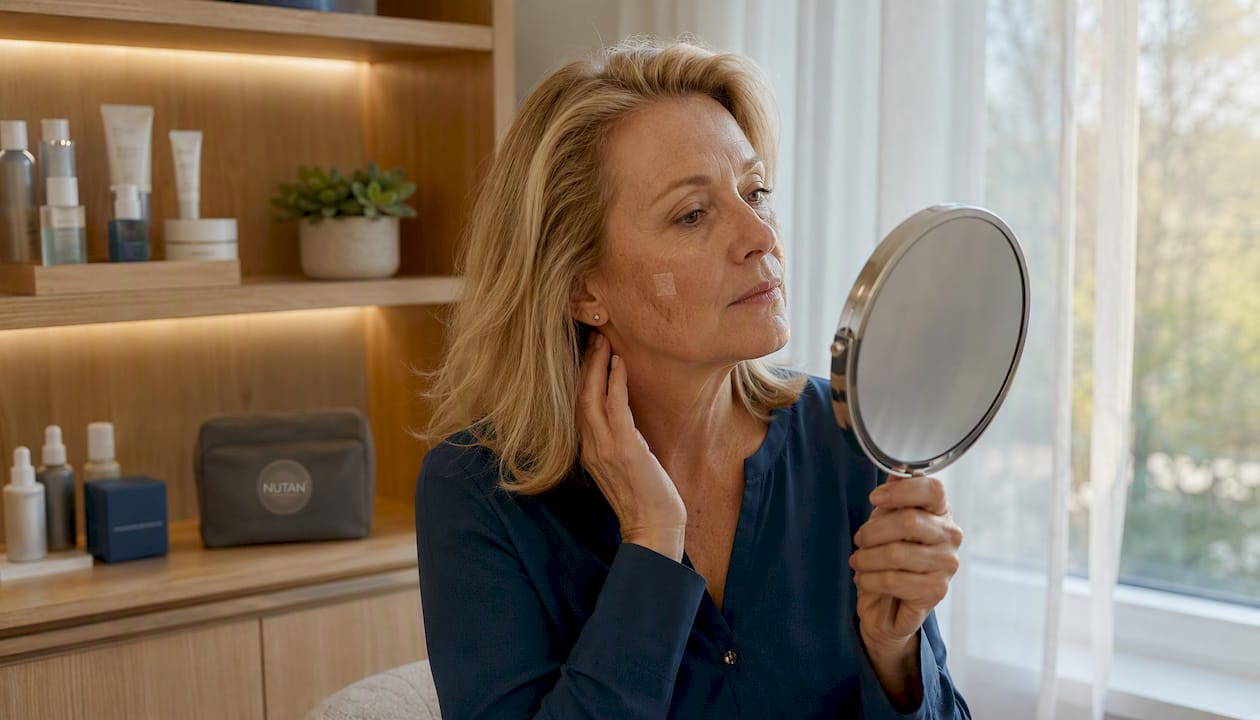
Photoaging, also called dermatoheliosis or photodamage, is the premature ageing of skin caused by cumulative exposure to ultraviolet radiation from the sun and artificial sources. It is distinct from the natural ageing process and is responsible for up to 90% of visible skin changes most people associate with growing older. Beyond cosmetic concern, photoaging raises the risk of precancerous lesions and skin cancer, making early awareness genuinely protective.
Three steps you can take today:
Apply a broad-spectrum SPF 30+ sunscreen every morning, including overcast days.
Avoid peak UK UV hours between 10:00 and 16:00 from March through October.
Check your skin regularly for new, changing, or bleeding lesions and see your GP promptly if anything concerns you.
Pro Tip: The British Association of Dermatologists recommends reapplying sunscreen every two hours during outdoor activity, not just once in the morning. Most people apply far less than the tested amount, which significantly reduces real-world protection.
Table of Contents
How photoaging develops inside your skin
Photoaging begins when UV radiation penetrates the skin and triggers a cascade of cellular damage. UVB acts primarily on the epidermis, the outermost layer, causing direct DNA strand breaks and the sunburn response. UVA penetrates more deeply into the dermis, where it degrades collagen and elastin fibres through oxidative stress and the activation of matrix metalloproteinases, enzymes that break down structural proteins. The result is a dermis that gradually loses its scaffolding, producing the sagging, wrinkling, and textural changes characteristic of photodamaged skin.
What makes photoaging clinically distinct is that the damage is cumulative. A single sunny afternoon contributes a small, largely invisible increment of harm. Decades of those increments, however, produce the visible signs that many people attribute simply to age. The terms dermatoheliosis, photodamage, and sun damage all describe the same process; photoaging is the most widely used clinical term.
Understanding the mechanism matters practically. Sunscreen blocks the UV radiation that drives collagen breakdown. Topical retinoids work partly by stimulating collagen synthesis, counteracting the structural loss that UV has already caused. Prevention and treatment are two sides of the same biological coin.
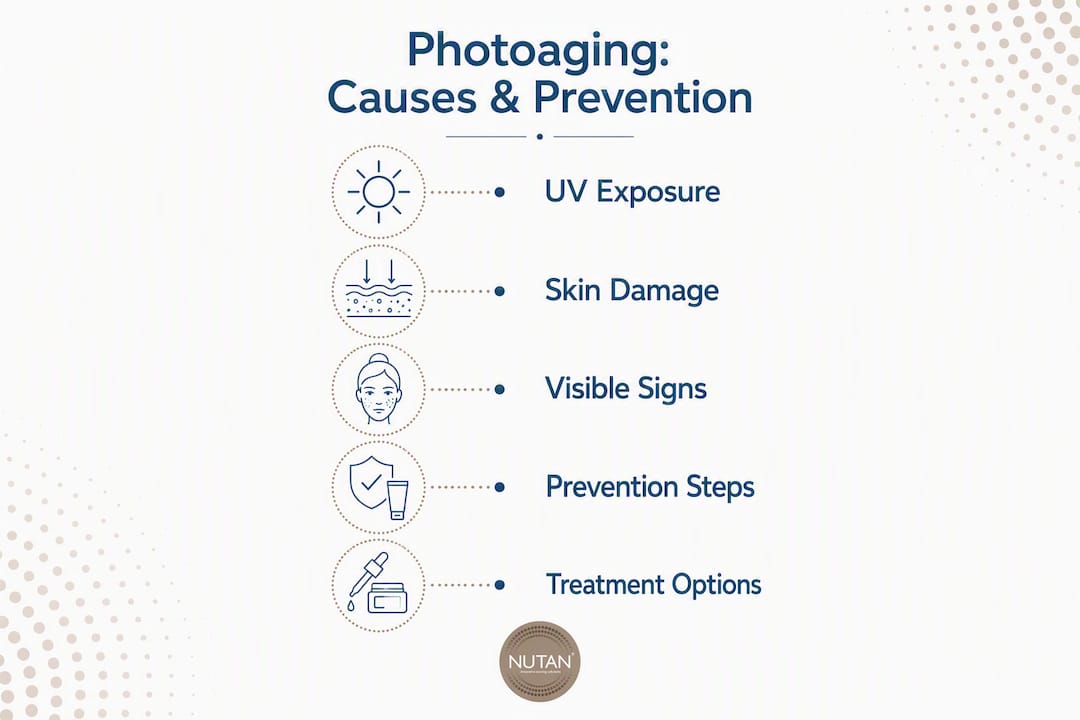
What are the visible signs of photoaging?
The signs of photoaging are wide-ranging and tend to appear first on the areas of skin that receive the most sun over a lifetime.
Common signs include:
Fine lines and coarse wrinkles, particularly around the eyes, mouth, and forehead
Elastosis, a leathery, thickened skin texture caused by degraded elastin
Solar lentigines, the flat brown or tan spots commonly called age spots or liver spots
Dyspigmentation, uneven skin tone including both hyperpigmentation and areas of pallor
Telangiectasias, small, visible broken capillaries near the skin surface
Rough, dry texture and a dull complexion
Actinic keratoses, scaly, rough patches that are considered precancerous lesions
The face, particularly the forehead and the skin around the eyes, tends to show changes earliest. The neck, chest (décolletage), backs of the hands, and forearms are also common sites because they accumulate significant lifetime UV exposure while often being overlooked during sunscreen application.
Actinic keratoses deserve specific attention. They are not merely cosmetic; they represent genuinely abnormal skin cells and carry a risk of progressing to squamous cell carcinoma. Any rough, persistent, or scaly patch that does not resolve within a few weeks warrants a clinical review.

What causes photoaging: UV types and artificial sources
Cumulative exposure to solar and artificial UV radiation is the primary driver of photoaging. Not all UV wavelengths behave identically, and understanding the differences helps explain why protection needs to be broad-spectrum and consistent.
Radiation type | Wavelength | Primary site of damage | Key effect |
UVA | — | Dermis | Collagen/elastin degradation, oxidative stress, photoageing |
UVB | — | Epidermis | Direct DNA damage, sunburn, melanoma risk |
UVC | — | Filtered by atmosphere | Minimal ground-level exposure |
Sunbeds and artificial tanning devices emit predominantly UVA radiation at intensities that can exceed natural sunlight. They accelerate photoaging and increase skin cancer risk; there is no medically safe level of sunbed use for cosmetic tanning purposes.
One practical point that surprises many people: UVA penetrates ordinary window glass. Sitting near a car window or a sunny office window for years contributes to cumulative dermal damage on the exposed side of the face and hands, even without any sensation of warmth or burning. Broad-spectrum protection remains relevant indoors when near glass.
How photoaging differs from natural ageing
Photoaging is extrinsic ageing, driven by an external environmental factor. Chronological, or intrinsic, ageing is an internal biological process governed by genetics, hormonal changes, and cellular senescence. Both processes affect the skin, but they produce different patterns of change and respond differently to intervention.
Feature | Photoaging (extrinsic) | Chronological ageing (intrinsic) |
Primary cause | Cumulative UV and artificial radiation | Genetics, time, hormonal change |
Typical signs | Wrinkles, pigmentation, elastosis, telangiectasias | Fine lines, thinning, dryness, loss of volume |
Onset | Can begin in teens and early twenties | Gradual from mid-twenties onwards |
Distribution | Sun-exposed areas only | Generalised across the body |
Reversibility | Partially improvable with treatment | Not reversible; manageable cosmetically |
The practical implication is significant. Because photoaging is driven by an external, modifiable factor, a meaningful proportion of visible skin ageing is preventable. Chronological ageing cannot be stopped, but the additional layer of photodamage on top of it can be substantially reduced with consistent protective behaviour throughout life.
Who is most at risk from photoaging?
Cumulative UV exposure, sunbed use, fair skin phototype, outdoor occupation, and immune suppression are the leading risk drivers for photoaging. Risk is not binary; it exists on a spectrum shaped by both behaviour and biology.
Key risk factors:
Skin phototype I–III: Lighter skin produces less melanin, offering less natural UV filtration. People with lighter phototypes tend to develop rhytids and elastosis more readily, while those with skin of colour more commonly experience dyschromia and pigmentation changes.
Cumulative lifetime UV dose: Outdoor workers, those in high-altitude or high-latitude environments, and people who spent significant time in the sun during childhood carry a higher burden of photodamage.
Sunbed use: Any history of sunbed use adds to cumulative UV load and accelerates the ageing process.
Geographic and seasonal factors: In the UK, UV index is significant from March through October, peaking in June and July. However, UVA remains present year-round.
Immune suppression: Organ transplant recipients and others on immunosuppressive therapy face substantially elevated risk of actinic keratoses and skin cancer.
Lack of protective behaviour: Consistently skipping sunscreen, wearing minimal clothing outdoors, and spending time in direct sun during peak hours all compound risk over decades.
Understanding your own phototype and adjusting behaviour accordingly is one of the most practical steps you can take. A guide to how different skin tones tan and respond to UV can help you understand your personal risk profile.
Complications and when to see a dermatologist
Photoaging can cause precancerous lesions and contributes to an elevated risk of skin cancer. This is the clinical reason why photodamage is more than a cosmetic concern.
Potential complications:
Actinic keratoses (AKs): Rough, scaly patches on sun-exposed skin. These are precancerous and should be assessed by a clinician. Left untreated, a proportion can progress to squamous cell carcinoma.
Squamous cell carcinoma (SCC): Can arise from untreated actinic keratoses; typically presents as a persistent, growing, or ulcerating lesion.
Basal cell carcinoma (BCC): The most common skin cancer in the UK, strongly associated with cumulative UV exposure.
Melanoma: Less directly linked to cumulative photoaging than BCC/SCC, but UV exposure remains a significant risk factor.
When to see your GP or a dermatologist:
See a clinician promptly for any skin lesion that is new, changing in size or colour, bleeding, itching persistently, or failing to heal within a few weeks. The NHS and the British Association of Dermatologists both provide clear referral guidance; your GP can refer you through the NHS two-week-wait pathway if a lesion looks suspicious.
UpToDate’s clinical review on photoaging provides detailed diagnostic criteria for clinicians, including dermoscopy findings and biopsy indications for atypical lesions.
Evidence-based prevention steps for UK readers
Daily broad-spectrum sunscreen combined with behavioural measures is the gold standard for preventing photoaging. In the UK, the UV index is high enough to cause skin damage from late March through September, but UVA exposure continues throughout the year.
Practical prevention checklist:
Choose a broad-spectrum sunscreen rated SPF 30 at minimum; SPF 50 is preferable for fair skin or extended outdoor time.
Apply generously to all exposed skin at least 15 minutes before going outside. Most adults use roughly half the amount needed for full protection.
Reapply every two hours during outdoor activity and after swimming or towelling.
Cover up with tightly woven clothing, a wide-brimmed hat, and UV-protective sunglasses.
Seek shade between 10:00 and 16:00, when UV intensity is at its highest.
Apply sunscreen on overcast days; UVA penetrates cloud cover and glass, so indoor and cloudy-day exposure still contributes to cumulative damage.
Never use sunbeds. There is no safe dose of artificial UV for cosmetic tanning.
Vitamin D and sun avoidance in the UK: The NHS advises that most people in the UK cannot make sufficient vitamin D from sunlight between October and March, and recommends a daily supplement of 10 micrograms during those months. Sensible sun protection during summer does not prevent adequate vitamin D synthesis; the NHS guidance is to enjoy short periods of sun exposure without burning, then apply protection.
Pro Tip: Topical vitamin C serum applied in the morning before sunscreen adds an antioxidant layer that helps neutralise free radicals generated by UV exposure. It does not replace sunscreen but works alongside it as part of a combined tanning and skincare routine that supports skin health.
Photoaging skin treatment: what actually works and what to expect
While the underlying cellular DNA damage from photoaging is permanent, visible appearance can often be meaningfully improved with topical and procedural treatments. Realistic expectations matter here; improvement is the goal, not reversal.
Topical treatments:
Prescription retinoids (tretinoin): The most evidence-backed topical treatment for photodamaged skin. They stimulate collagen synthesis and accelerate cell turnover. Visible improvement typically takes 12–24 weeks of consistent use, and skin may initially become dry or flaky. Available on NHS prescription or privately.
Topical antioxidants: Vitamin C, niacinamide, and vitamin E help reduce ongoing oxidative damage and can improve pigmentation over time. They complement retinoids rather than replace them.
Topical treatments for actinic keratoses: Fluorouracil cream, imiquimod, and diclofenac gel are prescription options used to treat AKs; cryotherapy (liquid nitrogen) is a common in-clinic procedure for individual lesions.
In-clinic procedures:
Chemical peels: Superficial to medium-depth peels using glycolic, salicylic, or trichloroacetic acid improve texture, pigmentation, and fine lines. Multiple sessions are usually needed, with a few days of redness and peeling afterwards.
Laser resurfacing: Ablative lasers (CO₂, Er:YAG) and non-ablative fractional lasers stimulate dermal remodelling. Results can be significant, but recovery from ablative treatments may take one to two weeks. Several sessions of non-ablative treatment are typically required.
Microneedling and microdermabrasion: Collagen-induction procedures with modest but real effects on texture and fine lines; generally well tolerated with minimal downtime.
Dermal fillers and botulinum toxin: Cosmetic adjuncts that address volume loss and dynamic wrinkles; they do not treat photodamage directly but improve overall appearance.
Stimulating dermal remodelling with retinoids, lasers, and chemical peels can materially improve appearance, though multiple sessions and ongoing maintenance are typically required for sustained results.
Choosing a practitioner in the UK: For prescription treatments, consult a GMC-registered dermatologist or GP. For aesthetic procedures, check that the practitioner holds a relevant regulated qualification (medical, dental, or nursing), ask to see before-and-after photography, and request a patch test before any laser or chemical treatment. Costs vary widely; a consultation with a consultant dermatologist via the NHS is free at the point of care, while private procedures range from modest to substantial depending on the intervention.
What research tells us about photoaging prevalence
Up to 90% of visible skin ageing changes are attributable to sun exposure rather than chronological ageing alone. That figure, drawn from peer-reviewed dermatology literature, reframes how most people think about wrinkles and pigmentation: the majority of what we see in the mirror is modifiable, not inevitable.
Studies in high-UV populations, including Queensland, Australia, show that visible photoaging signs can appear as early as the teens and early twenties. This is not a condition that begins at retirement age; the cumulative damage that produces visible changes in midlife often starts accumulating in childhood and adolescence. The implication is straightforward: the earlier protective habits are established, the greater the long-term benefit.
Behavioural measures combined with early topical therapy deliver the best long-term outcomes and reduce the need for more aggressive procedures later. Prevention is not just cheaper than treatment; it is more effective.
Key takeaways
Photoaging accounts for a large majority of visible skin ageing and is largely preventable with consistent daily sun protection, behavioural habits, and early use of evidence-based topical treatments.
Point | Details |
Definition | Photoaging is premature skin ageing from cumulative UV exposure, distinct from natural chronological ageing. |
Prevention priority | Daily broad-spectrum SPF 30+ sunscreen, shade during 10:00–16:00, and no sunbed use are the most effective steps. |
When to see a clinician | Any new, changing, bleeding, or non-healing skin lesion needs prompt GP or dermatologist review. |
Treatment reality | Visible improvement is achievable with retinoids and procedures, but DNA damage is permanent; maintenance is ongoing. |
NuTan® cosmetic option | NuTan® transdermal tanning patches offer a cosmetic route to a sun-kissed appearance with significantly reduced UV exposure. |
A perspective on living with and preventing photoaging
The most reassuring thing about photoaging is that it is largely within your control. Consistent daily protection, even when started later in life, slows further damage and gives topical treatments the best possible environment to work. Small, sustainable habits, a broad-spectrum SPF every morning, a vitamin C serum, and a hat on sunny days, compound quietly over years in exactly the same way that UV damage does. The skin you protect today is the skin you will be grateful for in a decade.
A safer cosmetic tanning option from NuTan®
For those who love the look of a warm, natural tan but want to avoid adding unnecessary UV exposure on top of daily environmental damage, NuTan® transdermal tanning patches offer a genuinely different cosmetic route.

NuTan® patches work by delivering a natural beta-melanocyte-stimulating hormone complex transdermally, activating the Melanocortin 1 Receptor (MC1R) on your skin’s melanocytes to kickstart your skin’s own pigment production. The result is a natural-looking tan that does not rub or wash off, achieved with significantly less UV exposure than conventional tanning methods. This is a cosmetic product, not a medical treatment, and it does not replace sun protection; daily sunscreen remains non-negotiable regardless of how you achieve your colour.
If you are conscious of photoaging and still want a golden glow without the UV cost, NuTan® tanning patches are worth exploring. For those wanting a stronger result, the NuTan® Triple Strength patches are available with worldwide delivery.
Useful sources and further reading
The following authoritative sources provide reliable, evidence-based information on photoaging, sun protection, and skin cancer risk in the UK context. Consulting your GP or a consultant dermatologist remains the best route for personalised assessment.
PMC — Photoaging review: Peer-reviewed clinical overview of photoaging mechanisms, prevalence, and the 90% visible ageing statistic; suitable for readers wanting the underlying science.
Cleveland Clinic — Sun-damaged skin: Clear patient-facing explanation of signs, causes, and treatment options including cryotherapy and topical agents.
Yale Medicine — Photoaging: Accessible clinical summary covering UVA/UVB differences, collagen damage, and treatment categories.
Springer — Photoaging: current concepts: 2025 peer-reviewed review covering molecular mechanisms, antioxidant strategies, and phototype-specific treatment considerations.
American Academy of Dermatology — Sun protection: Practical, evidence-based guidance on sunscreen, clothing, and shade; directly applicable to UK readers.
This article provides general health information and does not constitute medical advice. Consult your GP or a qualified dermatologist for personalised assessment and treatment recommendations.
FAQ
What are the signs of photoaging?
The most common signs are fine and coarse wrinkles, solar lentigines (flat brown spots), leathery skin texture (elastosis), telangiectasias, uneven pigmentation, and rough patches known as actinic keratoses. These appear predominantly on sun-exposed areas such as the face, neck, hands, and forearms.
What is the difference between ageing and photoaging?
Chronological ageing is a natural, genetically driven process affecting all skin equally across the body. Photoaging is premature ageing caused by cumulative UV exposure and appears only on sun-exposed areas; research attributes up to 90% of visible skin changes to photoaging rather than chronological ageing.
What reverses photoaging?
No treatment fully reverses photoaging because the underlying DNA damage is permanent. However, prescription topical retinoids, chemical peels, laser resurfacing, and microneedling can materially improve the visible appearance of photodamaged skin over weeks to months of consistent treatment.
How can you prevent photoaging naturally?
Daily broad-spectrum SPF 30+ sunscreen, protective clothing, seeking shade between 10:00 and 16:00, and avoiding sunbeds are the most effective preventive measures. Topical antioxidants such as vitamin C serum support protection by neutralising UV-generated free radicals alongside sunscreen.
Can photoaging affect younger people?
Yes. Studies in high-UV populations show visible photoaging signs appearing as early as the teens and early twenties, and cumulative damage begins in childhood. Establishing protective habits early significantly reduces long-term photodamage.
Recommended
Comments