

The role of antioxidants in skincare, explained by the science
- 12 minutes ago
- 12 min read
Antioxidants work by neutralising reactive oxygen species (ROS), the unstable molecules generated by UV exposure, pollution, and ordinary cell metabolism that break down collagen and accelerate visible ageing. Left unchecked, ROS trigger a molecular chain reaction that damages skin structures over years of exposure, as detailed in a comprehensive review of ROS and skin ageing. Topical antioxidants matter most here because they reach the skin in concentrations that oral intake rarely achieves, which is why dermatology treats them as a companion to sunscreen rather than a replacement for it.
Here’s what the current evidence actually supports:
Antioxidants scavenge ROS and reduce oxidative stress markers linked to premature ageing.
Topical application delivers higher local concentrations than dietary supplements in most cases.
Sunscreen remains the primary defence; antioxidants clean up the oxidative damage that sunscreen alone doesn’t fully prevent.
Formulation quality (stability, packaging, concentration) determines whether an antioxidant serum actually performs.
A 2026 systematic review and meta-analysis found that antioxidant-rich oral interventions improved skin hydration and reduced trans-epidermal water loss across clinical studies, though results varied by antioxidant type and trial length. Combined with the mechanistic evidence on ROS, this gives topical and oral antioxidant use a genuinely solid scientific footing rather than a marketing one.
Key Takeaways
Antioxidants work by neutralising reactive oxygen species that drive collagen breakdown, and topical formulations deliver the highest local concentrations for visible skin benefits.
Point | Details |
Antioxidants complement, not replace, sunscreen | Sunscreen blocks incoming UV; antioxidants neutralise the ROS that get through regardless. |
Formulation quality determines results | Airless, opaque packaging and stabilising combinations like vitamin C, E, and ferulic acid preserve potency. |
Oral and topical routes differ | Oral antioxidants modestly improve hydration and reduce water loss; topical delivery achieves higher local concentrations. |
More isn’t automatically better | Excessive antioxidant concentrations can act as pro-oxidants, so tested formulations matter over raw strength. |
NuTan supports evidence-based routines | Products like NuRejuv Collagen Instant Lift Face Cream (SPF 20) and NuEyes Eye Serum pair antioxidant principles with daily sun protection and targeted eye care. |
This article is general information, not a substitute for advice from a qualified doctor. Consult a qualified healthcare professional about your own circumstances before acting on anything here.
Table of Contents
The role of antioxidants in skincare at a molecular level
Every day, your skin generates reactive oxygen species simply by existing. Cellular metabolism produces them as a by-product. UV radiation multiplies them. Airborne pollutants and even blue light from screens add to the load. These ROS are unstable oxygen molecules missing an electron, and they steal electrons from nearby cellular structures to stabilise themselves, damaging DNA, proteins, and lipid membranes in the process.
That damage doesn’t stay contained. Left to accumulate, ROS activate a class of enzymes called matrix metalloproteinases (MMPs), which break down collagen and elastin, the structural proteins that keep skin firm. This is the biochemical basis of photoageing, and it’s why sun-exposed skin ages visibly faster than skin that’s been protected for decades.
Antioxidants intervene in three distinct ways, and understanding the difference matters for choosing the right product:
Direct scavenging. Molecules like vitamin C and vitamin E donate an electron to a ROS molecule, neutralising it before it can cause damage.
Metal chelation. Some antioxidants bind free iron and copper ions, which would otherwise catalyse further ROS production through a reaction called the Fenton process.
Enzyme induction. Certain antioxidants trigger your skin’s own defence system, upregulating enzymes such as superoxide dismutase (SOD), catalase (CAT), and glutathione peroxidase (GPx).
That third mechanism runs through a signalling route called the Nrf2 pathway, which acts as a master switch for your skin’s internal antioxidant defences. When Nrf2 is activated, it increases production of SOD, CAT, and GPx, giving skin a self-sustaining defence system rather than relying solely on externally applied molecules. A meta-analysis of antioxidant-rich interventions links this pathway to measurable improvements in inflammatory markers and photoageing indicators.
The downstream effects are what actually matter to you day to day. Lower MMP activity means collagen and elastin survive longer, so skin retains firmness. A calmer oxidative environment supports the skin barrier, reducing moisture loss and sensitivity. And because ROS also stimulate excess melanin production in response to UV damage, reducing oxidative stress can calm the pigmentation response that follows sun exposure, which is part of why antioxidants show up in products targeting uneven tone.
[

Which antioxidants actually work, and what each one does
Not all antioxidants behave the same way, and a serum ingredient list only tells you something useful once you know what each compound is meant to achieve. A detailed review of antioxidants in cosmetology groups the major skincare classes by mechanism rather than marketing claim, which is a far more useful lens.
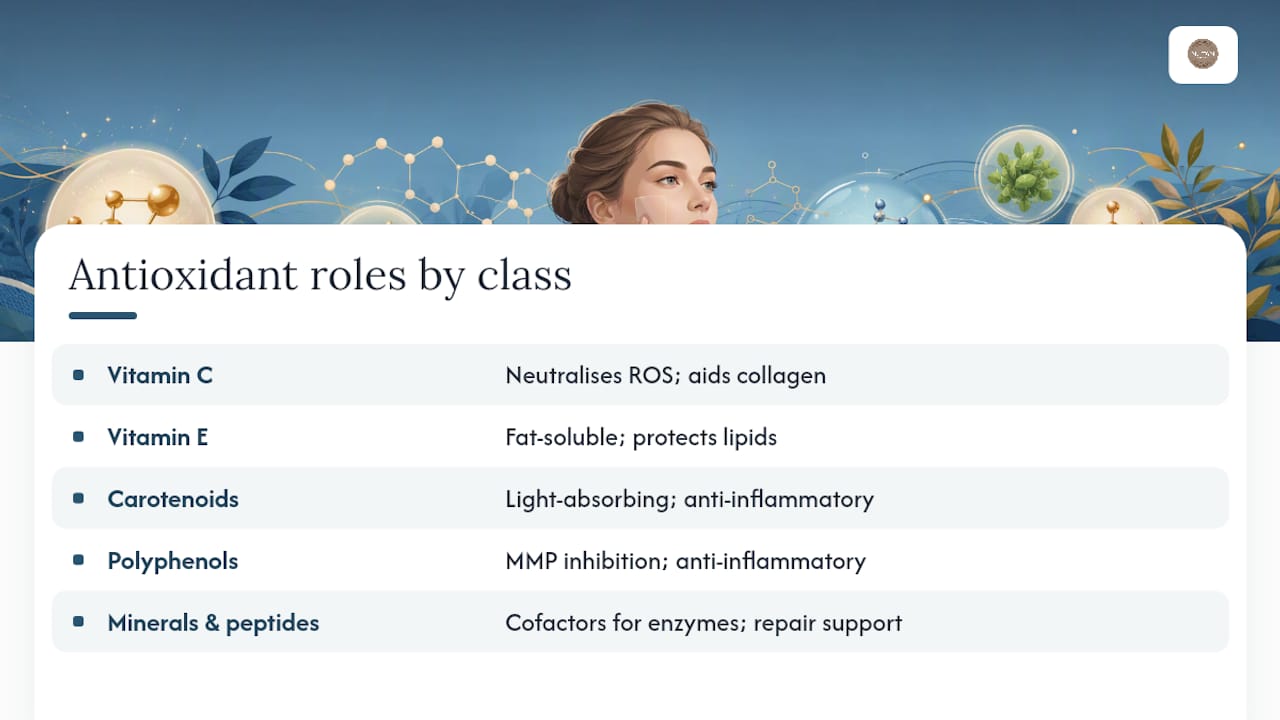
Vitamin C (L-ascorbic acid) is the most extensively studied topical antioxidant, and for good reason. It neutralises ROS directly, drives collagen synthesis by acting as a cofactor for the enzymes that build collagen fibres, and provides measurable photoprotection against UV-induced damage. Its Achilles heel is chemistry: L-ascorbic acid is only stable and effective at a low pH, typically below 3.5, which makes formulation tricky and can cause irritation on sensitive skin. Many brands now use derivatives like ascorbyl glucoside or sodium ascorbyl phosphate, which trade some potency for far greater shelf stability.
Vitamin E (tocopherol) works differently. It’s fat-soluble, so it embeds in cell membranes and protects lipids from oxidative breakdown, supporting the barrier that keeps moisture in and irritants out. Vitamin C and E are frequently formulated together because vitamin C regenerates spent vitamin E molecules, extending the antioxidant capacity of both.
Carotenoids, particularly astaxanthin and lycopene, offer a different profile again. These pigment molecules absorb light energy and provide anti-inflammatory support alongside photoprotection, making them a common addition in products aimed at environmental stress rather than acute UV damage.
Polyphenols such as resveratrol, green tea extract, and ferulic acid earn their place mainly through MMP inhibition and anti-inflammatory action. Ferulic acid has an added role as a stabiliser: it extends the effectiveness of vitamin C and E formulations, which is why the three often appear together on an ingredient label.
Minerals and peptides round out the picture as supporting players. Zinc and selenium act as cofactors for the SOD and GPx enzymes your skin produces naturally, while certain peptides support the repair processes that follow oxidative damage. Concentrations vary widely by product, but most topical antioxidants are formulated between 0.5% and 20%, depending on the molecule and its irritation potential.
Topical versus oral antioxidants: what the trials actually show
The evidence splits cleanly along one line: topical antioxidants act locally and quickly, oral antioxidants act systemically and slowly, and the two aren’t interchangeable.
On the oral side, a systematic review and meta-analysis of antioxidant-rich whole foods and supplements found consistent improvements in skin hydration and reductions in trans-epidermal water loss across the clinical studies reviewed. That’s a genuine, measurable outcome. But the researchers also flagged real heterogeneity: effect sizes varied depending on which antioxidant was studied, the dose used, and how long participants took it, which means “eat more antioxidant-rich food” is true but imprecise advice for anyone chasing a specific skin outcome.
Oral antioxidant supplementation shows a coherent but variable signal for improved hydration and reduced water loss, with effect sizes shaped heavily by the specific antioxidant, dose, and study duration rather than a uniform benefit across the board.
Topical application tells a more direct story for targeted concerns. Because the active ingredient sits on the skin rather than passing through digestion and circulation first, well-formulated topical antioxidants can achieve measurably higher local concentrations. That matters clinically for photoprotection, pigment evenness, and fine-line improvement, the three outcomes most topical antioxidant trials are designed to measure.
Oral intake supports overall skin hydration and barrier function over weeks to months.
Topical application delivers concentrated, localised antioxidant activity where you apply it.
Supplements don’t reliably achieve the therapeutic skin concentrations that topical products can, according to reviewed dermatological guidance.
The two approaches are complementary, not competitive, for anyone building a serious skincare routine.
If your priority is visible change in a specific area, a well-formulated serum will usually outperform a supplement bottle. If your goal is broader skin resilience, diet and supplementation still play a supporting role worth keeping.
Why formulation makes or breaks an antioxidant product
Here’s something most product labels won’t tell you: the antioxidant on the ingredient list may not be doing much by the time it reaches your skin. Many antioxidants are chemically unstable, degrading on contact with light, air, or heat, and a serum that’s been sitting in a clear jar on a sunlit shelf can lose a meaningful share of its potency before you’ve even opened it.
A detailed formulation review makes clear that packaging is not a cosmetic detail, it’s a functional one. Airless pump dispensers limit oxygen exposure with every use. Opaque or dark glass bottles block the UV and visible light that trigger degradation. A product without either isn’t necessarily ineffective, but it’s working against its own chemistry.
Formulators address instability chemically as well as physically. Encapsulation technology can shield a sensitive molecule until it’s applied, protecting it during storage. Ester derivatives, like the vitamin C variants mentioned earlier, sacrifice some raw potency in exchange for a formulation that survives longer on the shelf and penetrates skin more predictably.
Combination formulas exist for genuine chemical reasons, not just marketing appeal. The well-known trio of vitamin C, vitamin E, and ferulic acid works because each stabilises and extends the others: ferulic acid protects the vitamin C molecule from oxidation while vitamin E regenerates spent vitamin C, creating a longer-acting antioxidant system than any single ingredient could manage alone.
Check for airless or opaque packaging before assuming a serum will perform as advertised.
Look for stabilising co-ingredients like ferulic acid alongside vitamin C.
Be wary of clear glass droppers for light-sensitive actives; they look premium but shorten shelf life.
Understand that ester derivatives (ascorbyl glucoside, tocopheryl acetate) prioritise stability over raw strength.
Pro Tip: Store antioxidant serums away from bathroom windowsills and direct sunlight, even if the bottle is opaque. Heat alone accelerates degradation, and a warm bathroom is one of the worst places to keep them.
Building an antioxidant routine that actually delivers results
Getting genuine value from antioxidant skincare comes down to sequencing and consistency, not buying the most expensive serum on the shelf. Here’s how to structure it:
Cleanse first, using a gentle formula that won’t strip the barrier you’re trying to protect.
Apply your antioxidant serum in the morning, while skin is dry, giving actives like vitamin C time to absorb before you layer anything else.
Follow immediately with broad-spectrum sunscreen. Antioxidants and sunscreen work on different parts of the same problem: sunscreen blocks most incoming UV before it triggers ROS production, and antioxidants mop up what gets through regardless. Products like the NuRejuv Collagen Instant Lift Face Cream with SPF 20 combine both functions in one step.
Reserve retinoids for the evening, since combining retinoids with acidic antioxidants like L-ascorbic acid in the same application can cause irritation and reduce the effectiveness of both.
Give the routine time. Most visible changes in tone and texture typically require several weeks of consistent use, in line with the skin’s natural renewal cycle.
When choosing a product, run through a short checklist rather than trusting front-of-pack claims. Confirm the active form (ascorbic acid versus a derivative), check the concentration if it’s listed, look at the packaging for light and air protection, and see whether the brand references any clinical or peer-reviewed backing rather than vague “clinically proven” language with no source attached.
Pro Tip: If a vitamin C serum turns yellow, then brown, it has oxidised and lost much of its antioxidant activity. That colour change is one of the most reliable visual cues you’ll get that a product needs replacing.
For anyone building out a full multi-step approach, a structured skincare routine guide can help with sequencing beyond antioxidants alone, particularly if you’re combining them with other active ingredients.
Safety, sensitivity, and the pro-oxidant paradox
Antioxidants are generally well tolerated, but “generally” isn’t “universally,” and a few cautions are worth taking seriously.
L-ascorbic acid at higher concentrations can irritate sensitive or compromised skin, particularly when layered with exfoliating acids or retinoids in the same routine. If you’re prone to redness or have an active barrier issue, introduce one active at a time and watch for a reaction before stacking more.
There’s also a genuine paradox worth understanding: at excessive concentrations, some antioxidants can behave as pro-oxidants, actually generating ROS rather than neutralising them. A widely cited review of antioxidants in dermatology flags this directly, noting that balanced, evidence-backed use matters more than simply maximising concentration. More isn’t automatically better here, and clinical testing at specific concentrations exists precisely to establish where that balance sits.
Patch test any new antioxidant product on the inner forearm for 48 hours before facial use.
Introduce one new active ingredient at a time rather than overhauling a routine overnight.
Discontinue use if you notice persistent redness, stinging, or breakouts, and allow skin to recover before reintroducing.
Consult a dermatologist if you have a diagnosed skin condition or are combining antioxidants with prescription treatments.
Where the research stands now on antioxidants and skin
The strongest current evidence sits at the intersection of two research strands: the mechanistic work explaining how antioxidants interrupt oxidative damage, and the clinical trial data measuring what that actually produces on skin.
On the mechanistic side, the picture is increasingly clear. ROS drive MMP activity, MMPs degrade collagen and elastin, and antioxidants interrupt that cascade either directly or by activating the Nrf2 pathway to boost the skin’s own enzyme defences. That’s a coherent, well-supported model rather than a hypothesis.
The clinical signal for oral antioxidant interventions is real but modest: measurable gains in hydration and reduced water loss, not dramatic reversals of visible ageing. Ambition should be calibrated to that ceiling, not to marketing language borrowed from topical serum studies.
The 2026 meta-analysis of antioxidant-rich interventions is useful precisely because it doesn’t oversell its own findings. A measurable hydration gain or TEWL reduction translates to skin that holds moisture better and feels less tight or flaky day to day, a meaningful but incremental benefit rather than a transformation. Reading the evidence honestly means expecting steady improvement, not overnight results.
An evidence-first view on antioxidants and modern skincare
Sunscreen remains the primary defence against UV-driven skin damage, and no antioxidant, however well formulated, replaces that job. Where antioxidants earn their place is in mopping up the oxidative damage that gets through regardless, supporting collagen preservation, and helping skin recover from the environmental stress that daily life throws at it.
We think the biggest gap in most antioxidant marketing is honesty about scale. The mechanistic case is strong. The clinical case, particularly for oral supplementation, shows real but moderate effects, not miracles. Readers deserve that distinction stated plainly rather than dressed up.
NuTan’s own approach to skin health, from tanning to eye care, starts from the same evidence-first position: understand the mechanism, respect the data, and build routines around what’s actually been demonstrated rather than what sounds compelling on packaging. If you’re building out a fuller routine, our guide on photoageing causes and prevention is a useful next stop.
— NuTan
Where NuRejuv and NuEyes fit into an antioxidant routine
You don’t need a dozen products to build an evidence-based antioxidant routine, but the two steps that tend to matter most, daytime protection and the eye area, are worth getting right. The NuRejuv Collagen Instant Lift Face Cream with SPF 20 combines broad-spectrum sun protection with a collagen-support formula in a single morning step, which simplifies the layering advice covered earlier without cutting corners on either function.
The eye area ages differently to the rest of the face, thinner skin, less oil production, and constant movement, and it responds well to targeted care rather than whatever’s left over from your facial serum. The NuEyes Rejuvenating Eye Serum is formulated specifically for that area, addressing the visible signs of fatigue and ageing that a general antioxidant serum isn’t designed to reach.
Neither product replaces the fundamentals covered in this guide, sunscreen, sensible layering, and realistic timelines still come first. But if you’re ready to put the routine into practice, both are available with worldwide delivery, and you can view the full NuRejuv face cream range or order the NuEyes serum directly today.
Sources
FAQ
What is the main role of antioxidants in skincare?
Antioxidants neutralise reactive oxygen species that would otherwise damage collagen, elastin, and DNA, slowing the molecular processes behind visible skin ageing.
What is the most powerful antioxidant in skincare?
Vitamin C (L-ascorbic acid) has the strongest clinical evidence for photoprotection and collagen support, though its stability depends heavily on pH and formulation, and pairing it with vitamin E and ferulic acid extends its effectiveness.
What is the role of antioxidants in dermatology?
Dermatology uses antioxidants to reduce oxidative stress markers linked to photoageing and inflammation, generally as a complement to sunscreen rather than a standalone treatment.
Do antioxidants actually help skin, or is it marketing?
The mechanistic and clinical evidence for antioxidants reducing oxidative damage is genuine, though effects are typically gradual and moderate rather than dramatic, and formulation quality determines how much benefit a product actually delivers.
Should I use antioxidant serums in the morning or evening?
Morning application under sunscreen is most common, since antioxidants help offset the oxidative stress from daytime UV and pollution exposure, while retinoids are generally better reserved for evening use.
Recommended
Comments