

Can you tan with sunscreen on, or does SPF stop it?
- 11 minutes ago
- 7 min read
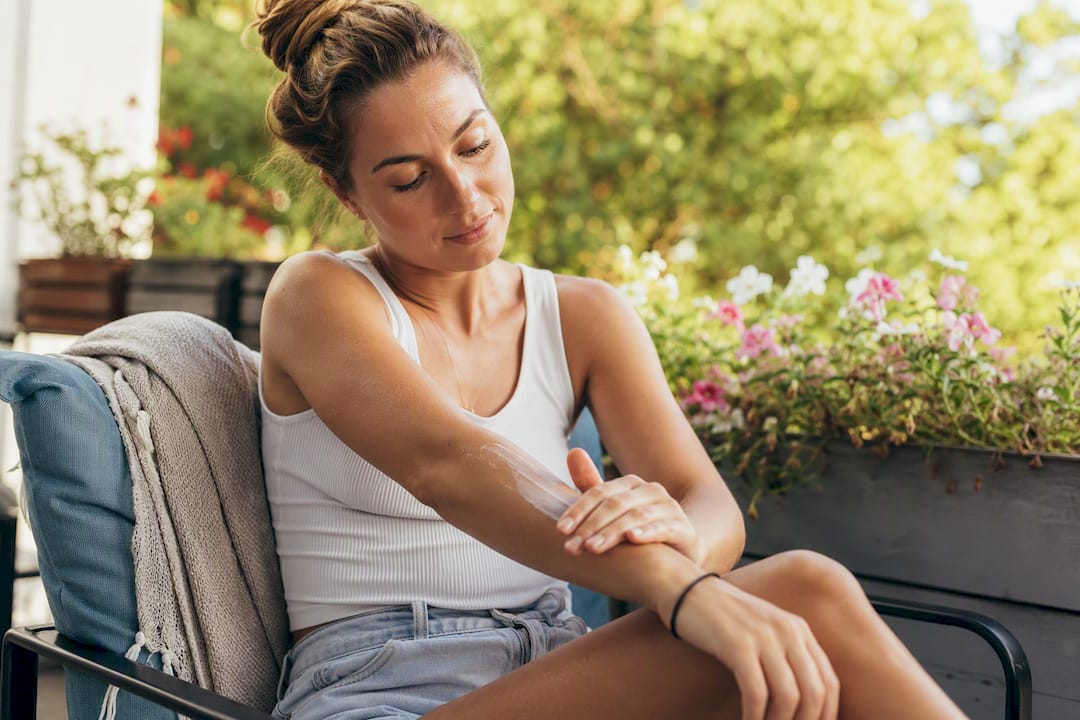
Yes, you can still tan while wearing sunscreen, because no product blocks all ultraviolet light. SPF30 lets through roughly 3% of UVB rays, and SPF50 around 2%, according to figures used by the NHS. That small residual dose is often enough to trigger melanin production over a day at the beach. Worth remembering: a tan is not a beauty bonus. It is visible evidence that your skin has been damaged and is defending itself.
Key Takeaways
Sunscreen reduces UV exposure but never eliminates it, which is why tanning remains possible even with correct use, and a tan itself signals skin damage rather than health.
Point | Details |
SPF isn’t a UV blocker | SPF30 lets through about 3% of UVB, SPF50 about 2%, enough to still trigger a tan. |
A tan means damage | Dermatologists agree there’s no such thing as a safe tan; colour change signals UV harm. |
Broad-spectrum matters | Choose SPF30+ with strong UVA filtering, since SPF alone mainly measures UVB. |
Application beats intention | Use 6 to 8 teaspoons for full-body coverage and reapply every two hours or after swimming. |
Consider a lower-UV route | NuTan® patches trigger natural melanin production, aiming for a similar tan with far less UV exposure. |
Table of Contents
Tanning with SPF: how sunscreen actually reduces UV exposure
SPF measures protection against UVB rays, the wavelength responsible for sunburn. It does not tell you much about UVA, the longer wavelength that penetrates deeper into skin and drives most tanning and premature ageing. That gap is precisely why sunscreen and sunbathing don’t cancel each other out. You can be diligent with SPF and still come home a shade darker.
This is where “broad-spectrum” labelling matters. A broad-spectrum sunscreen filters both UVB and UVA, but the Skin Cancer Foundation points out that UVA filtering quality varies considerably between products, even among those carrying the same SPF number.
SPF30 stops roughly 97% of UVB rays, letting about 3% through.
SPF50 stops roughly 98%, letting about 2% through.
Neither figure says anything about UVA blocking on its own, which is why UK guidance recommends pairing SPF30+ with at least a 4 star UVA rating.
That 2 to 3% isn’t nothing. Spread across several hours on a sun lounger, it is a steady drip-feed of UV that melanocytes are perfectly capable of responding to.
Why tanning still happens despite sunscreen
The biology is straightforward: any UV that reaches the skin can switch on melanocytes, the pigment-producing cells in the outer skin layer. Sunscreen lowers the dose; it does not remove it. UVA is the main driver of that gradual tan, and because SPF numbers are calibrated to UVB, a sunscreen can carry an impressive SPF rating while offering only moderate UVA control.
Then there’s human behaviour, which does more damage to sunscreen’s effectiveness than any formulation quirk. Common culprits include:
Applying too thin a layer, which cuts the stated SPF dramatically.
Missing patches of skin, especially ears, the back of the neck, and hands.
Skipping reapplication after two hours, or after swimming and sweating.
Using sunscreen that’s expired, separated, or been baking in a hot car all summer.
Layer enough of these lapses together and a “protected” day at the coast still ends in a tan, sometimes a burn too.
Sunscreen mistakes that quietly undo your protection
Most sun damage traces back to a handful of predictable errors, not bad luck. Fixing them is simple once you know what to look for.
Using too little product. The NHS recommends around 6 to 8 teaspoons for a full adult body, or about two tablespoons for exposed areas on a typical day out. Most people apply a fraction of that.
Forgetting to reapply. Every two hours is the baseline, sooner if you’ve been in water or sweating heavily.
Trusting a “base tan”. There is no such thing as a tan that protects you from burning; it offers, at best, the equivalent of a very low SPF.
Overlooking easy-to-miss spots. Ears, the nape of the neck, the tops of feet, and hands fade fastest and burn first.
Holding onto old bottles. Sunscreen degrades. If the texture has separated or the smell has changed, bin it.
Pro Tip: Set a phone alarm for every two hours you’re outside. Reapplication timing is the single most skipped step, and it’s the one that matters most.
Reducing tanning while keeping protection the priority
Sunscreen works best as one layer in a wider system, not a standalone shield. Choose a broad-spectrum SPF30 as your everyday minimum, moving up to SPF50 for prolonged exposure, intense sun, or fair skin, and apply it generously fifteen to twenty minutes before you go out.
Add physical barriers: a wide-brimmed hat, UPF clothing, and sunglasses all cut UV exposure without relying on chemistry alone.
Seek shade between 11am and 3pm, when UV intensity peaks in most of the northern hemisphere’s summer.
Choose a water-resistant formula for swimming or heavy sweating, then reapply immediately after towelling off, since even “water-resistant” sunscreens don’t survive a swim indefinitely.
Treat sunscreen as damage limitation, not permission to stay out longer. Dermatological guidance is consistent on this: extending your time in the sun because you’re wearing SPF defeats the purpose entirely.
Pro Tip: Reflective surfaces like water, sand, and pale paving bounce UV back at you from below, which is why you can still tan under an umbrella near the sea.
Want a tan without the UV risk? Safer options exist
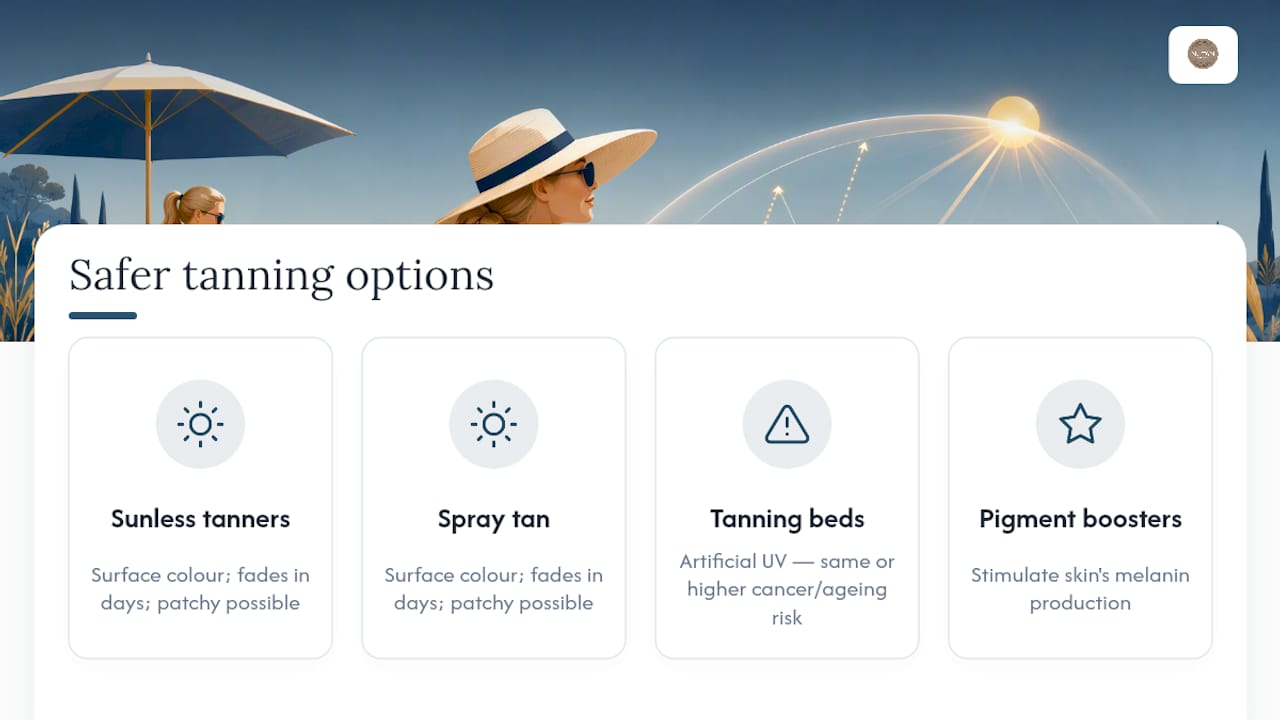
If the goal is a bronzed look rather than sun exposure itself, there are routes that skip UV altogether. Professional spray tanning delivers a temporary surface colour that fades within days, though results can be patchy without careful application and some people experience mild skin sensitivity to the solution used. Sunless self-tanning products offer a similar surface effect at home, with the same caveats around even coverage.
Tanning beds deserve a firm word of caution: they replace natural UVB and UVA with an artificial dose, and the Cleveland Clinic is unambiguous that this carries the same skin cancer and ageing risks as unprotected sun exposure, sometimes more concentrated.
There’s a third category worth knowing about: options that work with your skin’s own pigment-producing process rather than sitting on top of it. NuTan® approaches things from that angle, which the next section explains.
NuTan®: a transdermal approach to low-UV tanning
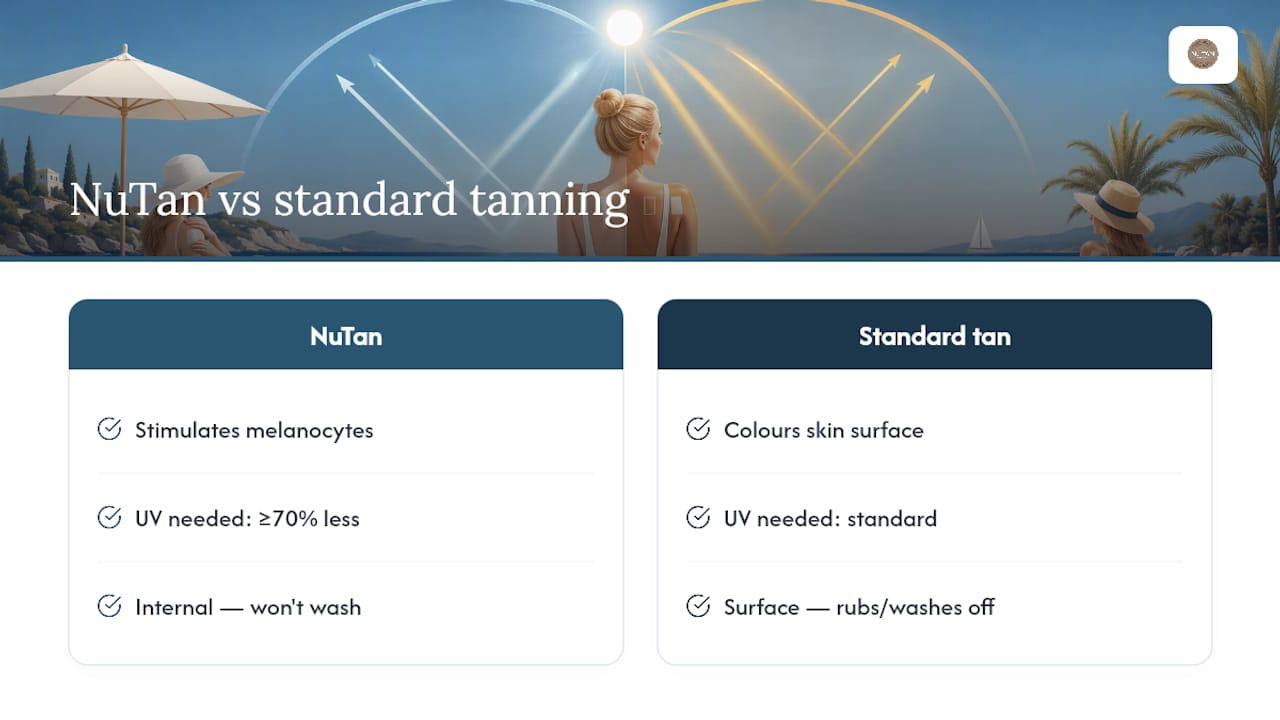
NuTan® tanning patches are built around a different idea entirely: rather than colouring the skin’s surface, the patches trigger your body’s own tanning process. The in-house Nutan MSH-ComplexB formulation binds to melanocortin receptors on melanocytes, the same cells sunscreen is trying to shield from UV in the first place, kickstarting natural melanin production.
The claimed benefit is exposure, not colour: NuTan® states its patches require over 70% less UV exposure than standard tanning methods to reach a comparable depth of colour. Because the tan develops from within the skin rather than sitting on top of it, it doesn’t rub or wash off the way a surface product can.
The tan comes from your own melanocytes doing the work, not a coating on top of the skin. Less UV needed, same natural result.
Author perspective: practical takeaway from NuTan®
Sun protection comes first, always. For readers wanting colour with far less UV, NuTan® offers a route worth exploring further on our site.
— NuTan
A gentler way to get colour: NuTan® patches, worldwide delivery
Sunscreen limits UV damage, but plenty of people still want visible colour without spending hours chasing it. That’s the gap NuTan® tanning patches are designed to close: a transdermal patch that works with your skin’s own melanin response, so you need far less UV time to reach a similar tan.
Because the patches trigger pigment production rather than sitting on the skin’s surface, the result looks like a natural tan and holds without rubbing or washing off, unlike surface products that fade unevenly. NuTan® ships worldwide, so wherever you’re reading this from, the tanning patches are available to order online. Always keep sunscreen in your routine alongside the patches during any outdoor time, and follow the included usage guidance on application and duration. If you’re weighing up strength options, the triple-strength patch is worth a look for those wanting a deeper result. Order online today and see how much less sun it takes.
Sources
This article is general information, not a substitute for advice from a qualified doctor. Consult a qualified healthcare professional about your own circumstances before acting on anything here.
FAQ
Can I still get a tan while wearing sunscreen?
Yes. No sunscreen blocks 100% of UV rays, so enough gets through, especially UVA, to trigger melanin production over time.
How long does it take to tan with sunscreen on?
It varies with skin type, SPF, and application, but because 2 to 3% of UVB still reaches skin at SPF30 to SPF50, a noticeable tan can develop over several days of repeated outdoor exposure.
Do you tan faster with sunscreen than without it?
No, tanning is slower with sunscreen, since it filters out the majority of UV rays, but it doesn’t stop tanning altogether the way many assume.
How do you tan safely when using sunscreen?
Apply a broad-spectrum SPF30 or higher generously, reapply every two hours, add shade and clothing, and consider a low-UV alternative like NuTan® patches for readers who want colour with minimal sun time.
Recommended
Comments