

Whitening with braces: what's safe now and what to wait for
- 2 days ago
- 10 min read
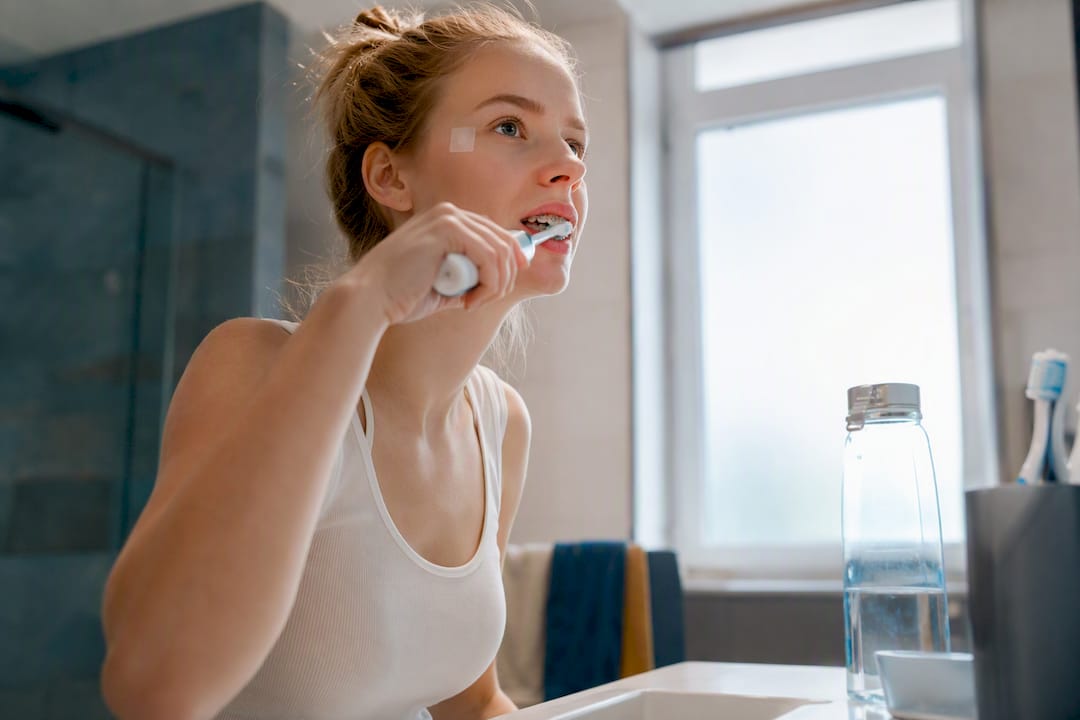
You can protect and even improve the brightness of your teeth while wearing braces, but deep bleaching should wait until after your brackets come off. Right now, focus on low‑abrasion toothpaste, orthodontic foams, and thorough brushing with an electric toothbrush to stop new staining. Full whitening treatment is usually best delayed for four to six weeks after debonding. NuTan® writes this guide from a dentist‑aware product perspective, having formulated maintenance ranges specifically for people in active orthodontic treatment.
TL;DR:
Whitening strips and trays are only suitable during active orthodontic treatment if a dentist approves, and full bleaching should be delayed until after brackets are removed.
Bonded braces block peroxide contact with enamel underneath, often resulting in uneven whitening patches once brackets are taken off.
After debonding, waiting four to six weeks before bleaching helps enamel recover, reducing sensitivity and ensuring a more uniform final result.
Residual adhesive can stain differently and must be properly removed and polished to achieve even whitening post-treatment.
Using gentle daily cleaning routines with low-abrasion toothpaste, interdental tools, and non-bleaching products during braces mitigates staining and preserves enamel health.
Table of Contents
Daily care to keep teeth bright while your braces are on
Brackets and wires create dozens of tiny ledges where plaque and stain‑causing pigments settle in daily, which is exactly why your daily routine matters more now than it ever will again. The good news: a few adjustments make a visible difference within weeks.
An electric toothbrush with an orthodontic head reaches around brackets far more effectively than manual brushing, and it removes more plaque and visible surface stain in the process. Angle the bristles at 45 degrees against the gumline and the bracket edge, holding for a few seconds per tooth rather than sweeping quickly across the arch.
Toothpaste choice matters too. Whitening pastes loaded with abrasive particles can wear enamel that’s already under stress from brackets and adhesive, so a low‑abrasion, fluoride formula with chemical stain‑dissolvers such as sodium hexametaphosphate is the safer daily pick.
Interdental cleaning fills the gaps a toothbrush cannot reach:
Use floss threaders or orthodontic floss under the archwire once daily, ideally at night
Add interdental brushes sized to fit between brackets and wire
A water flosser on a low‑to‑medium setting clears debris around brackets in seconds and is worth using after meals if you’re prone to staining
Orthodontic cleaning foams and low‑dose peroxide rinses can help control everyday surface staining without touching the deeper bleaching brackets would interfere with. These products work chemically, disrupting the plaque layer where a brush simply cannot get in.
On diet: rinse with water straight after coffee, curry, red wine, or berries rather than letting pigment sit against enamel and bracket adhesive for hours.
Pro Tip: Keep a travel-size bottle of water or an alcohol-free mouth rinse in your bag. A 10-second swill after a stained meal does more for your smile than an extra scrub that evening.
If you notice white, chalky spots forming around a bracket, or a bracket feels loose, contact your orthodontist promptly. Both can affect how evenly your teeth look once the braces come off.
Which whitening methods suit your type of brace?
Not every appliance behaves the same way under a whitening product, and this is where most confusion about whitening with braces comes from. The safest method depends almost entirely on whether your enamel is fully covered or partially blocked by hardware.
Removable clear aligners cover the whole tooth surface, so they’re the appliance type most compatible with whitening. Some patients whiten between aligner changes using dentist‑approved gel in the aligner tray itself, effectively turning the appliance into a whitening tray, provided a dentist has signed off on the concentration and schedule.
Lingual braces, fitted to the back of the teeth, leave the visible front surface completely clear. Strips or trays can sometimes work here too, though a dental check is still worthwhile since bonding pads sit close to the biting edge.
Fixed metal or ceramic braces on the front surface are the appliance type to be most cautious with. Whitening strips and standard trays are not recommended while brackets are bonded, because they cannot bleach the enamel hidden directly beneath each bracket. Surface treatments are the exception, not full bleaching:
Orthodontic cleaning foams for daily stain lifting
Low‑abrasion whitening toothpaste for surface polish
Alcohol‑free whitening mouthwash used as directed, never as a substitute for brushing
A quick way to think about it:
Aligners and lingual braces: strips or trays may be appropriate with dental guidance
Bonded front brackets: surface products only, full bleaching deferred
A narrative review on dental whitening during active fixed orthodontic treatment found that whitening can be feasible in selected cases even with brackets bonded, but it’s treated as an exception for urgent aesthetic needs rather than something to try casually at home.
Why whitening around bonded brackets causes uneven results
Peroxide and carbamide peroxide whiten by breaking down pigment molecules trapped in enamel, but they can only reach surfaces the product actually touches. A bracket covering roughly a third of the visible tooth blocks that contact entirely, so the enamel underneath stays its original shade while everything around it lightens.
When the brackets eventually come off, that shadow becomes a visible two‑tone patch, lighter enamel surrounding a darker rectangle where the bracket sat. It’s one of the main reasons dentists recommend patience over convenience.
Whitening during active fixed orthodontic treatment is feasible in selected cases, but it may produce darker areas beneath brackets and can reduce bracket bond strength, according to the narrative review on the topic.
Bond strength is the other concern. Bleaching agents can interact with the resin used to attach brackets, weakening the adhesive layer. A loosened bracket mid‑treatment usually means an extra orthodontic visit and can delay your overall timeline.
Sensitivity is common with any peroxide exposure, and enamel that’s already working around bonding material can react more noticeably. Some in‑clinic protocols manage this with staged, low‑concentration peroxide applications alongside desensitising varnish, precisely to protect both comfort and bond strength when whitening genuinely can’t wait.
The evidence here is still developing. Most studies are small, and clinicians generally treat in‑treatment whitening as a judgement call rather than a routine offering, reserved for specific aesthetic needs rather than general brightening.
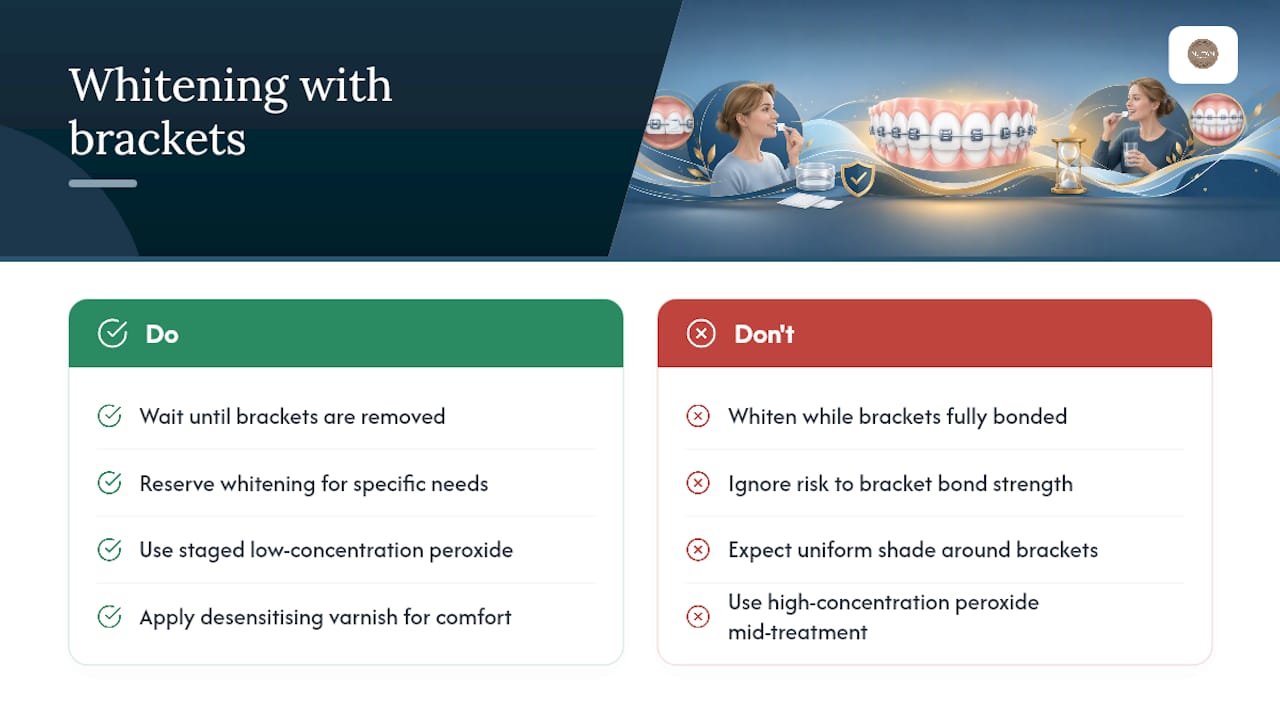
Whitening after braces: your step-by-step plan
Once brackets come off, the temptation is to bleach immediately. Resist it. Clinical guidance from WebMD recommends waiting around four to six weeks before strong in‑office bleaching, giving enamel time to remineralise and any lingering pulp sensitivity time to settle.
Here’s the sequence that gives the most predictable, even result:
Book a professional clean to remove leftover adhesive and polish away surface irregularities left by the bonding material
Ask your dentist to assess for white spot lesions or demineralisation, common under brackets that weren’t kept perfectly clean
Wait out the four‑to‑six‑week window before committing to strong bleaching, using this time for gentle maintenance only
Choose your method: in‑office bleaching gives the fastest, most controlled result under professional supervision, while dentist‑provided custom trays offer a slower but still even at‑home option
Introduce desensitising steps such as topical fluoride or potassium nitrate toothpaste if sensitivity appears during or after treatment
Light or laser‑activated bleaching is often marketed as faster, and it can speed the initial response. A review of bleaching agents and light activation found it doesn’t reliably produce better final results than peroxide alone, and evidence on ideal, safe settings is still limited, so don’t pay extra purely for the light.
Over‑the‑counter strips become reasonable once your dentist confirms your enamel has recovered and adhesive residue is gone, since the whole surface can finally whiten evenly.
Pro Tip: Book your post‑debond dental check before you book any whitening appointment. Catching white spot lesions early means your dentist can treat them first, so your final whitening result comes out uniform rather than patchy.
How bonding adhesive affects your final whitening result
The resin that attaches brackets to enamel does more than hold hardware in place. It sits directly on the tooth surface for months, sometimes years, and how well it’s removed afterwards has a real bearing on how your whitening turns out.
Leftover adhesive absorbs stain differently to natural enamel, often taking on a slightly different tone under whitening gel. That’s why professional adhesive removal and polishing at debond matters so much: it strips back any residual resin and smooths the surface, giving whitening product even contact across the whole tooth rather than patches of enamel and patches of old bonding material.
There’s a timing element too. Adhesive removal itself can create micro‑roughness on the enamel surface, which is part of why dentists want a settling period before bleaching starts. Whitening too soon, straight after debonding, risks uneven gel penetration into that freshly polished but not‑yet‑stable surface.
If you had ceramic brackets, check with your dentist whether any bonding material remains on the back or sides of teeth. It’s less visible but can still affect symmetry if a whitening tray or strip doesn’t quite reach it. A five‑minute check now saves a frustrating “why does this tooth look different” moment three months later.
Managing sensitivity from whitening during orthodontic treatment
Sensitivity is the most common side effect of any peroxide‑based whitening, and it tends to be more pronounced around orthodontic hardware, where enamel is already working harder and gum tissue can be slightly inflamed from brackets and wires.
The mechanism is straightforward: peroxide temporarily opens microscopic channels in enamel, allowing stimuli like cold air or cold drinks to reach the nerve more easily. This effect usually fades within a few days of stopping treatment.
To manage it during any dentist‑approved in‑treatment whitening, or after braces come off:
Use a desensitising toothpaste containing potassium nitrate for a week before starting whitening, not just after symptoms appear
Apply topical fluoride varnish, which your dentist can do in‑practice, to help remineralise enamel and blunt sensitivity
Space out whitening sessions rather than bleaching on consecutive days, giving enamel recovery time between applications
Avoid extremely hot or cold food and drink for 24 to 48 hours after any whitening session
If sensitivity is sharp, lingering beyond a few days, or affects a single tooth rather than several, mention it to your dentist rather than pushing through. It can occasionally signal an issue with a specific tooth, such as a crack or existing sensitivity condition, that’s unrelated to the whitening itself and needs separate attention.
Questions worth asking your orthodontist before you whiten
A five‑minute conversation at your next adjustment appointment can save you from an uneven result or a loosened bracket. Bring these questions with you.
Ask whether your specific case, aesthetic urgency, bracket type, treatment stage, makes you a reasonable candidate for supervised in‑treatment whitening, or whether it’s better to wait. Ask what concentration of peroxide, if any, they’d consider safe alongside your current adhesive and brackets. Ask how they’d manage sensitivity if you do proceed early.
Red flags to raise immediately rather than waiting for your next scheduled visit include: a bracket that feels loose after using any whitening or foam product, white chalky patches appearing near the gumline, or sharp, lasting sensitivity in one tooth rather than a general dull ache across several.
It’s also worth asking what they recommend for daily stain control in the meantime, since orthodontists often have a clear preference between electric brush heads, specific low‑abrasion pastes, or orthodontic foams based on what they see go wrong most often in their own patients. Don’t attempt DIY approaches like baking soda pastes or concentrated peroxide rinses without asking first. These can weaken bonding adhesive and risk a bracket coming away entirely, turning a cosmetic shortcut into an unplanned orthodontic appointment.
Why NuTan® designs maintenance products around the realities of braces
NuTan® built its oral care range around a simple observation: people in active treatment need brightness maintenance that won’t fight against their orthodontist’s work. Every formula prioritises low abrasivity and enamel protection over aggressive bleaching, because that’s what genuinely suits bonded brackets.
The line includes daily maintenance products for use during treatment and gentler options designed for the post‑debond period once a dentist has confirmed you’re ready. Stronger bleaching concentrations are always positioned as a step to take with dental guidance, never as a solo decision. That’s not caution for its own sake. It reflects what the clinical evidence actually supports.
— NuTan
The right NuTan® products for each stage of your treatment
Picking the right product often comes down to one question: are you maintaining brightness now, or restoring it once brackets are off? NuTan® splits its range along exactly that line, so you’re never reaching for a bleaching gel before your enamel is ready.

For daily maintenance while braces are still on, the Nusmile Ultimate Oral Care Bundle pairs low‑abrasion toothpaste with interdental tools built for navigating brackets and wire, and the enamel care bundle focuses specifically on fluoride support and surface protection through months of treatment. Both are designed to control staining without going anywhere near the bond strength concerns that come with strips or trays on bonded brackets.
Once your dentist has cleared you, usually that four‑to‑six‑week window after debonding, the NuSmile home whitening kit offers a dentist‑aligned at‑home route, while the Pap+ teeth whitening powder suits gentler surface brightening for anyone who wants a lighter touch before committing to a full kit. If you’d rather try a strip format post‑braces, NuSmile V34 whitening strips are formulated for full, even coverage now your enamel is no longer partially blocked by brackets.
[
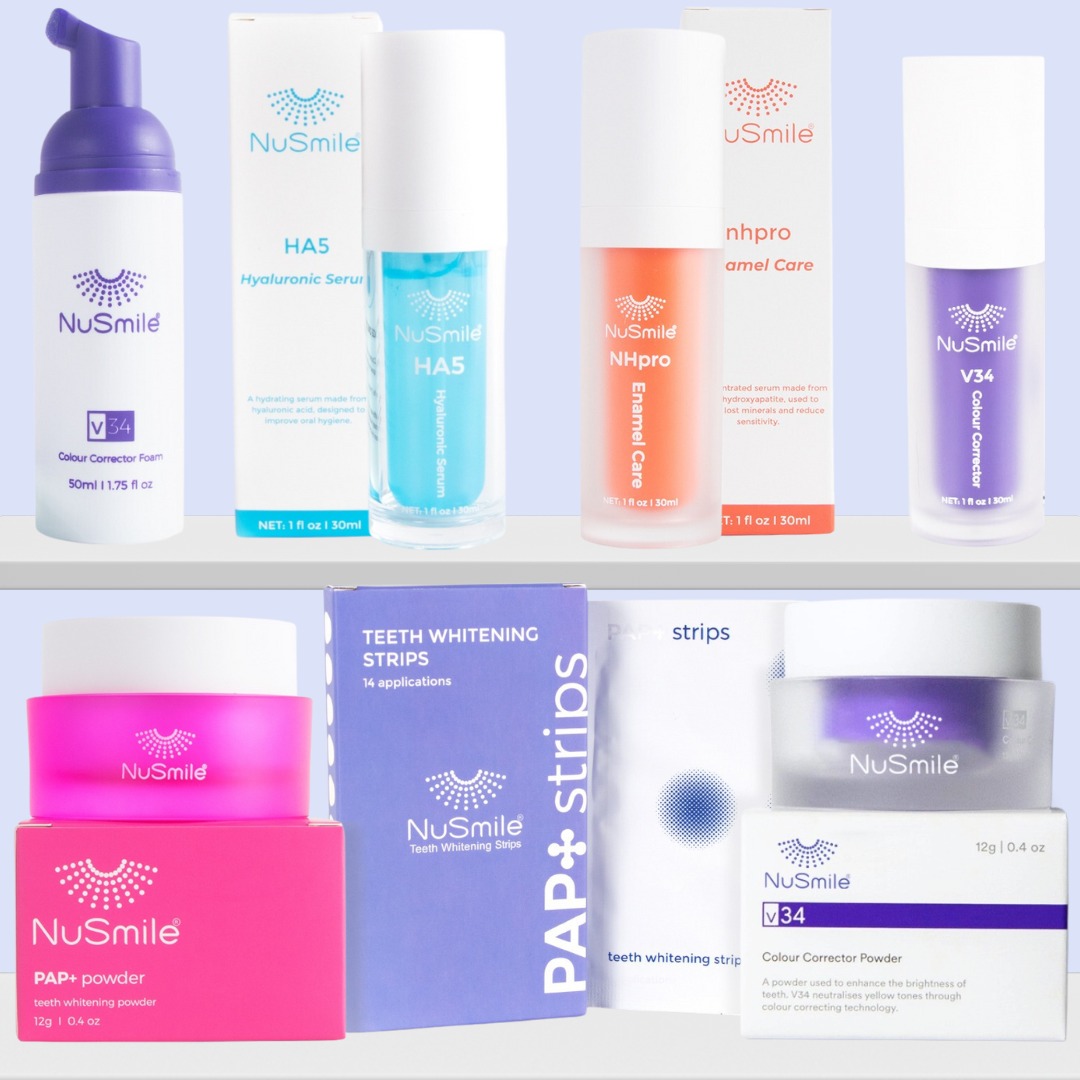
Ready to plan your post‑braces smile? Browse the full NuSmile whitening range and pick the kit that matches your timeline, whether that’s daily maintenance today or your first proper whitening session next month.
This article is general information, not a substitute for advice from a qualified doctor. Consult a qualified healthcare professional about your own circumstances before acting on anything here.
Sources
FAQ
Can you still whiten your teeth with braces on?
Yes, but only with surface‑level products like low‑abrasion toothpaste and orthodontic foams. Full bleaching is generally not recommended while brackets are bonded because it produces uneven results.
How can I fix yellow teeth while wearing braces?
Focus on thorough daily cleaning with an electric toothbrush, interdental brushes, and a low‑abrasion whitening toothpaste to lift surface stain without risking bracket bond strength. Deeper discolouration is best addressed after debonding.
How can I naturally whiten my teeth with braces on?
Rinsing with water after staining foods and drinks, along with consistent brushing and flossing, reduces new surface staining, though it won’t dramatically lighten existing discolouration. There’s no proven natural method that safely bleaches enamel hidden beneath bonded brackets.
Can I get whitening treatment after braces come off?
Yes, most dentists recommend waiting four to six weeks after debonding before in‑office or at‑home bleaching, giving enamel time to remineralise. Products like the NuSmile home whitening kit are designed for exactly this stage.
Recommended
Comments